Smain And Safti's Summer Day
Robert Hichens, an author celebrated for his atmospheric and psychologically acute narratives, invites listeners into a singular experience with "Smain And Safti's Summer Day." This novella-length piece, a testament to his enduring ability to conjure distant lands and intimate human moments, offers a brief but profound sojourn. Why should a modern listener turn their ear to a tale from an earlier century? Because within its carefully drawn scenes and quiet observations lie universal truths about connection, misunderstanding, and the ephemeral beauty of a single day—all rendered with lyrical precision. It's an opportunity to escape into a meticulously crafted setting, to observe characters whose lives unfold with vividness, and to reflect on the small, significant occurrences that shape our understanding of each other. The story opens beneath the relentless, golden sun of a North African landscape, a setting Robert Hichens knew and painted with masterful detail. Here, the air shimmers with heat, the scent of spices and dust hangs heavy, and the rhythms of life move to a different, ancient beat. We are introduced to Smain and Safti, two figures whose lives intersect on this particular, memorable summer day. Smain, perhaps a local guide or merchant, moves through his familiar world with an air of quiet contemplation, his days marked by the routines and traditions of his people. Safti, on the other hand, might be a younger, more impulsive spirit, perhaps eager for new experiences or burdened by unspoken desires. Their interaction begins subtly, a chance meeting or a pre-arranged encounter that sets the stage for the unfolding of their shared hours. As the day progresses, Hichens allows us to become silent witnesses to their evolving dynamic. Through simple conversations, shared silences, and the minutiae of their environment, a delicate connection begins to form, or perhaps, an existing relationship deepens and faces a moment of quiet crisis. The narrative is less about grand events and more about the micro-moments—a shared meal, a journey across a sun-baked path, an exchange of glances—that reveal character and hint at deeper currents beneath the surface. The landscape itself acts as a third character, its vastness and beauty reflecting the internal states of Smain and Safti. They navigate the day's challenges, whether external obstacles or the subtle barriers of culture and personality, drawing ever closer to a point of revelation, leaving the listener to ponder the implications of their summer day long after the sun has set on their encounter. Robert Hichens, born in Speldhurst, Kent, England, in 1864, was a prolific novelist, short story writer, and playwright whose literary career spanned over five decades. Initially destined for a career in music, studying at the Royal College of Music, he eventually found his true calling in the world of letters. His early experiences as a journalist and music critic honed his observational skills and his ability to craft evocative prose, qualities that would define his extensive output. Hichens was a figure of the late Victorian and Edwardian literary scene, gaining notoriety early on with his satirical novel The Green Carnation (1894), which lampooned the Aesthetic Movement and featured thinly veiled caricatures of Oscar Wilde and Lord Alfred Douglas, causing considerable scandal. Hichens developed a deep and lasting affection for North Africa and the Middle East, spending significant portions of his life in places like Algeria and Tunisia, as well as the Italian Riviera. These prolonged stays deeply influenced his writing, providing him with the authentic settings and cultural insights that distinguish many of his most acclaimed novels. Works like The Garden of Allah (1904), Bella Donna (1909), and Flames (1897) became popular bestsellers, often adapted for stage and screen, showcasing his talent for blending psychological drama with compelling narratives set against exotic backdrops. He was known for his elegant style, his keen understanding of human nature, and his willingness to tackle themes of sensuality, spiritual searching, and cultural difference, often in ways considered daring for his time. Hichens continued writing until his death in Zurich in 1950, leaving behind a substantial body of work. "Smain And Safti's Summer Day" distills several key themes that frequently animated Robert Hichens's work, presenting them with a focused intensity suited to its shorter length. One prominent theme is the observation of cultural difference and encounter. Through the interactions of Smain and Safti, Hichens gently illuminates the nuances of human connection across potentially divergent backgrounds. Listeners will notice how small gestures, unspoken assumptions, and differing worldviews subtly shape their communication. Perhaps a scene involves one character interpreting the silence of the other through their own cultural lens, leading to a moment of quiet revelation or misunderstanding about intent. Hichens often refrained from overt judgment, preferring instead to present these cultural distinctions with a detached yet empathetic eye, allowing the listener to draw their own conclusions about the universal and the particular in human behavior. Another significant thread woven into the narrative is the transience of moments and the passage of time. The very title, "Summer Day," underscores the finite nature of the experience recounted. The story invites contemplation on how a single, contained period can hold profound significance, shaping perceptions or altering destinies in subtle ways. A shared meal under a specific tree, or a conversation held while watching the slow movement of the sun across the dunes, becomes imbued with a heightened importance precisely because it is singular and fleeting. This focus on the ephemeral nature of human interaction and the indelible mark left by seemingly ordinary days offers a poignant meditation on memory and the lasting echoes of brief encounters. Robert Hichens's career coincided with a transformative period in British history—the late Victorian and Edwardian eras. This was an age marked by the zenith of the British Empire, which fostered a widespread public fascination with "exotic" lands and cultures, particularly those in North Africa and the Middle East. Travel narratives were immensely popular, and authors like Hichens met this demand by creating richly detailed fictional worlds based on their own extensive experiences abroad, appealing to readers' curiosity about different ways of life and the allure of the unfamiliar. Beyond mere escapism, Hichens's work often engaged with the shifting social and intellectual currents of his time. The fin de siècle saw a questioning of Victorian certainties, a growing interest in spiritualism, and a more open discussion of sensuality. Hichens, through his atmospheric settings and nuanced characterizations, explored these evolving themes, often setting his narratives in places where traditional European morality might be challenged or seen in a new light, making him a relevant and popular author. "Smain And Safti's Summer Day," extending for several hours, is a perfect candidate for audio immersion, allowing the listener to truly settle into Hichens's meticulously crafted world. The narration acts as a guide, leading you not only through the plot but into the very atmosphere of the story. Pay attention to how the narrator handles the descriptive passages—the way they might slow the pace to let the heat of the sun, the scent of the market, or the quietude of the desert evening truly register. The subtle inflections in the voices of Smain and Safti become crucial, conveying layers of emotion and cultural nuance that might be less apparent on the page. An experienced narrator can transform Hichens's elegant prose into a living, breathing experience, making the ephemeral beauty of a single summer day resonate with an almost tactile presence. It’s an ideal companion for a quiet afternoon or a contemplative evening, inviting a deep and unhurried engagement with its evocative tale.
Enjoyed Smain And Safti's Summer Day? A few ways to support us
Audible & Amazon links are affiliate; we may earn a small commission at no extra cost.
About this production
Human narration by a volunteer reader from LibriVox.org, the public-domain audiobook project. LibriVox volunteers record literary works whose copyright has expired in the United States, releasing the resulting recordings into the public domain.
Smain And Safti's Summer Day by Robert Hichens. The underlying text is in the U.S. public domain. We do not republish any modern copyrighted edition, translation, or commentary.
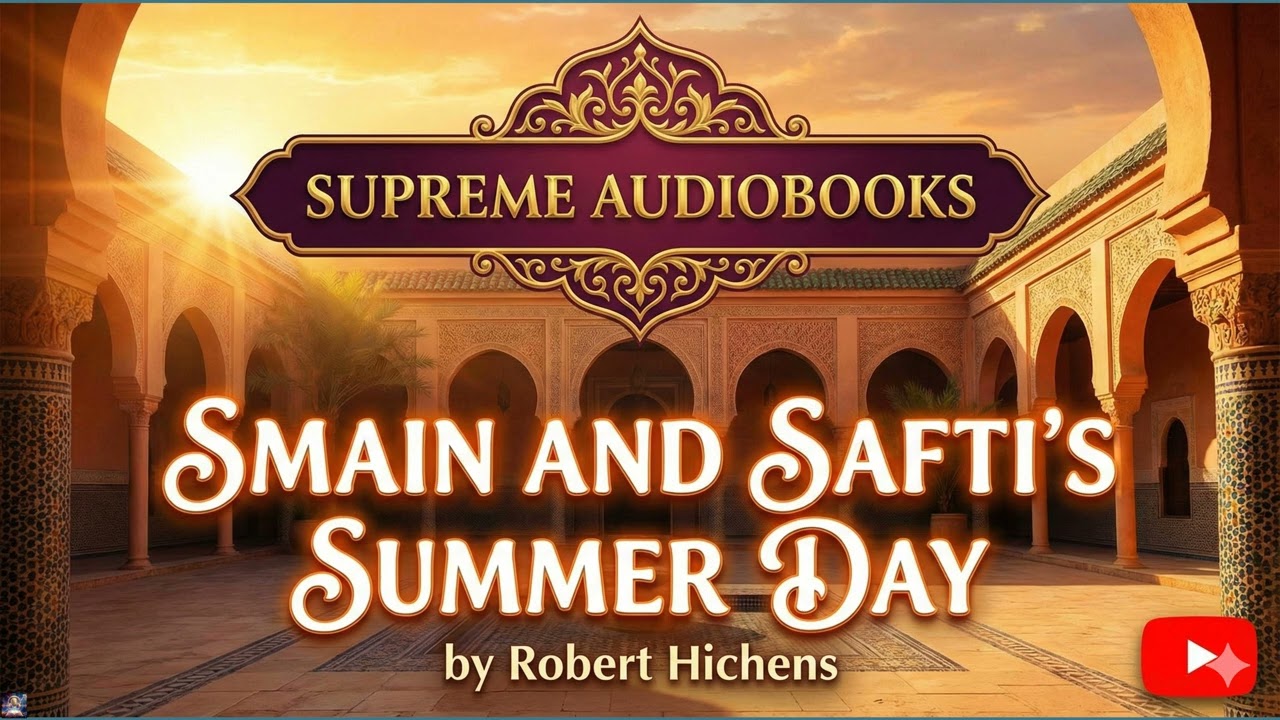
The 4K cinematic visuals accompanying this audiobook are generated by an AI image model from prompts derived from the source text. No copyrighted photos, paintings, or stock footage are used. AI generation is disclosed on every video on our YouTube channel as required by YouTube's altered/synthetic content policy.
English subtitles are transcribed from the LibriVox recording with OpenAI Whisper. Translations into the 11 other supported languages are produced by Meta's NLLB-200 neural translation model. No human translator's copyrighted translation is used.
Questions about sourcing or rights? See our DMCA & Sourcing policy or contact us.
Enjoyed this audiobook?
If you'd like to own a copy of Smain And Safti's Summer Day or hear a professionally produced edition, the links below help support free audiobook production at no extra cost to you.
As an Amazon Associate we earn from qualifying purchases. Audible / print links are affiliate.