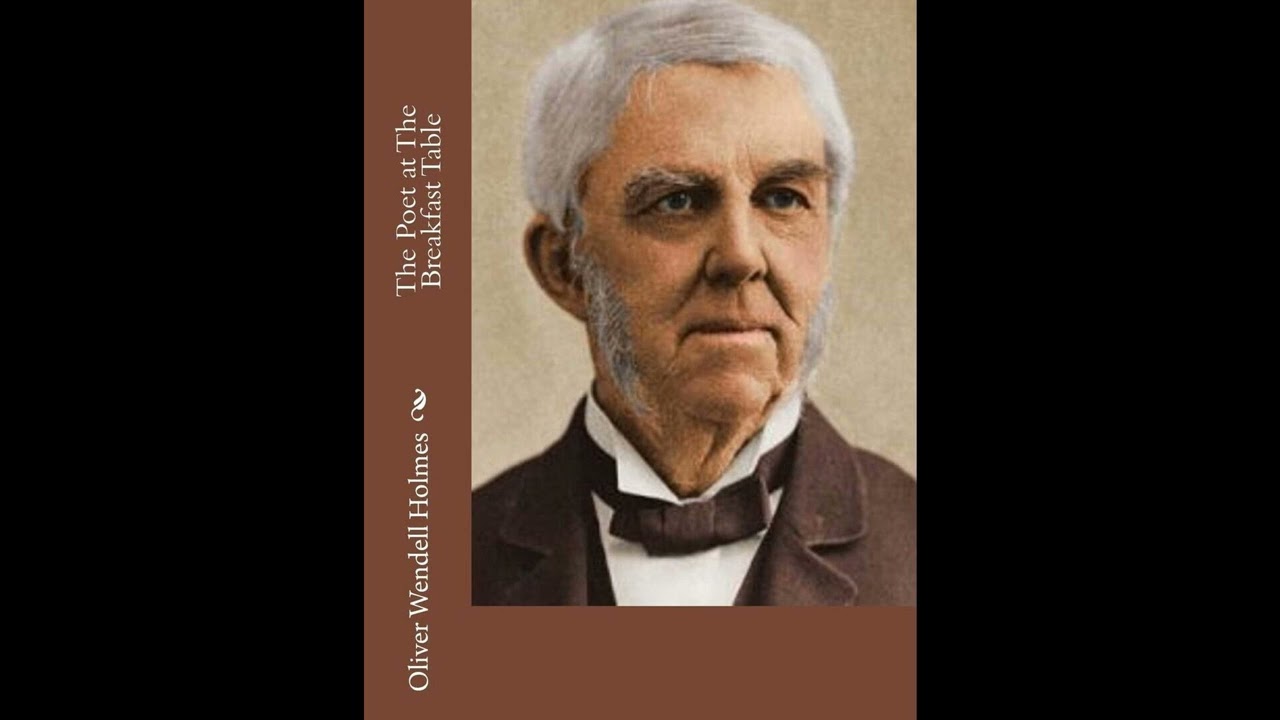
The Poet at The Breakfast Table
Oliver Wendell Holmes’s The Poet at The Breakfast Table welcomes listeners into a world where intellectual curiosity, wit, and profound observation are the daily bread. This volume, a delightful blend of fiction, philosophical musing, and charming essay, continues Holmes’s distinctive literary experiment, inviting us to pull up a chair and listen to the erudite—and often eccentric—conversations of a boarding house’s denizens. Far from being a relic of a bygone era, the book offers a refreshing perspective on enduring human questions: the nature of creativity, the interplay between science and spirit, and the search for meaning in the everyday. Its warmth, humor, and insightful character studies remain remarkably engaging, providing both comfort and intellectual stimulation for anyone seeking thoughtful companionship in prose. The setting for this literary performance is a bustling breakfast table in a nondescript American boarding house, a familiar backdrop for those acquainted with Holmes’s previous "Breakfast-Table" series. Here, the narrative unfolds not through a conventional plot, but through the vibrant interplay of its inhabitants. Our central figure is the Poet, who also acts as the observant narrator, sharing his musings and occasional verses alongside the lively chatter. Gathered around the table are a memorable cast of characters, each contributing their unique perspective: the analytical Astronomer, whose scientific mind often anchors discussions; the practical but good-hearted Landlady; the earnest Young Man Called John; the opinionated Professor of English; and several other figures, including the diminutive, somewhat irascible Little Gentleman and the gentle, wise Schoolmistress, a returning favorite from an earlier book. There isn’t a grand, sweeping plot in the traditional sense. Instead, the book progresses as a series of conversations, anecdotes, and reflections, loosely tied to the passage of time at the boarding house, hinting at the changing seasons and the comings and goings of guests. The "arc" of the story is the deepening understanding of these characters and the issues they discuss, revealing layers of human experience and thought. Discussions range widely, from the technicalities of poetic meter to the mysteries of the universe, from the foibles of social etiquette to the pangs of unspoken affection. While romantic elements occasionally surface, and individual stories are sometimes sketched, the true heart of the narrative lies in the dynamic exchange of ideas and the subtle revelation of personality through dialogue and quiet observation. The book avoids definitive resolutions, preferring to leave its audience with the lingering echo of a rich and stimulating exchange. The author, Oliver Wendell Holmes Sr. (1809-1894), was a man of extraordinary intellect and diverse talents. Born in Cambridge, Massachusetts, to a prominent family, he pursued a distinguished career in medicine, earning his M.D. from Harvard and later serving as a professor of anatomy at Dartmouth College and Harvard Medical School. Yet, parallel to his medical profession, Holmes cultivated a significant literary life. He emerged as a leading figure among the "Fireside Poets," a group of popular 19th-century New England writers known for their accessible, often moralistic verse. His pen gave us not only the celebrated "Breakfast-Table" books—starting with The Autocrat of the Breakfast-Table in 1858, followed by The Professor at the Breakfast-Table in 1860, and finally The Poet at The Breakfast-Table in 1872—but also well-known poems like "Old Ironsides" and a novel, Elsie Venner. Holmes possessed a remarkable ability to blend scientific rationality with humanist warmth, a trait that permeates his writings. He was a keen observer of human nature and a master of both wit and profound insight, often using humor to deliver deeper truths. His lasting place in American letters rests on his contributions to the essay form, creating a unique conversational style that captured the spirit of intellectual discourse. As the father of the eminent Supreme Court Justice Oliver Wendell Holmes Jr., he also holds a significant position in American intellectual history, representing a bridge between the idealism of Transcendentalism and the emerging pragmatism of the late 19th century. At its core, The Poet at The Breakfast Table enacts several enduring themes, presented with clarity and charm. One prominent theme is the nature of art and poetry, frequently debated among the characters. The Poet himself often shares his verses and opinions, prompting discussions about inspiration versus craft, the role of the imagination, and the very purpose of creative expression. For instance, the differences in how the practical Astronomer and the romantic Poet perceive the creation of verse illuminate the varied perspectives on artistic truth. Another significant theme is the dynamic tension between science and spirituality. As a medical man, Holmes brought a rational, empirical viewpoint to his writing, yet he also acknowledged and gave voice to the realms of the ineffable and the spiritual. Conversations between the scientifically minded Astronomer and characters with more traditional or emotional views frequently highlight this intellectual dialogue, showing how different ways of knowing can coexist. The book also explores individualism versus societal norms through its diverse cast of boarders. Each character, from the Young Man Called John searching for purpose to the Little Gentleman with his fixed opinions, represents a distinct personality grappling with their place in the world. Their interactions reveal the subtle pressures of conformity and the enduring human need for personal expression. Finally, the entire structure of the book champions the power of conversation and community. The very act of gathering around a table, sharing ideas, challenging viewpoints, and listening to one another, underscores the notion that wisdom and understanding often emerge not from solitary contemplation, but from shared discourse and the collective human experience. The ongoing exchange of anecdotes, arguments, and poems at the breakfast table itself stands as a testament to this belief. This work emerged in 1872, a period of significant change in the United States. The nation was still navigating the complex aftermath of the Civil War, grappling with questions of national identity, reconciliation, and reconstruction. Culturally, it was an era of burgeoning scientific discovery, with Darwin's theories still sparking passionate debate, forcing a reevaluation of traditional beliefs and scientific understanding. Rapid industrialization and urbanization were transforming American society, leading to new social structures and intellectual currents. In the literary world, there was a gradual shift from the romanticism and transcendental idealism that characterized earlier American literature toward a more pragmatic, realistic approach, though Holmes retained elements of both. The Poet at The Breakfast Table perfectly captures this transitional moment, offering a forum where the spiritual and the scientific, the past and the future, could meet and converse, reflecting the intellectual ferment of post-Civil War America. Listening to The Poet at The Breakfast Table as an audiobook offers a unique and particularly rewarding experience. The original text, with its conversational style and frequent digressions, translates beautifully to the spoken word. The total running time, spanning several hours, makes it an ideal companion for long commutes, a dedicated listening session, or leisurely background engagement. A skilled narrator can truly bring the diverse personalities of the boarding house to life, differentiating the voices of the Poet's musings from the interjections of the Astronomer or the Landlady. Pay attention to the pacing, which allows ample time for Holmes's wit to land and his philosophical insights to sink in, creating an atmosphere that feels intimate and inviting. It is like being given a coveted seat at that very breakfast table, allowing the listener to truly savor the clever dialogue, the subtle humor, and the profound observations as if they are unfolding in real-time.
Enjoyed The Poet at The Breakfast Table? A few ways to support us
Audible & Amazon links are affiliate; we may earn a small commission at no extra cost.
About this production
Human narration by a volunteer reader from LibriVox.org, the public-domain audiobook project. LibriVox volunteers record literary works whose copyright has expired in the United States, releasing the resulting recordings into the public domain.
The Poet at The Breakfast Table by Oliver Wendell Holmes. The underlying text is in the U.S. public domain. We do not republish any modern copyrighted edition, translation, or commentary.
The 4K cinematic visuals accompanying this audiobook are generated by an AI image model from prompts derived from the source text. No copyrighted photos, paintings, or stock footage are used. AI generation is disclosed on every video on our YouTube channel as required by YouTube's altered/synthetic content policy.
English subtitles are transcribed from the LibriVox recording with OpenAI Whisper. Translations into the 11 other supported languages are produced by Meta's NLLB-200 neural translation model. No human translator's copyrighted translation is used.
Questions about sourcing or rights? See our DMCA & Sourcing policy or contact us.
Enjoyed this audiobook?
If you'd like to own a copy of The Poet at The Breakfast Table or hear a professionally produced edition, the links below help support free audiobook production at no extra cost to you.
As an Amazon Associate we earn from qualifying purchases. Audible / print links are affiliate.