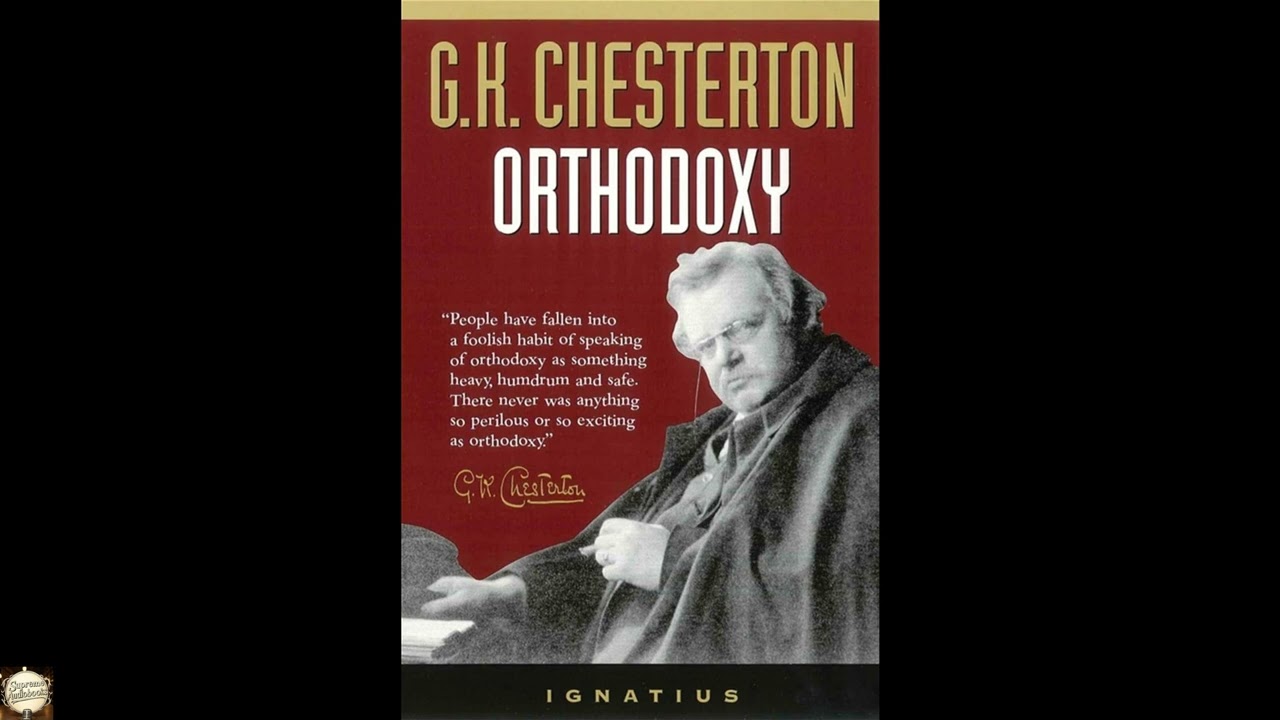
Orthodoxy
Imagine stepping into a grand debate, where the very foundations of existence are questioned, and the most outlandish answers are considered, only to find the oldest, most familiar answer is also the most surprising, the most daring, and the most truly radical. This is the exhilarating intellectual terrain G. K. Chesterton invites you to traverse in Orthodoxy, a book that isn't just a defense of Christian thought, but a boisterous, witty, and profoundly sane argument for common sense, joy, and the essential madness of the modern world. Written over a century ago, its arguments about reason, paradox, and the human longing for meaning resonate with remarkable force today, offering a refreshing counterpoint to cynicism and an invitation to see the world anew, not with naive acceptance, but with intelligent wonder. It's a work for anyone who has ever wrestled with philosophy, faith, or simply the baffling gloriousness of being alive. Orthodoxy charts a unique course, acting less like a sermon and more like a philosophical memoir. The central "character" is Chesterton himself, a young man growing up in late Victorian and Edwardian England, finding himself dissatisfied with the intellectual currents of his day. He sets out on a quest, not to affirm any pre-existing belief, but to invent his own philosophy, to construct a worldview entirely from scratch. His setting is the intellectual landscape of his time, where new scientific discoveries and various strains of agnosticism, pessimism, and relativism were reshaping how people understood truth and morality. He encounters these ideas, grappling with their logic, testing their implications, and often finding them to lead to logical absurdities or a profound melancholy. The arc of this intellectual adventure sees Chesterton systematically dismantling the prevailing orthodoxies of skepticism and materialism. He begins by trying to be original, to create a belief system that is uniquely his own, only to discover, with recurring surprise and delight, that every original thought he genuinely arrives at has already been articulated, and often better, by the very traditional Christian dogma he initially sought to escape or supersede. His central conflict becomes the realization that what he considered revolutionary thinking was actually leading him back to a belief system he thought was stale and conventional. This isn't a story of reluctant conversion, but of a joyful, almost incredulous rediscovery, as he finds in ancient doctrines not restriction, but liberation, not dullness, but an electric and endlessly surprising coherence that explains the world's beauty and brokenness better than any contemporary theory. Gilbert Keith Chesterton, born in London in 1874, became one of England's most prolific and recognizable literary figures before his death in 1936. A man of formidable intellect and an even more formidable physical presence, he was known for his booming laugh, his rotund figure, and his ever-present cigar. His early years saw him dabble in art school and radical politics, developing a distinctive perspective that valued common sense, paradox, and the inherent goodness of ordinary things. Though Orthodoxy predates his formal reception into the Catholic Church by more than a decade, it clearly lays the philosophical and spiritual groundwork for that decision. Throughout his career, he wrote prolifically across genres, penning everything from detective stories featuring the unassuming Father Brown to incisive social commentary and literary criticism. Among his other celebrated works are the fantastical novel The Man Who Was Thursday, a thrilling chase through a world of anarchists and poets, and The Everlasting Man, a sweeping historical argument for the uniqueness of Christ. He authored insightful biographies of figures like St. Francis of Assisi and St. Thomas Aquinas, demonstrating his ability to render complex ideas accessible and engaging. Often grouped with writers such as Hilaire Belloc as proponents of "Distributism"—an economic theory advocating for widespread ownership of productive property—Chesterton carved out a unique place in the early 20th-century literary canon, celebrated for his wit, his love of disputation, and his unwavering belief in the wonder of existence. Orthodoxy is steeped in a handful of profound themes, brought to life through Chesterton's distinctive literary style. One primary theme is the sanity found in paradox. Chesterton consistently argues that truth is often found in apparent contradictions, showing how Christian doctrine, far from being simplistic, embraces tensions that reflect the complexity of reality. For instance, he points out that the modern mind, striving for perfect logical consistency, often arrives at a conclusion of meaninglessness, whereas the "irrational" Christian belief in a God who is both omnipotent and loving, both transcendent and immanent, actually provides a more robust and joyful framework for understanding the world. He illustrates this by contrasting the madman's reason, which is perfectly logical within a flawed premise, with the "unreason" of a child's delight in a simple toy, which grasps a deeper truth about gratitude. Another prominent theme is the rehabilitation of gratitude and joy. Chesterton urges readers to approach existence not with jaded resignation or intellectual superiority, but with an almost childlike sense of wonder and thankfulness for creation. He critiques the prevailing pessimism of his era, which he saw as debilitating, suggesting instead that the very act of appreciating the givenness of things—a sunrise, a blade of grass, the simple pleasure of a meal—is a profound philosophical act. He describes the earth as a wild horse, galloping through the cosmos, and argues that dogma is not a chain but a saddle, allowing humanity to ride this magnificent creature rather than being thrown by it, giving purpose and direction to our wonder. To understand Orthodoxy is to understand the intellectual ferment of the early 20th century. Published in 1908, the book emerged from an era characterized by rapid scientific advancements, particularly Darwin's theories of evolution, which many saw as undermining traditional religious beliefs. Socialism was on the rise, challenging established social and economic structures. Various philosophical schools, including rationalism, logical positivism, and a growing skepticism toward absolute truth, were gaining traction, often leading to a sense of intellectual and moral relativism. Chesterton's work was a direct and spirited response to these developments. He saw many of these "modern" ideas, despite their claims of progress, leading to a kind of intellectual despair, a loss of the very joy and coherence that he felt was essential for human flourishing. He presented Orthodoxy not as a retreat into the past, but as a bold, forward-looking argument that ancient truths held the most radical and liberating answers for modern dilemmas. Chesterton's prose, with its characteristic wit, rhetorical flourish, and surprising turns of phrase, is particularly well-suited for the audiobook format. A skilled narrator can truly bring to life the author's booming intelligence and playful humor, making the arguments feel less like abstract philosophy and more like an engaging conversation with a brilliant, eccentric friend. Listeners can focus on the cadence of his sentences, the subtle shifts in tone as he builds an argument or demolishes a folly, and the ingenious way he uses paradox to illuminate truth. Over several hours of listening, the narrator's pacing can highlight the thunderous impact of his conclusions, the gentle wisdom of his observations, and the sheer delight Chesterton takes in the act of thinking itself. The experience allows his ideas to unfold organically, washing over the listener with an atmosphere of joyful intellectual adventure that a silent reading might sometimes miss.
Enjoyed Orthodoxy? A few ways to support us
Audible & Amazon links are affiliate; we may earn a small commission at no extra cost.
About this production
Human narration by a volunteer reader from LibriVox.org, the public-domain audiobook project. LibriVox volunteers record literary works whose copyright has expired in the United States, releasing the resulting recordings into the public domain.
Orthodoxy by G. K. Chesterton. The underlying text is in the U.S. public domain. We do not republish any modern copyrighted edition, translation, or commentary.
The 4K cinematic visuals accompanying this audiobook are generated by an AI image model from prompts derived from the source text. No copyrighted photos, paintings, or stock footage are used. AI generation is disclosed on every video on our YouTube channel as required by YouTube's altered/synthetic content policy.
English subtitles are transcribed from the LibriVox recording with OpenAI Whisper. Translations into the 11 other supported languages are produced by Meta's NLLB-200 neural translation model. No human translator's copyrighted translation is used.
Questions about sourcing or rights? See our DMCA & Sourcing policy or contact us.
Enjoyed this audiobook?
If you'd like to own a copy of Orthodoxy or hear a professionally produced edition, the links below help support free audiobook production at no extra cost to you.
As an Amazon Associate we earn from qualifying purchases. Audible / print links are affiliate.