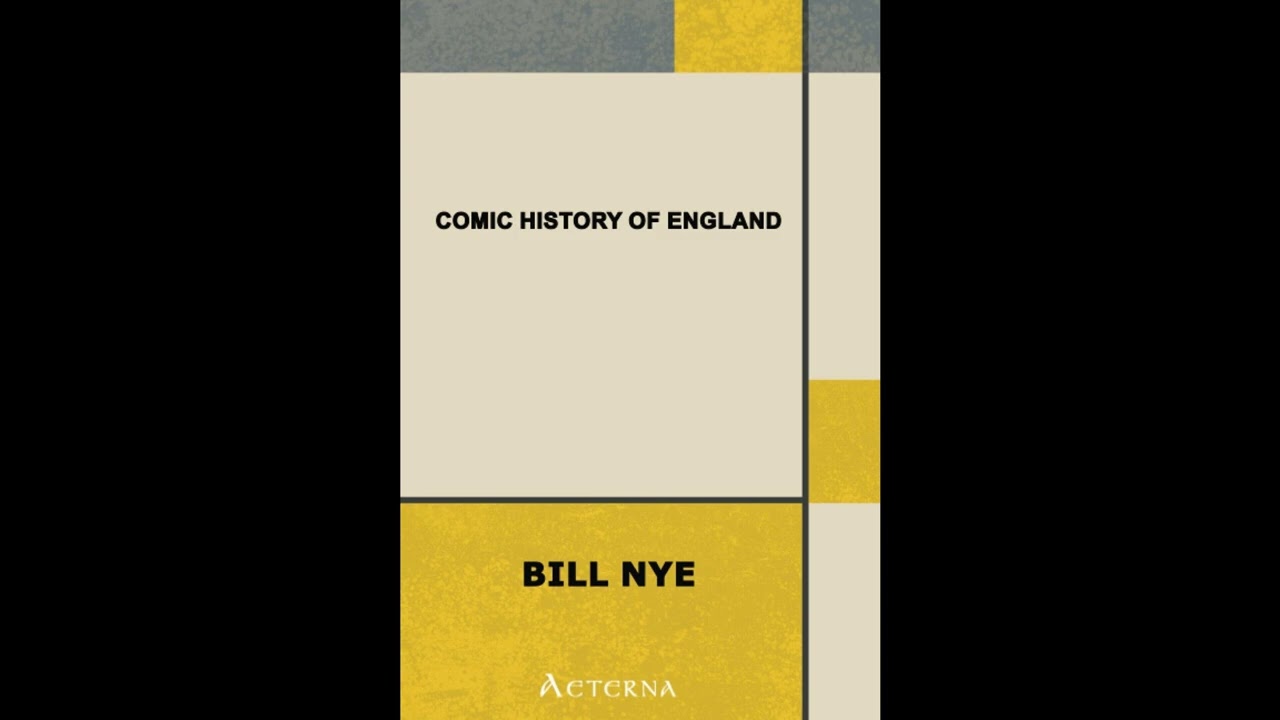
Comic History of England
For anyone who has ever found the pages of a history book to be as dry and dusty as the ancient artifacts they describe, Bill Nye's Comic History of England arrives as a bracing, riotous tonic. This is not the solemn, grand narrative often presented in schoolrooms or academic tomes. Instead, it is history as told by a mischievous uncle, a wise-cracking observer more interested in the foibles and absurdities of humanity than in glorifying monarchs or military victories. Why should the listener care about a nineteenth-century American humorist's take on English history today? Because Nye's irreverent spirit, his keen eye for human folly, and his unwavering belief that laughter can illuminate truth are as potent and relevant now as they were when he penned these pages. His work offers not just an education, but an experience—a delightful subversion of expectation that proves history need not be tedious to be profound, and that sometimes, the most insightful commentary comes wrapped in a joke. Nye's Comic History of England doesn't follow a conventional story arc with specific characters and a rising dramatic tension in the way a novel might. Instead, it takes the entire sweep of English history, from the foggy mists of prehistoric Britain to the relative modernity of Nye's own time, and subjects it to his uniquely satirical gaze. The "setting" is the vast panorama of centuries, where historical figures—from Caesar's legions invading the isle to the Norman conquerors, the Plantagenet kings, the Tudors, and beyond—become the unwitting players in Nye's grand comedic drama. He traces the lineage of kings and queens not with deference, but with a wry amusement, frequently pointing out their less-than-noble motivations, their often-petty squabbles, and the sheer randomness that sometimes dictated the course of empires. The central "conflict" isn't a battle between nations or individuals, but rather the ongoing struggle between humanity's pretension and its inherent absurdity. Nye acts as the ultimate debunker, stripping away the layers of myth and propaganda that often encrust historical narratives. He recounts famous events—King Alfred burning the cakes, Canute defying the tide, Henry VIII's marital woes, the Spanish Armada—not as solemn turning points, but as opportunities for a well-placed jibe or an anachronistic observation that pulls the past firmly into the realm of the present. The "arc of the story" is simply the chronological march of time, punctuated by Nye's sharp wit and humorous asides, leaving the listener with a fresh, often hilarious, perspective on the very foundations of Western civilization. He makes no pretense of objective scholarship; his goal is entertainment and enlightenment through laughter, never allowing the weighty mantle of history to obscure the very human, often fallible, characters beneath. The man behind this delightfully unconventional history was Edgar Wilson Nye, better known to his contemporaries and future generations as Bill Nye. Born in Shirley, Maine, in 1850, Nye's life path took him far from the New England coast. He moved with his family to Wisconsin as a young boy, eventually making his way west to Wyoming Territory in the 1870s. It was there, amidst the rugged landscape of the American frontier, that his distinctive voice as a humorist truly began to emerge. He worked as a journalist, even serving as the postmaster of Laramie, and gained considerable fame as the editor of the Laramie Boomerang, a newspaper he founded and filled with his characteristic deadpan wit and satirical observations. Nye cultivated a persona of the plain-spoken, slightly bewildered but ultimately shrewd observer of life's absurdities. His humor was often delivered with a straight face, a style that made his outlandish claims and unexpected punchlines all the more effective. Beyond his newspaper work, Nye became a highly successful lecturer, touring the country and sharing stages with other prominent humorists of his era. His other notable works include Baled Hay, Forty Liars and Other Lies, and Remarks, all collections of his essays and sketches that cemented his reputation as a leading figure in American humor. Nye belonged to a distinct literary movement of American frontier humor, often compared to—though stylistically different from—his contemporary, Mark Twain. He was a master of the tall tale and the understated jab, securing his place in the American literary canon as a vital voice in the development of American comedic prose before his untimely death in 1896. One of the foremost themes running through Nye's Comic History of England is a brilliant satire of authority and pompous historical narratives. Nye consistently deflates the grandeur of monarchs and historical figures, presenting them not as divine rulers but as flawed individuals driven by very human, often petty, desires. For instance, he might describe a king's grand declaration of war as stemming from a bad breakfast or a personal slight, rather than noble principles, thus highlighting the arbitrary nature of power. This subversion of the solemn historical record forces listeners to question the accepted versions of events and to look beyond the official narratives. Another significant theme is the democratization of history. Nye writes with an accessible, conversational style that strips away the academic pretense, making the complex tapestry of English history relatable and enjoyable for the common reader. He isn't writing for scholars; he's writing for anyone who appreciates a good laugh and a fresh perspective, inviting everyone to participate in the understanding, and even the debunking, of the past. Furthermore, Nye masterfully exposes the absurdity of power and human conflict. He often frames royal successions, invasions, and religious schisms not as inevitable forces of destiny, but as frequently comical power struggles, driven by ego, accident, or trivial matters. He might treat a major dynastic dispute with the same tone he would describe a neighborhood squabble, demonstrating how often the course of history hinges on individuals' whims and flaws. Lastly, an implicit theme of national character, particularly a subtle contrast between British and American sensibilities, underlies much of his commentary. Writing from an American perspective in the late nineteenth century, Nye often injects an outsider's pragmatism and an independent spirit into his observations, subtly critiquing the perceived stuffiness and historical pretension of the Old World. He highlights the enduring, often baffling, quirks of British tradition through a distinctly American lens of common sense and irreverence, offering a humorous cross-cultural dialogue. The late nineteenth century, when Bill Nye was at the height of his career and when works like Comic History of England were being written and published, was a dynamic period in American history. Following the Civil War, the United States was undergoing rapid industrialization, westward expansion, and a burgeoning sense of national identity. It was an era of immense societal change, marked by the rise of mass media, including popular newspapers, magazines, and the flourishing lecture circuit. Humorists like Mark Twain, Artemus Ward, and Petroleum V. Nasby enjoyed immense popularity, reflecting a public appetite for entertainment and social commentary delivered through wit. This historical context provides fertile ground for understanding why a work like Nye's emerged then. America, as a relatively young nation, was confident enough to cast a critical, and often humorous, eye on the traditions and histories of the Old World. Nye’s Comic History represents a distinctly American voice—pragmatic, irreverent, and democratic—applying its sensibility to the grand narratives of European heritage. It was a time when the "plain man's" perspective was gaining cultural currency, and Nye embodied that spirit perfectly, offering a history that resonated with a populace eager for intelligence delivered with a smile, asserting a unique cultural identity that didn't take itself too seriously. Listening to Bill Nye's Comic History of England as an audiobook transforms the experience of reading historical satire into an immediate, engaging performance. Nye's dry wit, his perfectly timed punchlines, and his often anachronistic observations are tailor-made for the spoken word. The narrator's ability to capture Nye's characteristic deadpan delivery and his conversational tone becomes paramount, bringing the author's unique voice to life with every sentence. Over its several hours run length, the listener can settle in for an extended period of delightful intellectual mischief. Pay attention to the subtle inflections in the narrator's voice as he transitions from recounting a grand historical event to delivering a sardonic aside, or as he captures the distinct personalities Nye assigns to historical figures, often reducing them to endearing or exasperating caricatures. The pacing will be crucial—a good narrator will understand how to build to Nye's comedic revelations, letting the humor breathe and land with maximum impact, creating the atmosphere of a clever, slightly rebellious friend recounting history around a campfire.
Enjoyed Comic History of England? A few ways to support us
Audible & Amazon links are affiliate; we may earn a small commission at no extra cost.
About this production
Human narration by a volunteer reader from LibriVox.org, the public-domain audiobook project. LibriVox volunteers record literary works whose copyright has expired in the United States, releasing the resulting recordings into the public domain.
Comic History of England by Bill Nye. The underlying text is in the U.S. public domain. We do not republish any modern copyrighted edition, translation, or commentary.
The 4K cinematic visuals accompanying this audiobook are generated by an AI image model from prompts derived from the source text. No copyrighted photos, paintings, or stock footage are used. AI generation is disclosed on every video on our YouTube channel as required by YouTube's altered/synthetic content policy.
English subtitles are transcribed from the LibriVox recording with OpenAI Whisper. Translations into the 11 other supported languages are produced by Meta's NLLB-200 neural translation model. No human translator's copyrighted translation is used.
Questions about sourcing or rights? See our DMCA & Sourcing policy or contact us.
View 10 famous quotes from this book →
Enjoyed this audiobook?
If you'd like to own a copy of Comic History of England or hear a professionally produced edition, the links below help support free audiobook production at no extra cost to you.
As an Amazon Associate we earn from qualifying purchases. Audible / print links are affiliate.