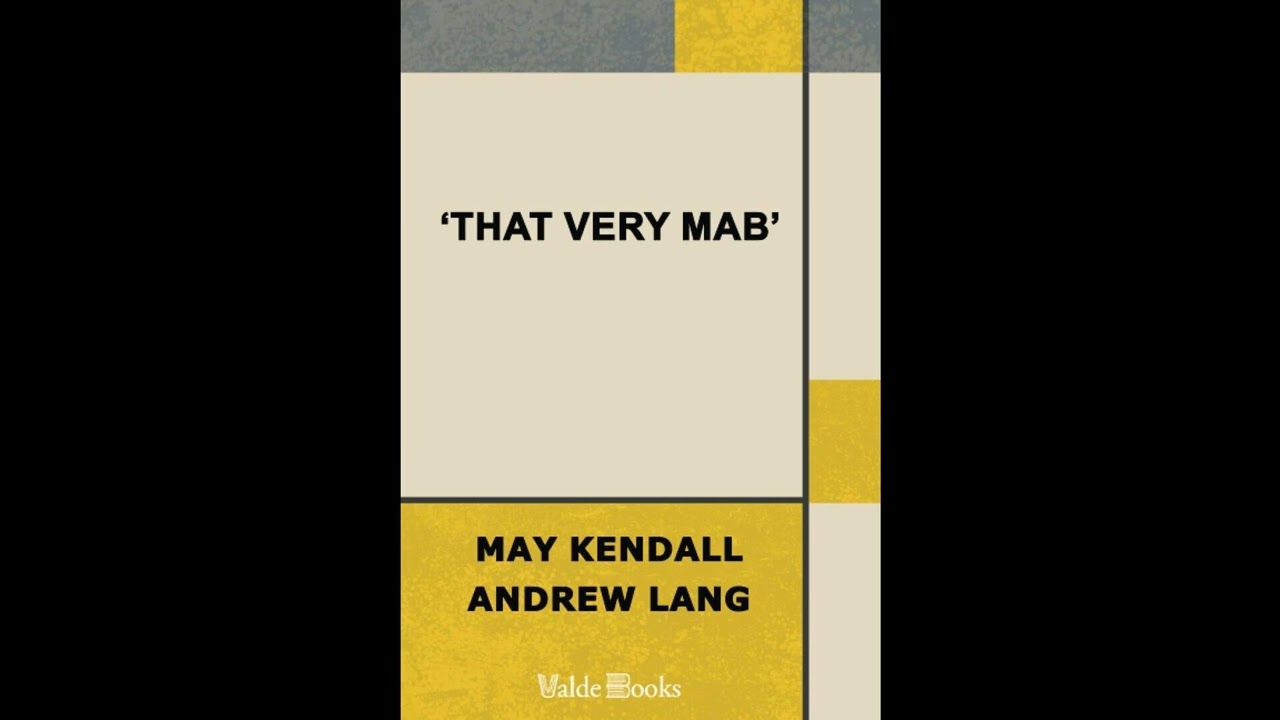
That Very Mab'
In the bustling literary landscape of the late Victorian era, where sentimentality often reigned, a distinctive voice emerged, wielding wit and intellect like a rapier. May Kendall’s novel, That Very Mab’, stands as a brilliant example of this period’s burgeoning social satire, a work that asks listeners to consider the hidden forces—or perhaps the self-inflicted illusions—that shape our everyday lives. More than a century after its initial appearance, this remarkable story retains its sharp edge, offering a playful yet incisive critique of human folly, societal expectations, and the persistent tension between reason and the delightful irrational. It’s a book that invites us to laugh at ourselves, to question our certainties, and to find the glimmer of the extraordinary lurking within the mundane. The story unfolds amidst the genteel, somewhat rigid backdrop of Victorian England, a world obsessed with decorum, scientific progress, and a burgeoning sense of industrial order. Our central figure is Professor Erasmus Finch, a man of precise habits and even more precise intellect. Finch dedicates his life to the objective study of ancient folklore, dissecting myths with scholarly rigor, but harboring a profound disdain for anything that smacks of "unscientific" fancy in his own immediate reality. He prides himself on his unimpeachable rationality, seeing the world as a solvable puzzle of cause and effect. Yet, this carefully constructed worldview begins to fray when a series of peculiar, inexplicable events starts to punctuate his otherwise predictable existence. These occurrences are not grand, dramatic supernatural interventions, but rather subtle disruptions: a misplaced manuscript that holds profound significance, a sudden, inexplicable shift in social dynamics within his academic circle, or a whisper of an old legend suddenly taking on an unsettling, almost tangible form. All these baffling phenomena quickly become attributed, by a growing consensus among those around him, to "Mab"—an elusive, mischievous, perhaps even symbolic entity. Is Mab the mythical Queen of Faeries made real? A collective hallucination? Or simply the embodiment of chance, whim, and human absurdity that Finch so vehemently denies? The narrative masterfully plays with this ambiguity, observing Finch's increasingly frantic attempts to logically categorize, dismiss, or even capture this elusive "Mab," only to find himself further entangled in its perceived influence. His world, once a bastion of reason, begins to reveal its cracks, forcing him to confront the limits of his own rationalist dogma and the unexpected power of the unexplainable. The author behind this clever invention was Emma Goldworth Kendall, who wrote under the more familiar pen name May Kendall. Born in 1861, she was a prominent figure in late Victorian letters, known for her sharp intellect and distinctive wit. Kendall came from a family of intellectuals and writers, which likely fostered her keen observational skills and her facility with language. While That Very Mab’, published in 1885, remains her most enduring novel, she was equally celebrated for her satirical poetry, contributing regularly to influential periodicals like Punch and Longman’s Magazine. Her verse often targeted scientific pretension, social hypocrisy, and the earnest solemnity of her age, demonstrating a unique ability to blend humor with philosophical depth. Kendall was part of a generation of women writers who began to subtly challenge the literary and social conventions of their time. She was often associated with the "New Humor" movement, which offered a refreshing alternative to the more sentimental or moralistic fiction prevalent during the late Victorian period. Later in her life, particularly after the turn of the century, Kendall became actively involved in social reform and the women's suffrage movement, working alongside notable figures like Eleanor Rathbone. Her work, though often humorous on the surface, consistently underscored a deeply felt belief in intellectual honesty, social justice, and the importance of questioning entrenched norms. She passed away in 1943, leaving behind a body of work that reveals a truly original mind. At its core, That Very Mab’ is a brilliant piece of social satire, subtly lampooning the earnestness and often absurd conventions of Victorian society. Through Professor Finch’s desperate attempts to maintain order in a world increasingly governed by an invisible, whimsical force, Kendall highlights the follies of intellectual arrogance and the inherent irrationality that often underpins human behavior. Consider, for instance, the scenes where Finch tries to apply empirical methods to track Mab’s supposed activities, meticulously charting "incidents" that defy all logic—a comical portrayal of the human need to categorize even the unknowable. Another prominent theme is the enduring tension between reason and imagination. The novel questions the supremacy of cold, hard logic, suggesting that there are vital aspects of human experience, from inspiration to simple happiness, that exist beyond the realm of scientific explanation. The story playfully shows how a strict adherence to rationalism can blind one to the rich, unpredictable textures of life, or indeed, to the underlying psychological truths that "Mab" might represent. Furthermore, Kendall uses "Mab" to comment on the nature of truth and perception. Is Mab real, or is she a collective psychological projection, an explanation people invent for the inexplicable? The narrative deliberately leaves this question open, allowing listeners to ponder how readily we create narratives and assign agency to forces we don't understand. This ambiguity serves to underscore the subjective nature of reality itself, a radical idea for its time. Finally, the book carries a subtle critique of patriarchal structures and the limitations placed upon intellect and intuition that don't fit into a masculine, scientific mold. While not overtly polemical, the way "Mab" disrupts a distinctly male-dominated, academic world can be seen as a quiet, clever subversion of established authority and intellectual dogma. The late 19th century was a period of immense intellectual and social change in Britain. Scientific advancements, particularly Darwin's theories, challenged traditional religious beliefs and encouraged a more empirical view of the world. Yet, alongside this surge in rationalism, there was also a flourishing interest in the supernatural, the occult, and alternative spiritualities, creating a fascinating cultural tension. Socially, the era saw the rise of the "New Woman" and growing calls for women's rights, questioning the rigid gender roles that had long defined Victorian society. Literary trends were shifting too, moving away from the earnest realism of earlier Victorian novels towards more experimental forms, often incorporating elements of fantasy, satire, or psychological insight. That Very Mab’ emerged from this fertile ground, reflecting the era’s fascination with both scientific progress and the hidden, unsettling forces that seemed to lie just beneath the surface of polite society. Kendall’s novel captures this zeitgeist, using humor and a fantastical premise to dissect the anxieties and intellectual debates of her time. Listening to That Very Mab’ as an audiobook offers a unique opportunity to appreciate May Kendall's precise, witty prose and the nuanced characterizations that bring her world to life. With several hours of compelling narration, it is perfectly suited for long commutes, a companion during household tasks, or a relaxing evening listen. A skilled narrator can truly elevate Kendall’s satirical voice, highlighting the dry humor in Professor Finch’s internal monologues and bringing out the distinct personalities of the supporting cast who grapple with "Mab’s" influence. Pay close attention to the pacing, which can deftly shift from the measured rhythm of academic discourse to the quickening pulse of Finch’s exasperation. The dialogue, often brimming with understated irony, becomes particularly vivid when spoken, allowing the listener to fully grasp the subtle barbs and clever observations embedded within the text. The auditory experience enhances the novel’s unique atmosphere, allowing the listener to immerse themselves in a world where the absurd gently, yet firmly, nudges reality.
Enjoyed That Very Mab'? A few ways to support us
Audible & Amazon links are affiliate; we may earn a small commission at no extra cost.
About this production
Human narration by a volunteer reader from LibriVox.org, the public-domain audiobook project. LibriVox volunteers record literary works whose copyright has expired in the United States, releasing the resulting recordings into the public domain.
That Very Mab' by May Kendall. The underlying text is in the U.S. public domain. We do not republish any modern copyrighted edition, translation, or commentary.
The 4K cinematic visuals accompanying this audiobook are generated by an AI image model from prompts derived from the source text. No copyrighted photos, paintings, or stock footage are used. AI generation is disclosed on every video on our YouTube channel as required by YouTube's altered/synthetic content policy.
English subtitles are transcribed from the LibriVox recording with OpenAI Whisper. Translations into the 11 other supported languages are produced by Meta's NLLB-200 neural translation model. No human translator's copyrighted translation is used.
Questions about sourcing or rights? See our DMCA & Sourcing policy or contact us.
Enjoyed this audiobook?
If you'd like to own a copy of That Very Mab' or hear a professionally produced edition, the links below help support free audiobook production at no extra cost to you.
As an Amazon Associate we earn from qualifying purchases. Audible / print links are affiliate.