Spring Days
George Moore's Spring Days opens a window onto a specific moment in late Victorian England, a world of country estates, social maneuvering, and the complex dance of courtship. It is a novel that, despite its period setting, resonates with persistent human questions about love, ambition, and the constraints of society. This story invites listeners to observe a family navigating the pressures of their time, particularly the young women grappling with their destinies in an era where marriage was often both an aspiration and a practical necessity. Its subtle humor and keen observation of character make it a compelling piece of classic literature, offering insight into the lives of those who lived a century ago, yet whose struggles for identity and connection feel remarkably familiar today. The story centers on the Cunningham family, whose lives unfold within the genteel yet often stifling confines of their rural English home. We meet the daughters – Agnes, Katherine, and Alice – each possessing distinct personalities and hopes for the future, but all bound by the expectations of their class and the limited options available to women of their standing. Agnes, the eldest, is approaching an age where her prospects are diminishing, and her anxieties about securing a suitable match become a quietly urgent undercurrent to the family's daily routines. Katherine, perhaps the most spirited, chafes against convention and dreams of a love that transcends mere social convenience, while Alice, the youngest, views the romantic entanglements around her with a blend of youthful idealism and dawning cynicism. Into this familial world drift a succession of suitors, each presenting a different possibility for the sisters and, by extension, the family’s future. There is Mr. Gillick, a man of some means and conventional rectitude, whose attentions are initially directed towards Agnes. Then there is Mr. Barfield, a younger, more dashing figure whose presence ignites different hopes and rivalries among the sisters. As relationships shift and alliances are formed and broken, the novel meticulously charts the emotional landscape of these young women, their whispered confidences, their private disappointments, and their public performances. The central conflict lies in the tension between genuine affection, the desire for financial stability, and the ever-present demands of social standing. The arc of the story follows the various romantic pursuits and missteps, revealing how societal pressures shape individual choices and how the search for happiness can be both a blessing and a burden. The narrative carefully builds towards a series of decisions, each carrying significant weight for the characters involved, but never fully revealing the final consequences of their paths. George Augustus Moore, the author, was a significant, if sometimes controversial, figure in Anglo-Irish literature. Born in 1852 in County Mayo, Ireland, into a wealthy Catholic landlord family, his early life was marked by a deep immersion in French culture. He spent much of the 1870s in Paris, ostensibly studying art, but more significantly, absorbing the currents of French Naturalism from writers like Émile Zola and Guy de Maupassant, and the artistic innovations of the Impressionists. This period profoundly shaped his literary sensibilities, pushing him towards a franker, more analytical portrayal of human nature and society than was common in contemporary English letters. Upon his return to London, Moore established himself as a novelist and art critic, becoming a prominent voice in the literary world. He was known for his elegant prose, his psychological realism, and his willingness to tackle subjects that were often considered taboo by Victorian standards. His early works, such as A Mummer's Wife (1885) and Esther Waters (1894), gained him a reputation as a leading Naturalist writer, depicting the struggles of ordinary people with an unflinching eye. Later in his career, Moore became deeply involved in the Irish Literary Revival alongside figures like W.B. Yeats, though his often-sharp opinions and independent spirit led to several high-profile disagreements. His memoirs, particularly Confessions of a Young Man (1888), offer a candid and often witty account of his own intellectual and artistic development. Moore died in 1933, leaving behind a body of work that bridged the Victorian and Modernist eras, distinguished by its stylistic refinement and psychological depth. Spring Days enacts several enduring themes, most notably the tension between societal expectations and individual desire. The Cunningham sisters, for instance, face immense pressure to marry well, to secure not just a husband but also a stable future that aligns with their family’s social standing. Katherine's quiet longing for a more passionate, less conventional love stands in stark contrast to the practical calculus often applied to marriage proposals, illustrating how personal yearning frequently clashes with the pragmatic demands of their world. The novel also closely examines the complex nature of love and marriage itself. Moore portrays various facets of romantic attachment: the fleeting crush, the strategic alliance, the quiet affection that grows over time, and the bitter disappointment of unrequited feelings. We see this in the differing approaches the sisters take to their suitors, with some prioritizing financial security and others searching for a more elusive emotional connection. Furthermore, the book explores the subtle hierarchies and aspirations within the upper-middle class, particularly through the lens of class and social mobility. The desirability of a suitor is often tied to his wealth and prospects, and a character’s perceived social standing can be a make-or-break factor in any romantic entanglement. A seemingly advantageous match, for example, might be carefully scrutinized for any hint of social impropriety or financial instability, revealing the rigid structures that governed relationships. Lastly, the novel touches upon the bittersweet passage of youth. The "spring days" of the title evoke a time of budding possibilities and youthful innocence, a period when choices feel limitless. Yet, as the narrative progresses, characters begin to realize the weight of their decisions and the inexorable march of time, reflecting on opportunities taken and those irrevocably lost, illustrating the sometimes harsh realities that follow the vibrant promise of youth. When Spring Days first appeared, it was positioned within a fascinating period of cultural and literary transition in England. The late 1880s saw the lingering influence of Victorian moral codes grappling with the nascent stirrings of modern thought. Socially, there was a growing awareness of the constraints placed upon women, even within affluent families, where marriage remained the primary avenue for status and security. The “New Woman” ideal was beginning to challenge traditional gender roles, though its full impact was yet to be felt. In the literary world, the novel emerged during the ascendancy of Realism and Naturalism, largely influenced by French writers. Authors sought to depict life more truthfully, often focusing on the struggles of individuals against their environment or hereditary predispositions, moving away from the more overtly sentimental or didactic narratives of earlier Victorian literature. Moore’s unflinching portrayal of social maneuvering and psychological complexity in Spring Days was a distinct part of this movement, offering a cooler, more analytical gaze at human relationships than some of his contemporaries. The work reflects a shift in storytelling, where the internal lives of characters and the unspoken pressures of society were becoming central concerns. Listening to Spring Days as an audiobook offers a singular opportunity to immerse oneself in this bygone world. The narrative, spanning several hours, unfolds with a measured pace that is perfectly suited for extended listening sessions, allowing the listener to truly settle into the rhythm of late Victorian life. A skilled narrator brings George Moore’s elegant, often precise prose to life, giving distinct voices to the varied characters – from the anxious Agnes to the subtly rebellious Katherine, and the often-domineering matriarch. Pay close attention to the nuances in dialogue, which subtly convey unspoken desires, social anxieties, and the intricate dance of conversational etiquette. The atmosphere created by the narration, with its evocation of drawing rooms, garden strolls, and hushed confessions, adds an additional layer of authenticity, transporting listeners directly into the heart of the Cunningham family’s world. It allows for a deeper appreciation of Moore's subtle characterizations and his keen observations of a society on the cusp of change.
Enjoyed Spring Days? A few ways to support us
Audible & Amazon links are affiliate; we may earn a small commission at no extra cost.
About this production
Human narration by a volunteer reader from LibriVox.org, the public-domain audiobook project. LibriVox volunteers record literary works whose copyright has expired in the United States, releasing the resulting recordings into the public domain.
Spring Days by George (George Augustus) Moore. The underlying text is in the U.S. public domain. We do not republish any modern copyrighted edition, translation, or commentary.
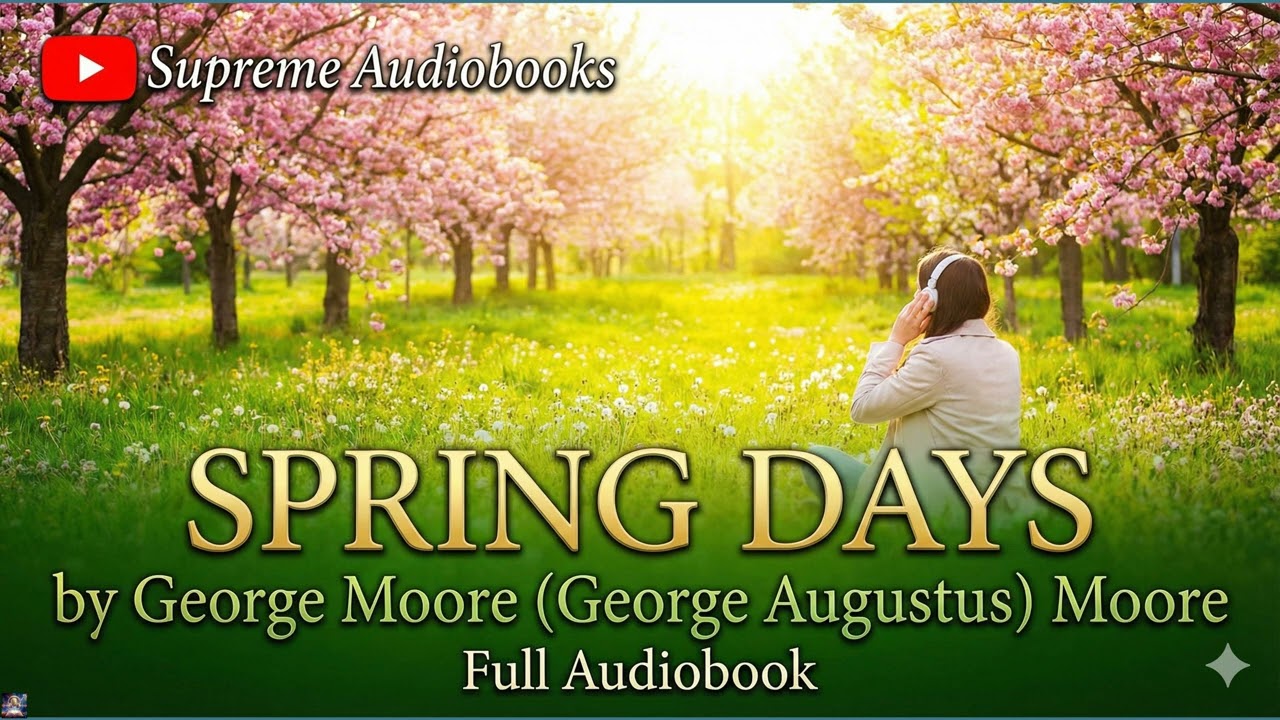
The 4K cinematic visuals accompanying this audiobook are generated by an AI image model from prompts derived from the source text. No copyrighted photos, paintings, or stock footage are used. AI generation is disclosed on every video on our YouTube channel as required by YouTube's altered/synthetic content policy.
English subtitles are transcribed from the LibriVox recording with OpenAI Whisper. Translations into the 11 other supported languages are produced by Meta's NLLB-200 neural translation model. No human translator's copyrighted translation is used.
Questions about sourcing or rights? See our DMCA & Sourcing policy or contact us.
Enjoyed this audiobook?
If you'd like to own a copy of Spring Days or hear a professionally produced edition, the links below help support free audiobook production at no extra cost to you.
As an Amazon Associate we earn from qualifying purchases. Audible / print links are affiliate.