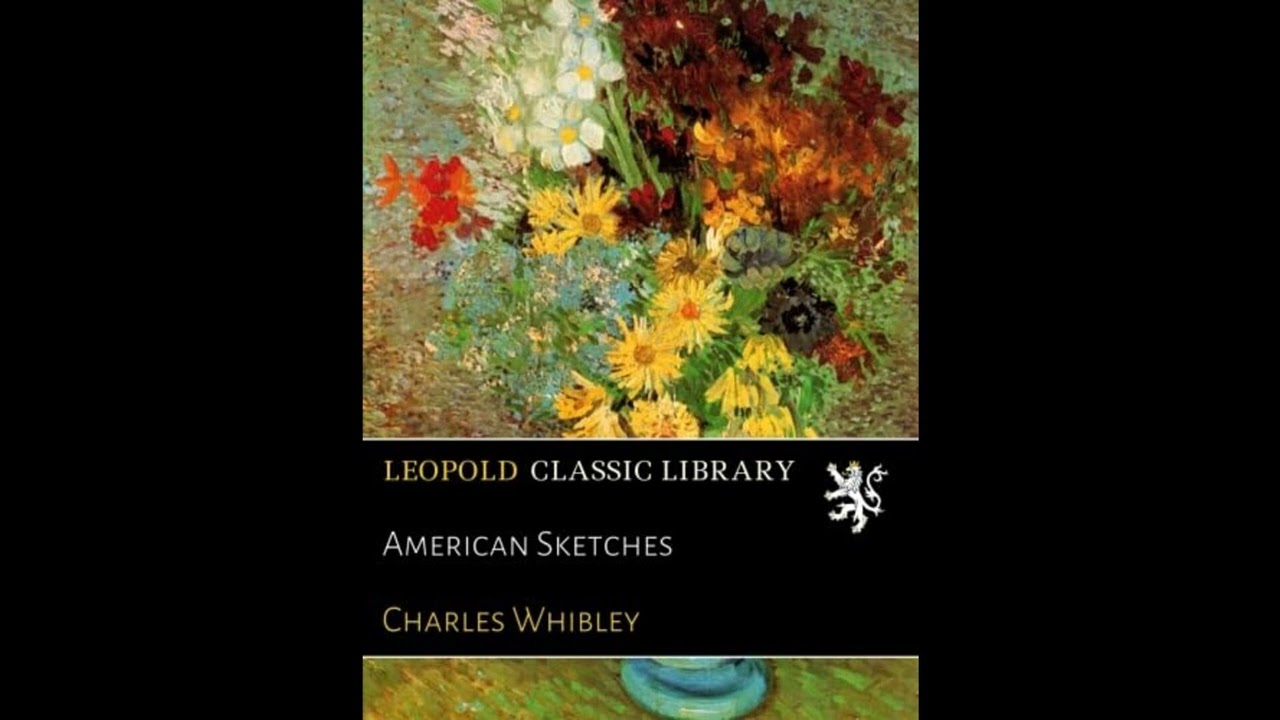
American Sketches
Step back in time to an America both familiar and strikingly foreign, viewed through the keen, often wry, gaze of a British intellectual. Charles Whibley's American Sketches offers more than a historical document; it provides a portal to the nascent identity of a nation at a pivotal moment. Imagine a time just beyond the seismic shifts of the Civil War, where a continent-spanning republic was rapidly forging its own distinct character, traditions, and even myths. This collection of observations, insights, and witty critiques invites us to consider not only what America was like over a century ago, but also how its foundational energies and inherent contradictions were perceived by an astute outsider. It's a chance to witness, firsthand, the very qualities that shaped the modern United States, making it a compelling listen for anyone seeking to understand the deep currents of American history and culture. This collection, rather than following a single narrative thread, presents a panoramic array of observations, each a standalone vignette contributing to a larger portrait of the United States. Whibley, acting as a perceptive cultural cartographer, guides us through various facets of American life. His focus is not on individual protagonists in a traditional sense, but on the collective "character" of the American people and the nation they were building. We encounter the bustling energy of emergent industrial centers, the lingering charm and complexities of the post-bellum South, and the audacious spirit of westward expansion. The "central conflict" that subtly underpins these sketches is the ongoing negotiation of American identity itself: how a diverse populace, spanning vast geographies, was attempting to define itself apart from its European heritage, while simultaneously struggling with internal divisions and the pressures of rapid modernization. The arc of the collection is one of progressive revelation, as Whibley's initial impressions give way to more nuanced understandings. He moves from broad brushstrokes describing the nation's democratic ideals and its unique social customs to more detailed studies of specific regions, institutions, or types of Americans. The listener gains an accumulating sense of what it felt like to be in America during this transformative period, from the hustle of New York City to the expansiveness of the prairies. Whibley's "characters" are often representative figures – the pragmatic businessman, the articulate orator, the independent pioneer – through whom he distills the essence of a particular American trait or societal trend. His observations are a blend of admiration and gentle critique, always striving to capture the authentic spirit of a young nation finding its voice on the world stage. Charles Whibley, born in 1859, was an influential English literary journalist, critic, and essayist whose career spanned the late Victorian and Edwardian eras. Educated at Clifton College and Jesus College, Cambridge, he became a prominent voice in London literary circles, known for his incisive intellect and distinctive prose style. He was a close associate of figures such as W.E. Henley and was a regular contributor to Blackwood's Magazine, a prestigious periodical where many of his "sketches" and critical essays first appeared. Whibley was often characterized by his conservative literary tastes and his commitment to classical values, frequently expressing skepticism about newer literary movements, yet always with a keen analytical eye. His contributions to literature extended beyond American Sketches. Other notable works include Literary Portraits, Studies in Frankness, and Lord John Manners and His Friends, all showcasing his talent for biographical and critical commentary. Whibley held a unique position as a bridge between the older guard of literary criticism and the evolving landscape of early 20th-century letters. His clear, elegant prose and his willingness to engage directly with cultural phenomena cemented his reputation as a significant commentator of his time, even if he did not initiate a new literary movement himself. He passed away in 1930, leaving behind a body of work that continues to provide valuable insights into the social and intellectual currents of his era. American Sketches brilliantly illuminates several core themes. One prominent theme is cultural identity, specifically the forging of a distinct American character in contrast to European norms. Whibley often illustrates this by contrasting the perceived informality and democratic spirit of American institutions with the more stratified traditions of Britain. For example, he might describe the accessible nature of an American politician or public figure, showing how a culture of self-made individuals shaped a different kind of leadership compared to inherited privilege. Another key theme is the impact of progress and modernity on society. Whibley frequently notes the rapid industrialization, the burgeoning cities, and the embrace of innovation that characterized America. He might paint a scene of a sprawling factory or a newly constructed railway, illustrating how technological advancement was reshaping not just the landscape but also the very rhythm of American life, often with both awe and a touch of concern for what might be lost. A third theme is the concept of space and frontier, reflecting the nation's vast geography and the enduring spirit of expansion. Whibley's observations often move from the established East Coast to the still-developing West, highlighting the different temperaments and societal structures that emerged from these distinct environments. He might depict the resourcefulness of settlers in a remote territory, contrasting it with the more refined customs of Boston or Philadelphia, thereby showing how geography influenced national character. Finally, the theme of democracy and its discontents runs through the collection. Whibley, while often admiring American ideals, also casts a critical eye on the practicalities and occasional excesses of a fully democratic society, questioning how individual liberty balanced with collective order. He might offer a subtle critique of political rhetoric or public sentiment, demonstrating how the exercise of popular will could sometimes lead to outcomes surprising to an observer from a more deferential culture. When Whibley composed these sketches, America was undergoing a period of profound transformation. The latter half of the nineteenth century, following the scars of the Civil War, saw the country rapidly industrialize, giving rise to the Gilded Age with its immense wealth, growing social inequalities, and significant technological advancements like widespread electrification and the expansion of the railroad system. Massive waves of immigration were reshaping the demographic landscape, leading to burgeoning urban centers and a complex multicultural mosaic. Politically, the nation was grappling with the aftermath of Reconstruction and navigating its emergence as a global power. Culturally, there was a tension between lingering romantic ideals and the rise of realism and naturalism in literature, seeking to capture the grittier realities of American life. Whibley, as a British observer, arrived in America at a time when the nation was aggressively asserting its own identity on the global stage, making his outsider's perspective particularly valuable in capturing the essence of this dynamic period. His work emerged from a desire to understand and interpret this powerful, rapidly evolving society for a European audience. Listening to American Sketches as an audiobook transforms the experience of reading a collection of essays into an intimate journey guided by a discerning voice. The narrator’s measured pacing allows Whibley's thoughtful prose to unfold naturally, giving space for the listener to absorb his detailed descriptions and witty asides. A well-chosen voice, perhaps with a subtle British timbre, can perfectly embody Whibley’s observational style – intellectual, occasionally droll, and always articulate. The "several hours" run length makes it an ideal companion for commutes, thoughtful walks, or quiet evenings at home, offering digestible segments of insight that can be paused and reflected upon. Listen for the subtle shifts in atmosphere as Whibley moves from bustling cityscapes to tranquil rural scenes, and appreciate how the narrator brings to life the various "voices" Whibley observes, whether through direct quotation or evocative description. This auditory presentation allows the listener to directly engage with the rhythm and cadence of Whibley's language, enhancing the feeling of stepping directly into the past and gaining a direct understanding of a pivotal moment in American history.
Enjoyed American Sketches? A few ways to support us
Audible & Amazon links are affiliate; we may earn a small commission at no extra cost.
About this production
Human narration by a volunteer reader from LibriVox.org, the public-domain audiobook project. LibriVox volunteers record literary works whose copyright has expired in the United States, releasing the resulting recordings into the public domain.
American Sketches by Charles Whibley. The underlying text is in the U.S. public domain. We do not republish any modern copyrighted edition, translation, or commentary.
The 4K cinematic visuals accompanying this audiobook are generated by an AI image model from prompts derived from the source text. No copyrighted photos, paintings, or stock footage are used. AI generation is disclosed on every video on our YouTube channel as required by YouTube's altered/synthetic content policy.
English subtitles are transcribed from the LibriVox recording with OpenAI Whisper. Translations into the 11 other supported languages are produced by Meta's NLLB-200 neural translation model. No human translator's copyrighted translation is used.
Questions about sourcing or rights? See our DMCA & Sourcing policy or contact us.
Enjoyed this audiobook?
If you'd like to own a copy of American Sketches or hear a professionally produced edition, the links below help support free audiobook production at no extra cost to you.
As an Amazon Associate we earn from qualifying purchases. Audible / print links are affiliate.