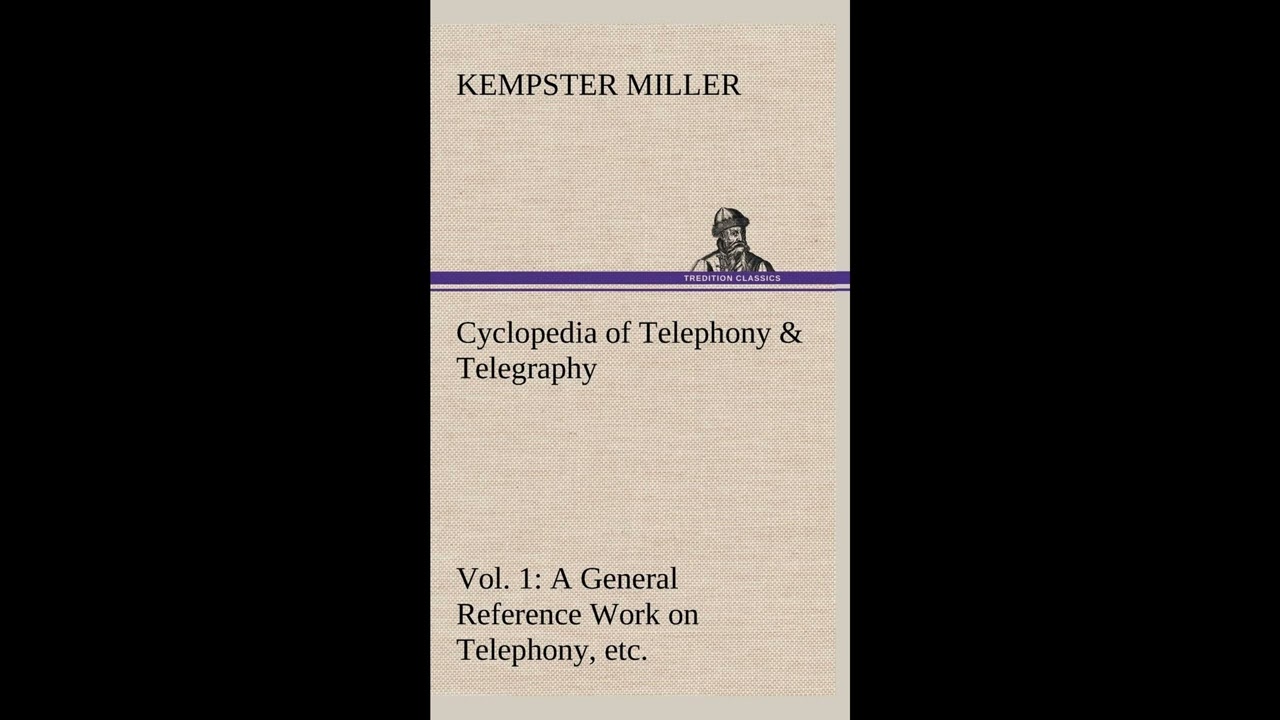
Cyclopedia of Telephony & Telegraphy Vol. 1 A General Reference Work on Telephony
Step into a fascinating echo chamber of innovation, a world where the very idea of conversing across vast distances was nothing short of miraculous. "Cyclopedia of Telephony & Telegraphy Vol. 1 A General Reference Work on Telephony" offers more than a collection of technical specifications; it is a profound testament to human ingenuity, a meticulously assembled chronicle of how the world began to shrink under the powerful influence of the voice carried by wire. Today, as we navigate a world where instant global communication is taken for granted, this foundational volume provides a crucial historical lens, allowing us to understand the colossal intellectual and engineering effort that laid the groundwork for our interconnected age. It is a vital record, revealing the profound questions engineers and inventors grappled with, and the elegant, often ingenious, solutions they devised to bring the future into being. The narrative of this volume unfolds not through fictional characters, but through the relentless drive of human curiosity and practical application, setting its scene in a world hungry for connection, poised at the turn of the 20th century. Imagine the bustling cities, the sprawling continents, and the profound isolation that vast distances once imposed. The "main characters" here are the concepts themselves: the electrical impulse, the acoustic wave, and the complex machinery designed to harness them. The central conflict presents itself as the monumental challenge of transmitting clear, reliable voice signals over ever-increasing distances, overcoming the inherent limitations of materials and physics. How does one convert sound into electricity, send it efficiently, and then faithfully convert it back to sound, all while managing interference, attenuation, and the sheer logistical nightmare of connecting millions of individual conversations? The arc of this "story" traces the systematic evolution of telephony from its nascent, experimental stages to a standardized, robust system poised for mass adoption. Listeners follow the progression from simple point-to-point connections to the complex architecture of central battery exchanges, magneto systems, and early automatic switching. The book details the ingenious designs of telephone receivers and transmitters, the intricacies of various circuit diagrams, and the practical considerations of installing and maintaining these groundbreaking networks. It's a progression from the initial spark of an idea – voice over distance – to the meticulous codification of a global infrastructure, a triumph of systematic thinking that solved the most pressing communication problems of its time. "Cyclopedia of Telephony & Telegraphy Vol. 1 A General Reference Work on Telephony" emerges from an era when knowledge itself was undergoing a transformation, with a growing demand for accessible technical information. Unlike a work penned by a single individual, this kind of cyclopedia often represents the collective genius of an entire generation of engineers, scientists, and educators. These comprehensive volumes were typically produced by technical institutions or publishing houses specializing in industrial arts, drawing upon the expertise of various contributors who were at the forefront of their respective fields. The "author" here is therefore not a singular biographical figure, but the concerted effort of a professional community dedicated to cataloging, standardizing, and disseminating the cutting-edge knowledge of its day. This tradition of collaborative authorship for technical reference works underscores a pivotal cultural shift. The late 19th and early 20th centuries saw a powerful movement to professionalize engineering and industrial trades. Institutes like the American School of Correspondence and similar educational bodies sought to empower a burgeoning workforce with the practical knowledge needed to build and operate the machines of a new industrial age. This collective intelligence, synthesized and organized into volumes such as this one, reflects a communal aspiration to master the forces of technology and to ensure that the vital skills for the future were widely understood and readily available, creating a shared foundation for further progress and development across society. Beneath the technical diagrams and detailed descriptions, several profound themes surface from this work. First, the text embodies the spirit of innovation and progress. Consider the detailed sections on the development of different types of switchboards—from simple manual plug-and-jack systems to more sophisticated arrangements. Each advancement, meticulously documented, represents a tangible step forward in efficiency and capability, directly demonstrating humanity's relentless drive to overcome limitations and refine existing solutions. Secondly, the book powerfully enacts the theme of standardization and systemization. The methodical classification of various apparatus, the clear exposition of circuit designs, and the establishment of operational procedures highlight the critical need to bring order and reliability to a rapidly expanding and inherently complex technological network. It shows the intellectual discipline required to create a coherent system from a multitude of individual inventions. Furthermore, a significant theme is the democratization of knowledge and, by extension, communication itself. The very existence of a "general reference work" on telephony indicates a desire to make this technical understanding accessible beyond a small circle of inventors and academics, empowering a wider array of engineers, technicians, and curious individuals to comprehend and participate in this new technological landscape. This widespread dissemination of practical knowledge was crucial for the rapid adoption and maintenance of telephonic networks, ultimately bridging distances between people and fostering unprecedented human connection—the ultimate, unspoken purpose of every schematic and explanation contained within these pages. This volume emerges from a truly transformative historical period. The late 19th and early 20th centuries witnessed an unprecedented acceleration of technological advancement, driven by the mature Industrial Revolution, the advent of electrification, and the burgeoning power of mass production. Communication technologies, spearheaded by the telegraph and then profoundly reshaped by the telephone, did not merely improve; they fundamentally redefined how business operated, how governments functioned, and how individuals interacted. This era saw the rise of global corporations, demanding instantaneous information exchange, and a growing middle class, eager for personal connection beyond geographical constraints. The demand for skilled labor to build, operate, and maintain these new infrastructures was immense, driving the need for comprehensive educational resources like this cyclopedia. It captures the essence of a moment when the world was irrevocably changing, moving towards an "information age" where speed and reach of communication would become paramount. This book stands as a foundational text from the period when communication became instantaneous and widespread, effectively laying the intellectual and technical groundwork for every subsequent development in global connectivity, from radio to the internet. Listening to "Cyclopedia of Telephony & Telegraphy Vol. 1" as an audiobook offers a singular opportunity to engage with this material in a deeply immersive way. The experience transforms what might appear on the page as dry technical prose into an engaging narrative of human ingenuity and meticulous problem-solving. A skilled narrator brings clarity and a sense of measured wonder to the descriptions of circuits, apparatus, and operational procedures, making the complex concepts more approachable and digestible than they might be in print. The several-hour length allows for sustained focus, enabling listeners to absorb the intricate details and ponder the broader historical implications without the visual strain of diagrams and dense text. It invites a reflective appreciation for the colossal achievements of early telephony, making the journey through these foundational principles not just educational, but genuinely thought-provoking, connecting the listener directly to the foundational sounds of the modern world.
Enjoyed Cyclopedia of Telephony & Telegraphy Vol. 1 A General Reference Work on Telephony? A few ways to support us
Audible & Amazon links are affiliate; we may earn a small commission at no extra cost.
About this production
Human narration by a volunteer reader from LibriVox.org, the public-domain audiobook project. LibriVox volunteers record literary works whose copyright has expired in the United States, releasing the resulting recordings into the public domain.
Cyclopedia of Telephony & Telegraphy Vol. 1 A General Reference Work on Telephony. The underlying text is in the U.S. public domain. We do not republish any modern copyrighted edition, translation, or commentary.
The 4K cinematic visuals accompanying this audiobook are generated by an AI image model from prompts derived from the source text. No copyrighted photos, paintings, or stock footage are used. AI generation is disclosed on every video on our YouTube channel as required by YouTube's altered/synthetic content policy.
English subtitles are transcribed from the LibriVox recording with OpenAI Whisper. Translations into the 11 other supported languages are produced by Meta's NLLB-200 neural translation model. No human translator's copyrighted translation is used.
Questions about sourcing or rights? See our DMCA & Sourcing policy or contact us.
Enjoyed this audiobook?
If you'd like to own a copy of Cyclopedia of Telephony & Telegraphy Vol. 1 A General Reference Work on Telephony or hear a professionally produced edition, the links below help support free audiobook production at no extra cost to you.
As an Amazon Associate we earn from qualifying purchases. Audible / print links are affiliate.