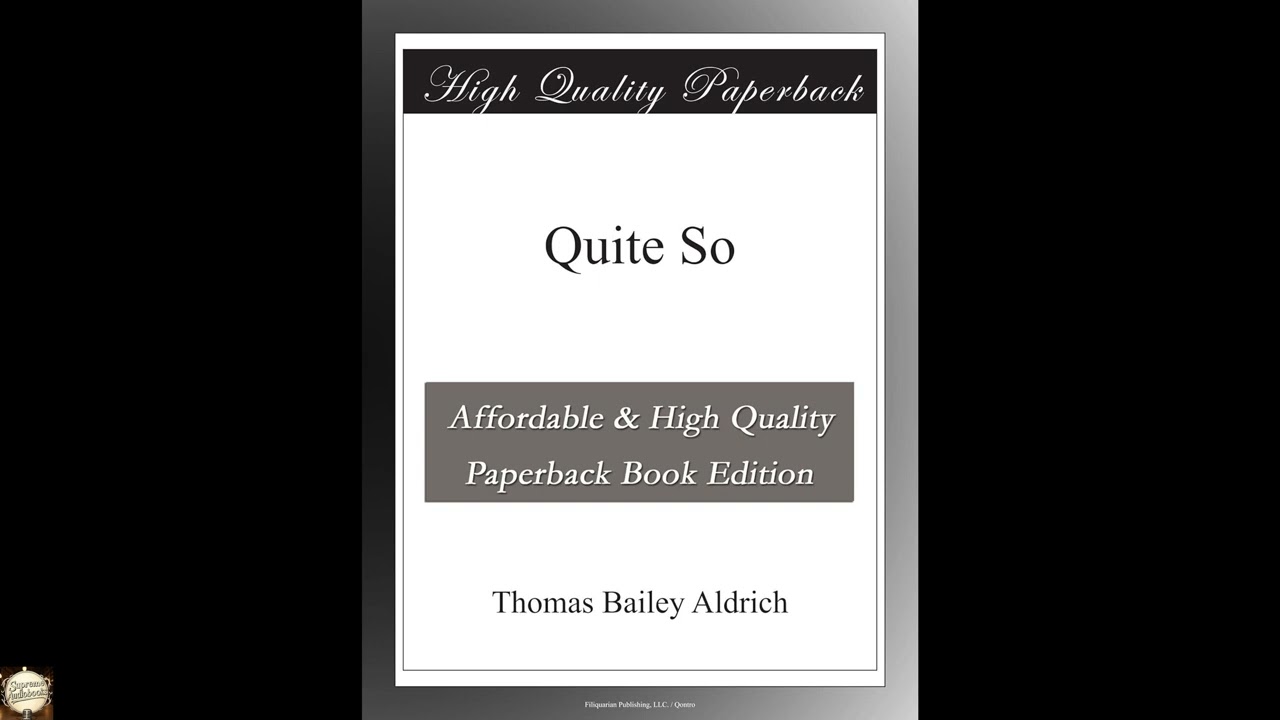
Quite So
Step into the quietly discerning world of Thomas Bailey Aldrich with Quite So, a literary gem that invites us to pause and consider the subtle currents beneath everyday interactions. This audiobook offers an astute observation of human nature and the unspoken agreements that shape our lives, presenting a narrative that, despite its late nineteenth-century origins, resonates with anyone who has ever pondered the precision of language or the delicate dance of social convention. Aldrich’s prose, celebrated for its clarity and understated wit, draws listeners into a narrative that reveals profound truths in the most unassuming of moments, making it a compelling listen for those who appreciate the enduring power of classic storytelling. In the tranquil, tree-lined village of Willow Creek, a place where neighborly routines form the steady rhythm of life, we meet Mr. Phineas Finch. A man of meticulous habits and a retired librarian, Phineas cherishes precision above all else—in his organized shelves, his morning constitutional, and most particularly, in language. His days unfold with a predictable grace until a seemingly minor linguistic observation disrupts his quiet equanimity. At the local general store, amidst the cheerful clatter of commerce and friendly gossip, Phineas overhears Mrs. Gable, a well-meaning but occasionally imprecise resident, utter the phrase "quite so" in a way that, to Phineas's ears, rings subtly amiss. For Phineas, "quite so" carries a specific weight, a nuance of reserved acknowledgment rather than unqualified affirmation. Mrs. Gable, however, employs it as a simple, emphatic "yes, exactly." This small discrepancy becomes a quiet obsession for Phineas, spurring him to observe the usage of the phrase throughout Willow Creek. He listens intently to conversations in the park, at the bake shop, and during polite calls, each instance building a mosaic of how the community navigates agreement and understanding. The story follows Phineas's gentle, almost imperceptible quest to reconcile his internal dictionary with the fluid realities of social speech, and his internal debate about whether, or how, to gently illuminate this perceived linguistic deviation to Mrs. Gable or others. His dilemma remains a personal one, a thoughtful internal comedy playing out against the backdrop of an outwardly placid small town. The pen behind such nuanced observations belonged to Thomas Bailey Aldrich, an American author, poet, and editor whose literary career spanned the latter half of the nineteenth century. Born in Portsmouth, New Hampshire, in 1836, Aldrich's early life was marked by a move to New York City at the age of sixteen, where he began working in a counting-house. This early exposure to the bustling city and the world of commerce provided a backdrop against which his burgeoning literary ambitions would soon take flight. He quickly gravitated towards journalism and poetry, finding his voice amidst the literary circles of the day and contributing to various periodicals. Aldrich's reputation grew steadily, leading him to Boston, a significant hub for American letters. There, he became the editor of the esteemed Atlantic Monthly, a position he held from 1881 to 1890, succeeding William Dean Howells. This role placed him at the heart of the American literary establishment, where he championed new voices while also continuing to produce his own acclaimed work. Among his most beloved contributions is The Story of a Bad Boy, a semi-autobiographical novel published in 1870, often credited as a precursor to the modern boy's story genre. Aldrich's poetry, known for its lyrical quality and careful craftsmanship, also earned him considerable praise, and his short stories, many collected in volumes like Marjorie Daw and Other People, cemented his place as a master of the form, particularly adept at depicting New England life and character with delicate humor and sentiment. He passed away in 1907, leaving behind a body of work that quietly illuminated the human condition. Quite So elegantly stages several enduring themes relevant to human experience. One central theme involves the delicate dance of social decorum and the inherent ambiguity of language. Phineas Finch's internal struggle over the phrase "quite so" highlights how seemingly minor verbal distinctions can carry immense personal weight, revealing the often-unspoken rules governing polite interaction. Listeners observe, through Phineas’s careful musings, the careful performance of agreement and disagreement in a community. A second theme touches upon the profound influence of individual perception versus shared reality. Phineas’s precise, scholarly understanding of a phrase clashes with the casual, colloquial usage prevalent in Willow Creek. This dynamic illustrates how personal interpretations can create entirely separate internal worlds, even within a closely knit society, and underscores the subtle divisions that can arise from differing perspectives on common usage. The narrative also lightly touches on the charm of introspection and the quiet beauty of small-town life, where personal dramas unfold with gentle intensity. The era in which Thomas Bailey Aldrich penned his stories was a fascinating period for American culture and literature. Following the immense upheaval of the Civil War, the nation entered a phase of rapid industrialization, westward expansion, and the emergence of modern cities. Yet, alongside this progress, there was a persistent strain of nostalgia for a simpler, pre-industrial America, particularly for the idealized vision of rural New England life. Literarily, the late nineteenth century saw a gradual shift from the romanticism of earlier decades towards realism and, eventually, naturalism. Aldrich, while appreciating the emerging currents, largely maintained a style rooted in the "genteel tradition," favoring refined language, well-crafted plots, and a focus on character and atmosphere over raw social commentary or brutal honesty. His stories, including Quite So, offered readers a respite from the increasingly complex modern world, providing narratives that prioritized clarity, sentiment, and a gentle humor, reflecting a desire to preserve certain cultural values amidst rapid change. Listening to Quite So as an audiobook transforms Aldrich's meticulous prose into an immediate, engaging experience. At several hours in length, it offers an ideal companion for a morning commute, a quiet afternoon tea, or a contemplative evening walk. The narrator's performance is paramount here, as Aldrich's stories thrive on nuance. A skilled voice brings Mr. Phineas Finch's internal monologues to life, allowing listeners to truly inhabit his precise world, making his observations on language feel deeply personal and relatable. Pay attention to the subtle shifts in the narrator's tone and pacing as Phineas grapples with his linguistic dilemma; these vocal choices enhance the quiet humor and the occasional pangs of existential doubt that underscore the narrative. The carefully rendered dialogue, with each character's distinct voice, paints a vivid picture of Willow Creek, creating an enveloping atmosphere that draws you into this charming, observant piece of classic literature.
Enjoyed Quite So? A few ways to support us
Audible & Amazon links are affiliate; we may earn a small commission at no extra cost.
About this production
Human narration by a volunteer reader from LibriVox.org, the public-domain audiobook project. LibriVox volunteers record literary works whose copyright has expired in the United States, releasing the resulting recordings into the public domain.
Quite So by Thomas Bailey Aldrich. The underlying text is in the U.S. public domain. We do not republish any modern copyrighted edition, translation, or commentary.
The 4K cinematic visuals accompanying this audiobook are generated by an AI image model from prompts derived from the source text. No copyrighted photos, paintings, or stock footage are used. AI generation is disclosed on every video on our YouTube channel as required by YouTube's altered/synthetic content policy.
English subtitles are transcribed from the LibriVox recording with OpenAI Whisper. Translations into the 11 other supported languages are produced by Meta's NLLB-200 neural translation model. No human translator's copyrighted translation is used.
Questions about sourcing or rights? See our DMCA & Sourcing policy or contact us.
Enjoyed this audiobook?
If you'd like to own a copy of Quite So or hear a professionally produced edition, the links below help support free audiobook production at no extra cost to you.
As an Amazon Associate we earn from qualifying purchases. Audible / print links are affiliate.