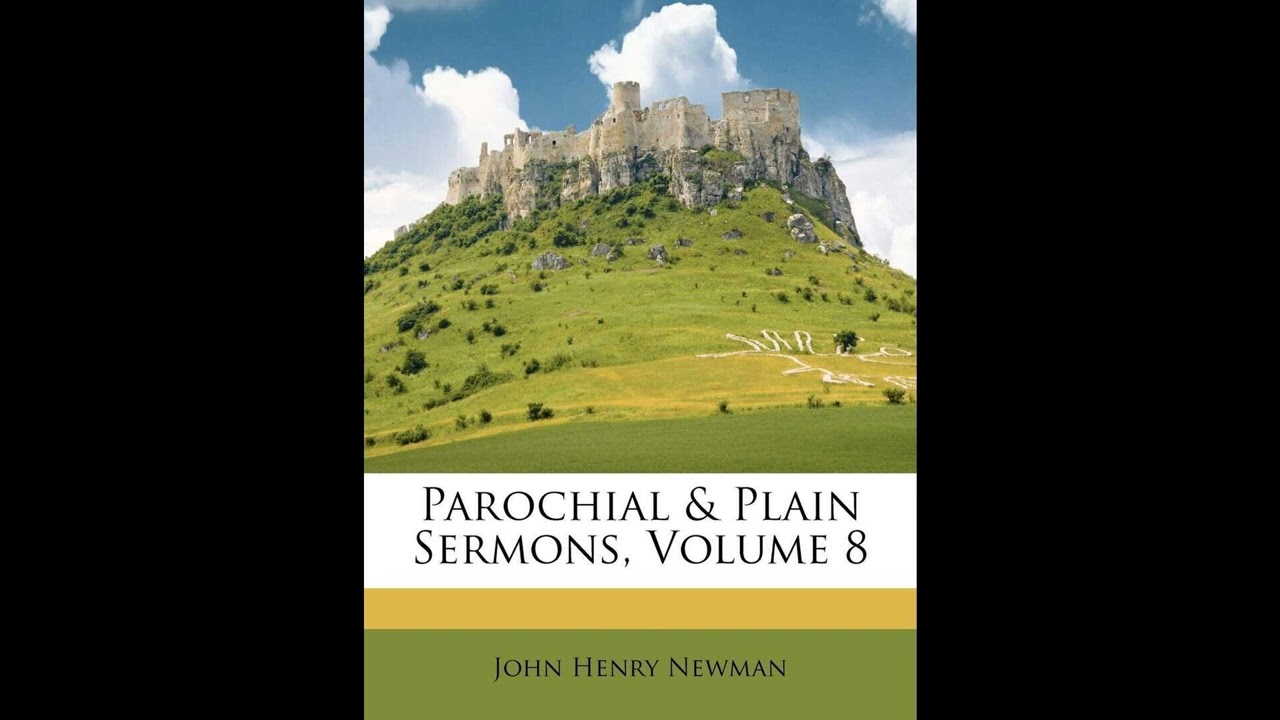
Parochial & Plain Sermons, Volume 8
Cardinal John Henry Newman’s Parochial & Plain Sermons, Volume 8 offers more than a historical artifact; it presents a direct encounter with one of the nineteenth century’s most formidable intellects and spiritual guides. These addresses, originally delivered from Anglican pulpits, transcend their immediate context to speak with profound relevance to anyone grappling with questions of faith, doubt, and the human condition. Newman, a master of English prose, dissects moral dilemmas and spiritual truths with a clarity and depth that continues to resonate. Listening to these sermons today is not merely an act of historical appreciation, but an invitation to personal reflection, offering insights into human nature and divine purpose that remain strikingly pertinent in a world still seeking meaning. Within this eighth volume, a collection of Newman’s addresses unfolds, inviting the listener into the intimate setting of the parish church where these words were first heard. While sermons do not follow a traditional narrative, their internal logic and thematic progression offer a kind of spiritual arc. The "setting" is primarily the human heart and mind, confronted with the divine. Newman, as the guiding voice, acts as a learned pastor and profound philosopher, addressing a "congregation" representing every soul caught between the demands of the world and the call of conscience. His gentle yet insistent voice leads listeners through contemplations on the nature of God, the challenges of Christian living, and the subtle workings of grace in everyday existence. The central conflict animating these sermons is the perennial struggle between the visible, often distracting, world and the invisible, eternal realm. Newman grapples with how individuals might maintain integrity, foster genuine belief, and pursue holiness amidst the secularizing forces and moral compromises of their age. Each sermon, therefore, can be seen as a chapter in this ongoing spiritual drama, presenting a particular aspect of the conflict and offering guidance. Listeners will find themselves drawn into arguments that illuminate the complexities of faith, reason, and the practical application of spiritual principles, moving from initial premise to compelling conclusion without ever presuming an easy resolution to the deeper mysteries of existence. John Henry Newman, born in London in 1801, lived a life marked by profound intellectual inquiry and spiritual transformation. Educated at Trinity College, Oxford, he became a Fellow of Oriel College and a prominent figure in the Anglican Church. His early career was defined by his role as a leader of the Oxford Movement, also known as Tractarianism. This High Church revival sought to reassert the Catholic heritage and doctrinal purity of the Church of England, emphasizing the importance of tradition, the sacraments, and the apostolic succession. Newman’s powerful sermons, delivered from the pulpit of St. Mary's, Oxford, were instrumental in shaping the movement's intellectual and spiritual direction, influencing countless students and clergy. A pivotal moment in Newman’s life occurred in 1845 when, after years of intense theological study and spiritual discernment, he converted to Roman Catholicism. This decision sent shockwaves through Victorian England, costing him many friendships and much of his public standing in Anglican circles. He was later ordained a Catholic priest and founded the Oratory of St. Philip Neri in England. His vast literary output during both his Anglican and Catholic periods includes theological treatises, historical essays, poems, and autobiographical works. Among his most celebrated writings are Apologia Pro Vita Sua, a powerful defense of his conversion, and The Idea of a University, a foundational text on education. He was made a Cardinal by Pope Leo XIII in 1879, recognizing his immense contributions to theology and intellectual life. Newman passed away in 1890, leaving behind a legacy as one of the most significant religious thinkers and prose stylists of the English-speaking world. Newman’s sermons exemplify several core themes that define his expansive thought. A recurring concern is the interplay between faith and reason. Rather than presenting them as adversaries, Newman consistently shows how reason, rightly understood, can prepare the mind for faith and how faith, in turn, provides the ultimate framework for understanding reality. For instance, he frequently begins by acknowledging common human experience or rational dilemma, then meticulously constructs an argument that points towards a spiritual truth, demonstrating how the seemingly irrational aspects of belief can be seen as deeply coherent within a larger divine plan. Another prominent theme is the primacy of conscience. Newman articulates conscience not merely as a subjective feeling, but as the voice of God within the human soul, a direct moral guide. He often illustrates this through scenarios of moral choice, urging listeners to cultivate and obey this inner light, portraying it as the most direct path to apprehending divine will, even when it conflicts with societal pressures or personal desires. The sermons also frequently address the hiddenness of God and the reality of Divine Providence. Newman grapples with the paradox of an all-powerful, ever-present God who often seems distant or concealed in the everyday world. He encourages a perception that discerns God's hand in seemingly ordinary events, portraying life not as a series of accidents but as a divinely guided unfolding. He draws on biblical narratives and parables, showing how the subtle signs of God's presence are often overlooked by those unwilling to look beneath the surface. Furthermore, the sermons underscore the practical demands of Christian discipleship. This is not abstract theology but a call to lived religion. Newman constantly grounds his discussions in the everyday struggles of his congregation, illustrating how virtues like humility, obedience, and self-denial are not lofty ideals but concrete actions required in daily interactions, shaping individual character and spiritual growth. These sermons emerged from a tumultuous period in nineteenth-century England, a time of profound cultural and intellectual shifts. The Victorian era saw rapid industrialization, burgeoning scientific discoveries, and a growing intellectual skepticism that challenged traditional religious authority. Liberal theological trends were gaining traction within the Church of England, leading to concerns about the erosion of orthodox doctrine and a weakening of the church’s spiritual vitality. The Oxford Movement, of which Newman was a central figure, rose in direct response to these pressures. Its adherents aimed to reassert the apostolic origins and sacramental nature of the Church of England, combating both state interference and internal theological liberalism. Newman’s preaching provided a powerful, eloquent voice for this movement, offering a spiritual and intellectual antidote to the prevailing uncertainties and secularizing forces, emphasizing the continuity of Christian tradition and the necessity of personal holiness in an age of change. To experience Parochial & Plain Sermons, Volume 8 as an audiobook is to encounter these pivotal texts in their most authentic form. Sermons, by their very nature, are meant to be heard, to resonate through the spoken word and influence the listener directly. A skilled narrator brings Newman's meticulous prose to life, allowing the listener to appreciate his careful pacing, his rhetorical questions, and the subtle cadences that make his arguments so compelling. Over several hours, this collection offers ample opportunity for sustained reflection, perfect for thoughtful listening during quiet moments or alongside daily routines. Attending to the narrator's voice allows one to discern the gravity of Newman's pronouncements, the warmth of his pastoral appeal, and the precise, often beautiful, construction of his sentences, drawing the listener into a deeper engagement with the profound spiritual and intellectual challenges Newman so brilliantly addresses.
Enjoyed Parochial & Plain Sermons, Volume 8? A few ways to support us
Audible & Amazon links are affiliate; we may earn a small commission at no extra cost.
About this production
Human narration by a volunteer reader from LibriVox.org, the public-domain audiobook project. LibriVox volunteers record literary works whose copyright has expired in the United States, releasing the resulting recordings into the public domain.
Parochial & Plain Sermons, Volume 8 by Cardinal John Henry Newman. The underlying text is in the U.S. public domain. We do not republish any modern copyrighted edition, translation, or commentary.
The 4K cinematic visuals accompanying this audiobook are generated by an AI image model from prompts derived from the source text. No copyrighted photos, paintings, or stock footage are used. AI generation is disclosed on every video on our YouTube channel as required by YouTube's altered/synthetic content policy.
English subtitles are transcribed from the LibriVox recording with OpenAI Whisper. Translations into the 11 other supported languages are produced by Meta's NLLB-200 neural translation model. No human translator's copyrighted translation is used.
Questions about sourcing or rights? See our DMCA & Sourcing policy or contact us.
Enjoyed this audiobook?
If you'd like to own a copy of Parochial & Plain Sermons, Volume 8 or hear a professionally produced edition, the links below help support free audiobook production at no extra cost to you.
As an Amazon Associate we earn from qualifying purchases. Audible / print links are affiliate.