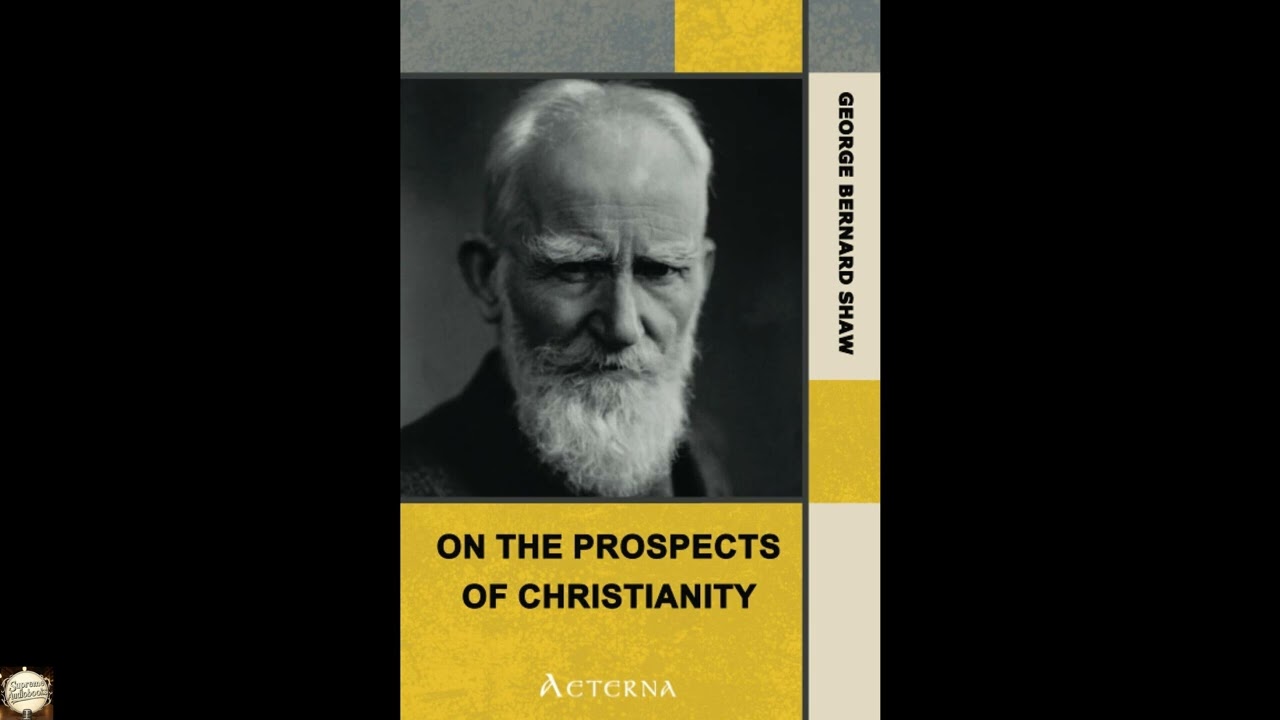
On the Prospects of Christianity. Bernard Shaw's Preface to Androcles and the Lion
More than a century after its initial publication, Bernard Shaw’s masterful Preface to his play Androcles and the Lion stands as an electrifying, still-provocative examination of Christianity, its tumultuous history, and its very real prospects in the modern world. This is not merely a literary introduction; it is a full-fledged philosophical treatise, a blistering social critique, and a call to intellectual arms that resonates deeply today. As contemporary society grapples with questions of faith, secularism, the role of institutions, and the practical application of ethical ideals, Shaw’s incisive arguments challenge listeners to look beyond dogma and consider the radical, often inconvenient, truths at the heart of Christian teachings. He compels us to ask: What would it truly mean to live by the tenets of Jesus, and how far have we—as individuals and as a civilization—strayed from that demanding path? Shaw’s monumental preface unfolds as a comprehensive intellectual survey, guiding the listener through a landscape of historical interpretation and moral reckoning. It establishes its intellectual setting in the early twentieth century but swiftly expands its scope, reaching back to ancient Judea and Rome, tracing the evolution of Christianity from a revolutionary cult to a world-spanning religion. The central figures are, of course, Jesus himself, portrayed not as a divine being but as a profound social reformer and ethical anarchist, and the various interpreters and institutions—from Saint Paul to the Roman emperors, medieval theologians to modern evangelists—who have shaped, and often distorted, his message. Shaw’s central conflict is the stark chasm between the pure, uncompromising ethical demands of Jesus’s original teachings and the institutional compromises, political adaptations, and intellectual dilutions that have defined historical Christianity. He argues that what most people call "Christianity" is, in fact, a complex edifice built upon Jesus's teachings, often in direct opposition to them. The arc of Shaw’s argument is meticulously constructed, beginning with a provocative assertion that the Gospels, far from being mere chronicles, are political documents designed to soften Jesus’s revolutionary edge for Roman consumption. He systematically dismantles prevailing assumptions, demonstrating how the early Church, needing to survive and grow within a hostile empire, effectively ‘paganized’ Christ, transforming his radical social agenda into a mystical doctrine of personal salvation. He contrasts the "Gentile Christ"—a figure suitable for empire-building—with the "Jewish Christ"—a figure whose teachings, if truly embraced, would dismantle the very structures of power and wealth that society holds dear. Shaw’s prose crackles with his signature wit and intellectual ferocity as he lays bare the historical machinations and theological evasions that, in his view, have allowed Christian nations to wage war, uphold class distinctions, and accumulate vast wealth, all while professing adherence to a Messiah who advocated peace, poverty, and universal brotherhood. His "story" is the compelling, often uncomfortable, unfolding of a profound historical and philosophical critique, leading to a provocative re-evaluation of what faith truly demands. George Bernard Shaw, born in Dublin in 1856, remains one of the most towering and influential literary figures of the English-speaking world. A man of formidable intellect and prodigious output, he moved to London in 1876, where he initially struggled as a novelist before finding his voice as a trenchant critic of music, art, and drama. His transformation into a world-renowned playwright and social commentator marked a pivotal moment in late Victorian and Edwardian literature. A lifelong socialist, a fervent advocate for women’s suffrage, vegetarianism, and numerous other progressive causes, Shaw utilized his writing not just for entertainment, but as a potent vehicle for social and political reform. He was a leading light of the Fabian Society, a British socialist organization that advocated for gradual rather than revolutionary change, and his plays consistently challenged societal conventions and moral hypocrisies. Shaw’s literary output is vast and diverse, encompassing over sixty plays, numerous essays, and several novels. Key among his celebrated plays are Pygmalion, later adapted into the musical My Fair Lady; the searing social critiques Mrs. Warren's Profession and Major Barbara; the philosophical epic Man and Superman; and the historical drama Saint Joan. He was awarded the Nobel Prize in Literature in 1925, cementing his place in the literary canon as a brilliant satirist, a master of paradox, and a profound humanitarian. Shaw’s work bridges the gap between the Victorian age and Modernism, carrying forward the intellectual and social concerns of the nineteenth century while anticipating the disillusionment and philosophical inquiry of the twentieth. His plays revolutionized English drama, introducing a new level of intellectual engagement and realistic dialogue, establishing him as the most significant British playwright since Shakespeare. Shaw’s preface is keenly interested in the discrepancy between ethical ideals and practical realities. He repeatedly highlights the vast difference between the radical demands of Jesus—such as turning the other cheek, loving one’s enemies, or selling all possessions to follow him—and the often-compromised actions of individuals and institutions purporting to follow Christ. For example, he points to the historical fact that while Jesus preached non-resistance, Christian nations have waged some of the bloodiest wars in history. Another core theme is social criticism and the possibility of genuine reform. Shaw employs the religious discussion as a springboard for his broader critique of capitalist society, conventional morality, and political structures. He argues that a true adoption of Christ’s principles would necessitate a complete overhaul of property relations, governmental systems, and economic hierarchies, illustrating this by contrasting Jesus’s anti-materialistic stance with the Church’s historical accumulation of wealth and power. Furthermore, the nature of belief and sincerity forms a crucial thread throughout the text. Shaw constantly probes what it truly means to be a "Christian"—is it merely outward conformity, or a profound internal commitment to a demanding way of life? He challenges the listener to distinguish between nominal adherence to doctrine and actual emulation of Christ’s ethics. He shows, through historical examples, how many who claimed to be Christians actively resisted the practical implications of Jesus’s teachings. Finally, the preface underscores the evolution of ideas over time. Shaw meticulously traces how religious and ethical concepts are not static but dynamic, constantly reinterpreted, adapted, and sometimes fundamentally altered by successive generations to suit their own cultural, political, and economic contexts. His detailed historical survey of theological shifts demonstrates how Jesus’s original message was progressively molded to fit the needs of the Roman Empire, then feudal society, and finally industrial capitalism, illustrating how ideas are living entities susceptible to human manipulation and redefinition. This profound preface emerged from the intellectual ferment of the early twentieth century, published in 1913, on the precipice of the First World War. It was a period marked by significant cultural upheaval, where the certainties of the Victorian era were giving way to modernist questioning and a growing skepticism towards established institutions, including the Church. The rise of scientific inquiry, particularly Darwinism, had challenged traditional religious dogma, prompting intellectuals to reconsider the foundations of faith. Philosophers like Nietzsche had already articulated a radical critique of conventional morality and religion, and Shaw, ever attuned to the intellectual currents of his time, was engaging with these profound questions. The period also witnessed the rise of various social reform movements, including socialism, which Shaw championed, along with burgeoning feminist and labor movements, all challenging existing power structures. Shaw’s work was a direct response to what he perceived as the complacency and hypocrisy of contemporary Christianity, which he believed had largely abandoned its radical, revolutionary core in favor of comfortable dogma and complicity with the status quo. He saw the Church as having become a bulwark of conservatism rather than a force for genuine social transformation. This pre-war era, characterized by intense social and political ferment, provided the perfect backdrop for Shaw to issue his provocative call for a return to what he considered the authentic, revolutionary spirit of Christ’s teachings. His preface was a deliberate attempt to shock people out of their uncritical acceptance of conventional religiosity, compelling them to confront the profound ethical demands that true faith, as he understood it, actually entailed. Listening to On the Prospects of Christianity as an audiobook transforms Shaw’s intricate arguments into a dynamic, compelling intellectual experience. A skilled narrator breathes life into Shaw’s witty, often sardonic, and always incisive prose, allowing the listener to truly appreciate the rhythm and force of his intellectual challenges. The several hours of run time offer ample opportunity for sustained engagement, whether during daily commutes, long walks, or dedicated listening sessions. The listener can follow the precise unfolding of Shaw's argumentative thread, discerning the shifts in his tone from dry academic analysis to fervent prophetic pronouncement. Pay close attention to the way the narration handles Shaw’s rhetorical questions, his ironic asides, and the dramatic flair with which he presents his most challenging ideas. The experience becomes less like reading a text and more like attending a spirited, thought-provoking lecture, where the atmosphere of intellectual debate and philosophical provocation is brought vividly to life through the power of the spoken word.
Enjoyed On the Prospects of Christianity. Bernard Shaw's Preface to Androcles and the Lion? A few ways to support us
Audible & Amazon links are affiliate; we may earn a small commission at no extra cost.
About this production
Human narration by a volunteer reader from LibriVox.org, the public-domain audiobook project. LibriVox volunteers record literary works whose copyright has expired in the United States, releasing the resulting recordings into the public domain.
On the Prospects of Christianity. Bernard Shaw's Preface to Androcles and the Lion by George Bernard Shaw. The underlying text is in the U.S. public domain. We do not republish any modern copyrighted edition, translation, or commentary.
The 4K cinematic visuals accompanying this audiobook are generated by an AI image model from prompts derived from the source text. No copyrighted photos, paintings, or stock footage are used. AI generation is disclosed on every video on our YouTube channel as required by YouTube's altered/synthetic content policy.
English subtitles are transcribed from the LibriVox recording with OpenAI Whisper. Translations into the 11 other supported languages are produced by Meta's NLLB-200 neural translation model. No human translator's copyrighted translation is used.
Questions about sourcing or rights? See our DMCA & Sourcing policy or contact us.
View 10 famous quotes from this book →
Enjoyed this audiobook?
If you'd like to own a copy of On the Prospects of Christianity. Bernard Shaw's Preface to Androcles and the Lion or hear a professionally produced edition, the links below help support free audiobook production at no extra cost to you.
As an Amazon Associate we earn from qualifying purchases. Audible / print links are affiliate.