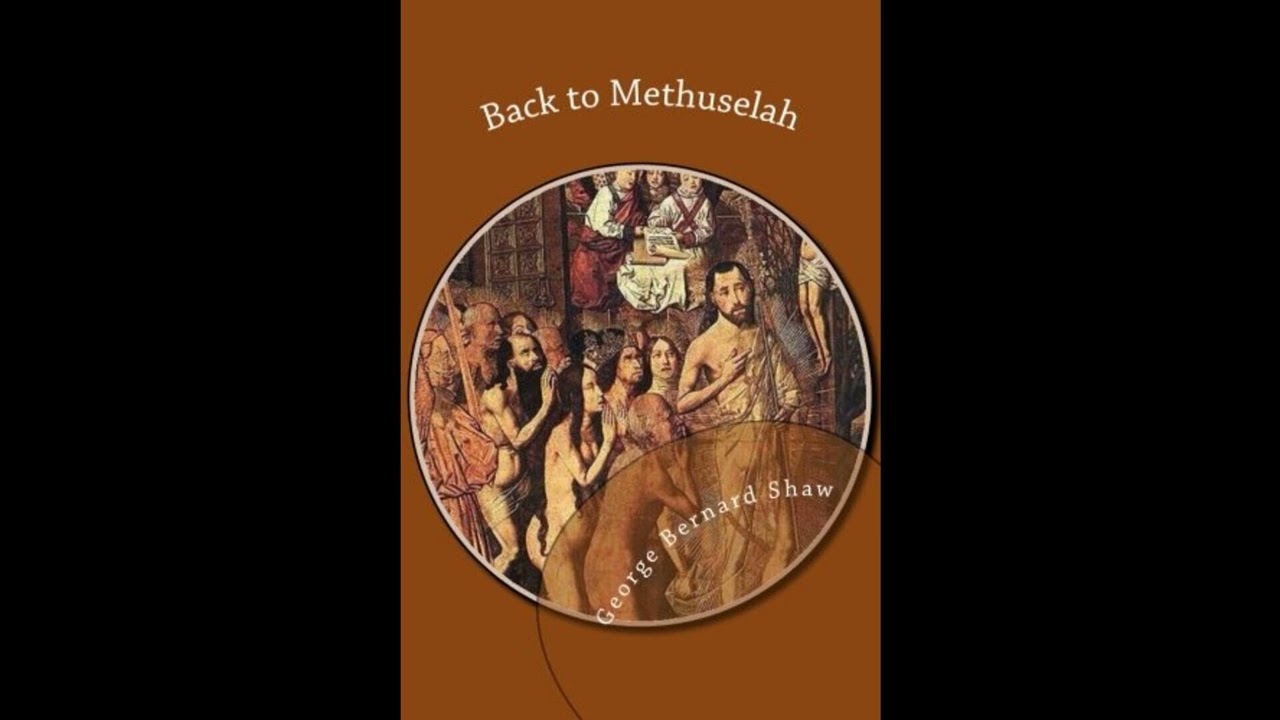
Back to Methuselah
George Bernard Shaw's Back to Methuselah stands as one of the most audacious and intellectually ambitious theatrical works ever conceived in the English language. This sprawling "metabiological pentateuch" is far more than a simple play; it is a profound meditation on the very trajectory of human existence, stretching across tens of thousands of years from the Garden of Eden to the unimaginable future of 31,920 AD. Shaw challenges us to consider our biological limitations, our capacity for evolution, and the fundamental question of whether humanity possesses the inherent wisdom and foresight to govern itself, or if our brief lifespans condemn us to repeat the same follies. In an era grappling with accelerating technological change, questions of longevity, and the existential threats posed by our own creations, Shaw's grand experiment in speculative drama resonates with unsettling power, inviting us to contemplate our species' ultimate destiny and our potential to transcend our current selves. The narrative unfolds in five distinct plays, beginning "In the Beginning" in the Garden of Eden. Here, we meet Adam and Eve, grappling with the mysteries of life, death, and the genesis of murder through the tragic figure of Cain. This initial part establishes Shaw’s premise that the fear of death, born of limited life, created a fundamental flaw in human nature, and that a longer life might lead to greater understanding. The story then leaps forward to 1920 with "The Gospel of the Brothers Barnabas," introducing two elderly gentlemen who propose a revolutionary idea: humanity can, through sheer willpower and a conscious act of creative evolution, extend its own lifespan to hundreds, even thousands, of years. This notion, rooted in Lamarckian ideas, ignites furious debates among politicians, clerics, and the public, all reacting with skepticism or alarm to a concept that would fundamentally reshape society. "The Thing Happens" fast-forwards to 2170, where the prophecies of the Barnabas brothers have begun to materialize. Individuals are discovered who have, seemingly spontaneously, achieved vastly extended lifespans, creating a new, long-lived class of "Ancients" who possess immense patience and perspective, clashing sharply with the still short-lived majority. The subsequent play, "Tragedy of an Elderly Gentleman," takes us to the year 3000 AD. By this point, society is profoundly divided, with the long-livers having largely retreated to an autonomous community in Ireland, while the remaining short-livers – primarily politicians and businessmen – struggle to comprehend the advanced intellect and serene detachment of their evolved counterparts. An "Elderly Gentleman," representing the limited perspective of his kind, undertakes a poignant pilgrimage to witness the long-livers, a journey that highlights the vast chasm between the two branches of humanity. The cycle culminates "As Far as Thought Can Reach," set in 31,920 AD, where humanity has undergone a radical transformation, shedding its physical form, its youth, and its emotional attachments to become pure, disembodied intellects, constantly meditating on the universe. George Bernard Shaw, born in Dublin, Ireland in 1856, moved to London in 1876 and became one of the most influential cultural figures of his age. Initially a struggling novelist, he found his voice as a music and theatre critic, known for his sharp wit and provocative opinions. His commitment to Fabian Socialism deeply informed his work, leading him to use the stage as a platform for social critique and intellectual debate. Shaw was a prolific playwright, penning over 60 plays, including such enduring works as Pygmalion, Man and Superman, and Saint Joan. He redefined British theatre, moving it away from Victorian melodrama towards a more intellectually rigorous form of drama, often filled with incisive social commentary and brilliant, rapid-fire dialogue. Shaw's impact extended far beyond the theatre; he was a public intellectual, a vocal proponent of various causes, from women's suffrage to vegetarianism, and a recipient of the Nobel Prize in Literature in 1925, which he initially considered refusing. His plays consistently interrogated societal norms, hypocrisy, and the conventional wisdom of his time. He saw drama not just as entertainment but as a powerful tool for philosophical inquiry and moral persuasion. By the time of his death in 1950, Shaw had established himself as a towering figure in English literature, second only to Shakespeare in his lasting dramatic influence and his ability to hold a mirror up to humanity's foibles and potential. Central to Back to Methuselah is Shaw's concept of "Creative Evolution," a philosophical alternative to Darwinian natural selection. Shaw posited that life itself possesses an intelligent will, a "Life Force," capable of directing its own evolution. This idea is explicitly introduced by the Barnabas brothers, who argue that humans can consciously will themselves to live longer, shedding the perceived handicap of a short lifespan. The later plays then offer a dramatic demonstration of this theory, as characters indeed begin to achieve extended lifespans, transforming society and altering the very definition of humanity. Shaw uses this premise to investigate the limitations imposed by a short life, suggesting that our brief existence prevents us from developing the necessary wisdom, foresight, and patience to effectively govern ourselves or solve the world's most complex problems. The short-lived politicians in "The Gospel of the Brothers Barnabas" illustrate this perfectly, reacting with predictable, myopic self-interest and an inability to grasp the long-term implications of the Barnabas's proposals. Another significant theme is the evolving nature of intelligence and the purpose of human existence. As humanity progresses through the millennia, it gradually sheds physical form, youthful passions, and even individuality, striving towards pure intellect and abstract thought. The "Ancients" in the distant future view physical existence as a mere apprenticeship, a distraction from the true business of consciousness. This raises profound questions about what constitutes progress, whether our emotional and physical selves are ultimately hindrances to our highest potential, and what kind of ultimate reality humanity is striving towards. Shaw's incisive political satire also shines through, particularly in the interactions between the short-lived humans and the long-livers, or in the initial public and governmental reactions to the idea of longevity. He exposes the vanity, short-sightedness, and often absurd rituals of human politics and social structures, satirizing the inherent flaws in systems run by beings destined for a quick demise. This visionary work was written and published in the immediate aftermath of World War I, appearing in 1921. The Great War had shattered many illusions about human progress and rationality, leaving a profound sense of disillusionment across Europe. Shaw, a committed pacifist and social critic, saw the war as a catastrophic failure of human governance, directly attributable to the short-sightedness and limited capacity for wisdom he believed inherent in beings with lifespans of merely seventy years. He felt that humanity, despite its scientific and technological advancements, was morally and intellectually stagnant. Back to Methuselah emerged as Shaw's radical answer to this crisis: a desperate, yet optimistic, plea for humanity to evolve beyond its current limitations, to literally live long enough to gain true wisdom. It was a bold intervention into the cultural and scientific debates of the time, challenging not only Darwinian orthodoxy but also the prevailing despair by proposing a path towards a fundamentally improved human future. Listening to Back to Methuselah as an audiobook offers a truly exceptional way to engage with Shaw's expansive vision. As a play of ideas, its power lies primarily in its eloquent dialogue and complex philosophical debates, making it perfectly suited for the spoken word. A skilled narrator brings clarity to Shaw's often lengthy speeches and intellectual arguments, distinguishing the many characters and their unique perspectives across the millennia. The extended run length of several hours allows the listener to become fully immersed in Shaw's meticulously crafted universe, absorbing the gradual progression of human evolution and the profound shifts in societal understanding. The pacing, voice, and atmosphere created by a good performance elevate the experience, transforming a challenging text into a vivid, thought-provoking journey through the past, present, and imagined future of humankind. You can simply relax and let Shaw's brilliant, often witty, prose wash over you, allowing his challenging ideas to germinate in your mind.
Enjoyed Back to Methuselah? A few ways to support us
Audible & Amazon links are affiliate; we may earn a small commission at no extra cost.
About this production
Human narration by a volunteer reader from LibriVox.org, the public-domain audiobook project. LibriVox volunteers record literary works whose copyright has expired in the United States, releasing the resulting recordings into the public domain.
Back to Methuselah by George Bernard Shaw. The underlying text is in the U.S. public domain. We do not republish any modern copyrighted edition, translation, or commentary.
The 4K cinematic visuals accompanying this audiobook are generated by an AI image model from prompts derived from the source text. No copyrighted photos, paintings, or stock footage are used. AI generation is disclosed on every video on our YouTube channel as required by YouTube's altered/synthetic content policy.
English subtitles are transcribed from the LibriVox recording with OpenAI Whisper. Translations into the 11 other supported languages are produced by Meta's NLLB-200 neural translation model. No human translator's copyrighted translation is used.
Questions about sourcing or rights? See our DMCA & Sourcing policy or contact us.
Enjoyed this audiobook?
If you'd like to own a copy of Back to Methuselah or hear a professionally produced edition, the links below help support free audiobook production at no extra cost to you.
As an Amazon Associate we earn from qualifying purchases. Audible / print links are affiliate.