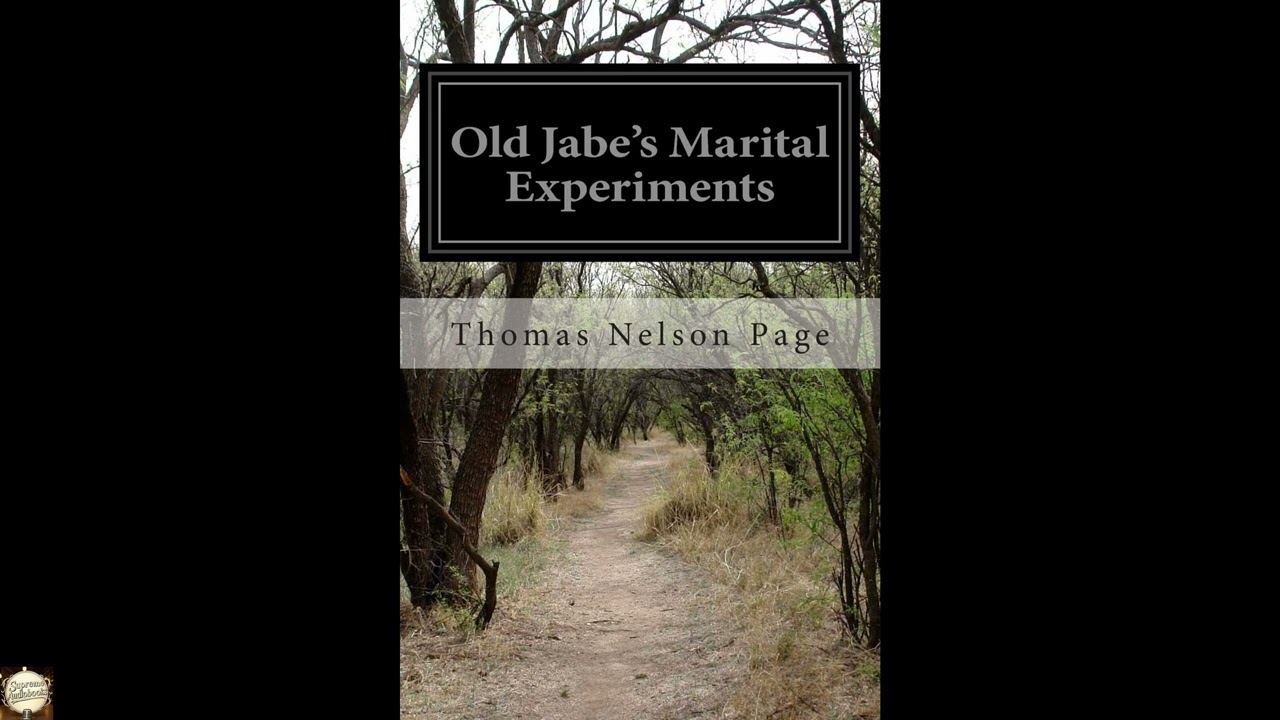
Old Jabe's Marital Experiments
Step into the twilight years of the nineteenth-century American South with "Old Jabe's Marital Experiments," a nuanced and often humorous look at life after the Civil War through the eyes of a unique character. Thomas Nelson Page, a prominent voice of his era, offers a story that, despite its period trappings and sometimes challenging perspectives, remains a valuable document of a society in flux. It presents a world grappling with new freedoms and old habits, where the universal human desire for companionship unfolds against a backdrop of profound social change. For the listener interested in the complexities of Southern literature, the evolution of racial representation, and the enduring quest for love, this audiobook provides a window into a specific cultural moment, prompting reflection on how far we have come—and perhaps, how far we still have to go. The narrative transports listeners to a post-Civil War Virginia plantation, a landscape forever altered yet still bearing the imprints of its past. Here we meet Old Jabe, a formerly enslaved man who, though now free, has chosen to remain on the land where he has spent his life, continuing to work for his former owner, Mars’ Jeems. Jabe is a character of profound simplicity and profound will, his thoughts often a delightful tangle of logic shaped by decades of observation and a fiercely independent spirit. The central premise blossoms when Jabe, in his advanced years, determines that he needs a wife. This decision, seemingly straightforward, becomes anything but as Jabe approaches the institution of marriage with a methodical, almost scientific, zeal. His "experiments" involve a series of attempts to secure a suitable partner, each one revealing more about Jabe's perception of domestic bliss, the expectations placed upon women, and the practical realities of managing a household. From the bustling community gossip that surrounds his courtships to the various, often comical, predicaments he finds himself in, Jabe's quest becomes a mirror reflecting the broader community. Mars’ Jeems, Jabe’s former master, observes these marital endeavors with a mixture of amusement, exasperation, and a paternalistic affection, providing a contrasting perspective that highlights the shifting relationship dynamics between formerly enslaved people and their white counterparts in the Reconstruction era. The story follows Jabe through these successive marital ventures, each one adding another layer to his evolving, if sometimes misdirected, understanding of companionship and home. Thomas Nelson Page (1853-1922) was a significant, albeit often controversial, literary figure of the American South. Born into an aristocratic Virginia family, Page grew up amidst the destruction of the Civil War and the subsequent Reconstruction era, experiences that profoundly shaped his worldview and his writing. Trained as a lawyer, he practiced in Richmond for many years before his literary success allowed him to devote himself fully to writing. Page became one of the most prominent exponents of the "plantation tradition" in Southern literature, a genre characterized by its nostalgic portrayal of the antebellum South and its often romanticized depiction of relations between white slaveholders and enslaved people. His career saw the publication of numerous short stories and novels, many of which first appeared in popular magazines of the day. Works like "Marse Chan" and "Meh Lady," collected in "In Ole Virginia," established his reputation for rendering Southern dialect and capturing the supposed charm of a bygone era. Later in his life, Page served as the U.S. ambassador to Italy during World War I, a testament to his prominence beyond the literary sphere. While his work is often criticized today for its racial stereotypes and its tendency to idealize a problematic past, Page remains an essential figure for understanding the literary and cultural landscape of the late nineteenth and early twentieth centuries, providing insight into how many white Southerners processed the profound changes of their time. "Old Jabe's Marital Experiments" enacts several important themes, offering a window into its historical moment. Foremost is the changing social order of the Reconstruction era. Jabe's freedom to choose a spouse, and indeed his very pursuit of one, represents a significant departure from his former condition. Yet, the ongoing presence of Mars’ Jeems and the enduring social hierarchies complicate this freedom, showing that while legal status changed, long-standing relationships and expectations often lingered. We see this in the subtle ways Jabe still seeks Mars’ Jeems’ advice, or in the community’s reactions, which often reflect ingrained assumptions about class and race. Another central theme is the universal desire for love and companionship, particularly as one ages. Jabe’s "experiments" are, at their heart, a deeply human quest for connection, warmth, and the simple comfort of shared domesticity. His determined, almost philosophical, approach to finding a wife, despite his age and the community’s sometimes mocking glances, speaks to a resilience of spirit and a fundamental need that transcends his circumstances. Furthermore, the story indirectly touches upon humor and resilience in the face of adversity. The narrative, while sometimes using humor that might seem uncomfortable to modern readers, also portrays the sheer determination of people adapting to dramatically altered realities, finding pockets of joy and meaning in their day-to-day lives, even when those efforts yield unexpected results. The cultural and political climate in which Thomas Nelson Page wrote "Old Jabe's Marital Experiments" was defined by the aftermath of the Civil War and the turbulent period of Reconstruction. The nation was grappling with the abolition of slavery, the reunification of North and South, and the struggle to define the status of formerly enslaved people. In the South, this era saw the dismantling of the plantation system, economic hardship, and a powerful desire among many white Southerners to romanticize the antebellum period. This sentiment gave rise to the "Lost Cause" narrative, which sought to portray the Confederacy in heroic terms and slavery as a benign institution. Literarily, this was the heyday of local color writing, a movement that sought to capture the distinct dialects, customs, and landscapes of particular regions, often in response to the rapid industrialization and standardization occurring across the country. Page was a master of this form, using dialect extensively to portray his characters. His work, including this story, often served to reinforce certain prevailing ideas about the South—ideas that simultaneously celebrated its traditions and struggled to confront the injustices of its past. "Old Jabe's Marital Experiments" thus emerged from a desire to tell stories of the "New South" through the lens of figures from the "Old South," often with a blend of nostalgia and a certain paternalistic affection for his Black characters. Listening to "Old Jabe's Marital Experiments" as an audiobook offers an immersive experience, especially given Page's reliance on dialect and conversational narrative styles. The performer's voice becomes crucial in conveying the distinct rhythms of Southern speech, bringing to life the individual cadences of Old Jabe, Mars’ Jeems, and the various community members who populate the story. The run length, several hours, makes it suitable for extended listening sessions, allowing the listener to settle deeply into the rural setting and its unique social dynamics. A skilled narrator will underscore the humor, the occasional pathos, and the underlying complexities of the relationships, ensuring that the dialogue, often central to the characterization, rings true. This auditory presentation allows for a richer appreciation of the atmosphere, transporting the listener directly into the specific time and place Page sought to preserve, making the journey through Jabe's determined quest for companionship all the more vivid and immediate.
Enjoyed Old Jabe's Marital Experiments? A few ways to support us
Audible & Amazon links are affiliate; we may earn a small commission at no extra cost.
About this production
Human narration by a volunteer reader from LibriVox.org, the public-domain audiobook project. LibriVox volunteers record literary works whose copyright has expired in the United States, releasing the resulting recordings into the public domain.
Old Jabe's Marital Experiments by Thomas Nelson Page. The underlying text is in the U.S. public domain. We do not republish any modern copyrighted edition, translation, or commentary.
The 4K cinematic visuals accompanying this audiobook are generated by an AI image model from prompts derived from the source text. No copyrighted photos, paintings, or stock footage are used. AI generation is disclosed on every video on our YouTube channel as required by YouTube's altered/synthetic content policy.
English subtitles are transcribed from the LibriVox recording with OpenAI Whisper. Translations into the 11 other supported languages are produced by Meta's NLLB-200 neural translation model. No human translator's copyrighted translation is used.
Questions about sourcing or rights? See our DMCA & Sourcing policy or contact us.
Enjoyed this audiobook?
If you'd like to own a copy of Old Jabe's Marital Experiments or hear a professionally produced edition, the links below help support free audiobook production at no extra cost to you.
As an Amazon Associate we earn from qualifying purchases. Audible / print links are affiliate.