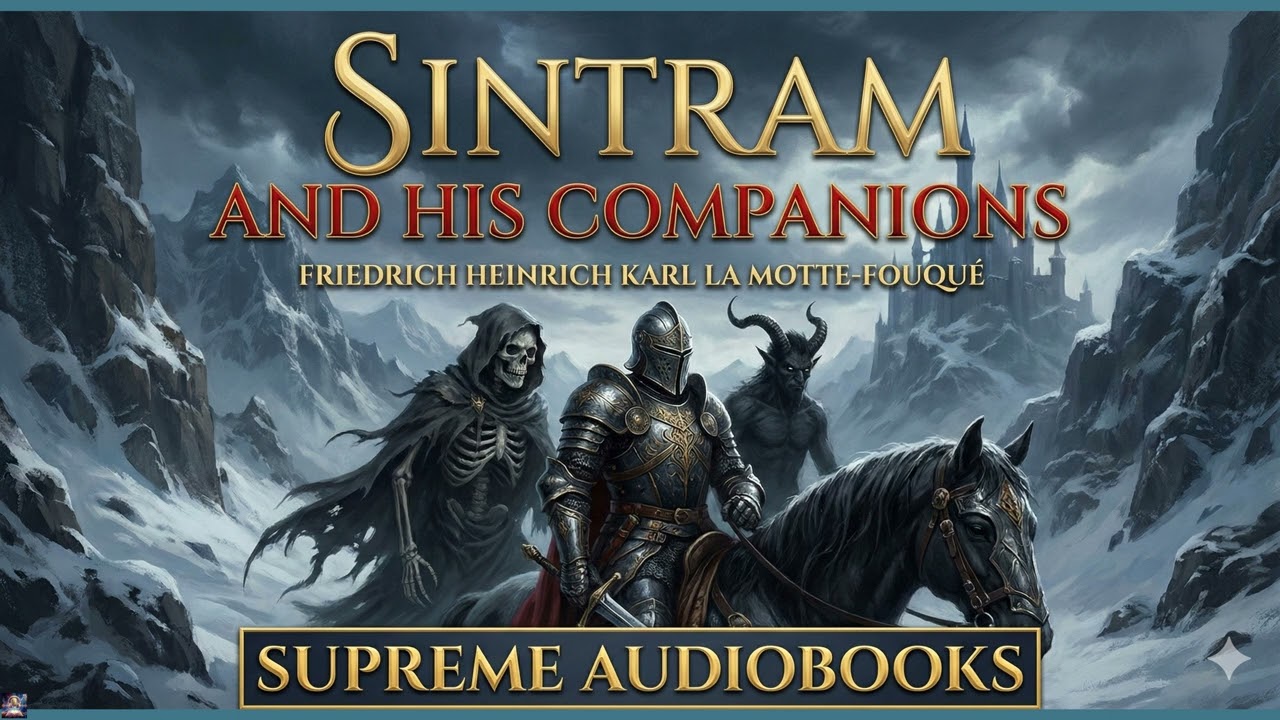
Sintram and his Companions
"Sintram and his Companions" reaches out from the early 19th century, a powerful and often unsettling work of German Romanticism that still speaks profoundly to our modern anxieties. More than a simple tale of knights and castles, this is a deep dive into the human soul’s eternal battle against its own shadows, a struggle for virtue in a world besieged by temptation and despair. Friedrich de la Motte-Fouqué, the author, gives us a compelling, allegorical narrative that feels as relevant now as it did when first published, questioning the nature of evil, the path to redemption, and the enduring power of faith amidst overwhelming darkness. This isn't just a historical curiosity; it's a resonant psychological drama wrapped in the grand, mythical cloak of medieval romance, demanding attention from anyone who ponders the forces that shape our moral lives. The story unfolds in a rugged, mystical Northland, where snow-capped peaks give way to dark, ancient forests and windswept castles. We meet Sintram, the young son of the stern Prince Biorn and the gentle Princess Verena, a youth burdened by a profound internal conflict. From his father's lineage, Sintram inherits a formidable, almost wild nature, a fierce temper, and a propensity for dark visions that plague his waking hours and dreams. Yet, from his mother, he possesses a tender heart and a yearning for purity and spiritual peace. This dual inheritance sets the stage for a dramatic internal war, where Sintram must contend with both the external dangers of his world and the more insidious threats lurking within his own psyche. Sintram's world becomes more complicated with the arrival of Folko von Montfaucon, a brave and virtuous knight, and his beautiful wife, Gabriele. Gabriele, with her ethereal grace and unwavering goodness, becomes an idealized figure in Sintram's troubled mind, inspiring him towards nobility and self-control. However, her presence also intensifies his inner turmoil, as his forbidden admiration for her fuels a powerful tension between earthly desire and spiritual aspiration. Throughout his life, Sintram is haunted by enigmatic, supernatural figures: the "Little Master," a seductive, demonic presence who whispers doubts and urges him towards sin, and the "Death-Knight," a formidable, silent specter. These figures are not mere external antagonists but seem to materialize from Sintram's deepest fears and darkest impulses, constantly testing his resolve and challenging his commitment to the path of righteousness. His arc sees him grow from a tormented youth, struggling with an uncontrollable temper and violent urges, into a knight repeatedly tested by trials both mundane and miraculous. His quest is less about external conquests—though moments of chivalric action do punctuate the narrative—and more about the mastery of his own soul. He grapples with temptation, despair, and the constant lure of his baser instincts, trying to reconcile his wildness with his yearning for virtue. The story builds with relentless atmospheric pressure, each encounter with the supernatural pushing Sintram closer to a pivotal moment of choice, where he must finally confront the darkness within and without, striving for spiritual peace amidst the world's dangers. The author of this unique tale was Friedrich Heinrich Karl La Motte-Fouqué, born in Brandenburg, Prussia, in 1777, and passing away in 1843. A descendant of a noble Huguenot family, Fouqué lived a life that mirrored some of the Romantic ideals he championed. He served in the Prussian military during the Napoleonic Wars, an experience that undoubtedly shaped his understanding of courage, duty, and the stark realities of conflict, elements often reflected in his tales of chivalry. Fouqué emerged as a significant voice within the German Romantic movement, which flourished in the early 19th century. His literary output was extensive, characterized by a deep fascination with medieval sagas, Norse mythology, and chivalric codes. While his novella "Undine," a poignant story of a water spirit, remains his most widely recognized contribution to literature, "Sintram and his Companions," published in 1815, reveals a more robust, darker, and philosophically ambitious facet of his genius. This work is often considered a more mature and profoundly allegorical extension of his Romantic sensibilities, showing his capacity to plumb the depths of psychological and spiritual conflict, setting him apart in a literary landscape populated by figures like Novalis and E.T.A. Hoffmann. One of the central themes in "Sintram" is the profound inner struggle and psychological conflict faced by its protagonist. Sintram's "wild blood" and recurring dark visions are not merely plot devices; they are manifestations of his internal battle against his own base desires and violent urges. For instance, his encounters with the "Little Master" can be seen not just as meetings with an external devil, but as confrontations with the personified elements of his own destructive tendencies—the doubt, the despair, the tempting whisper of self-abandonment. He constantly fights to rein in his temper and chooses the path of difficult virtue over easy vice, highlighting the perpetual human struggle for self-mastery. Related to this is the theme of redemption versus temptation. Sintram is relentlessly assailed by forces that seek to lead him astray, epitomized by the seductive cunning of the "Little Master" and the ominous presence of the "Death-Knight." These dark figures present alluring alternatives to virtue, promising power or release from suffering. Yet, characters like Gabriele, and later a wise Monk, offer paths to spiritual salvation, representing purity, guidance, and the possibility of grace. Sintram’s repeated falls and his subsequent, often arduous, efforts to rise again and pursue a higher path illustrate the Christian allegorical framework that underpins the narrative, emphasizing forgiveness and the enduring power of repentance. The period in which "Sintram and his Companions" was conceived and published, the early 1810s, was a time of immense political and cultural ferment in Europe, particularly in Germany. The Napoleonic Wars had redrawn maps and shattered old orders, leading to a profound sense of national identity and a yearning for a unique German cultural voice. Against this backdrop of upheaval, the German Romantic movement flowered, reacting against the rationalism and perceived coldness of the Enlightenment. This era saw a renewed interest in folklore, mythology, and the medieval past, not merely for historical accuracy, but as sources of spiritual truth and national character. Writers like Fouqué sought to re-enchant the world, to find meaning and heroism in myth and legend, often blending elements of the supernatural with an idealized vision of chivalry. "Sintram" perfectly embodies this Romantic sensibility, combining a reverence for medieval ideals with a profound psychological depth and an exploration of the numinous, reflecting the era's desire to find grander narratives and spiritual anchors in a rapidly changing world. It was a reaction, too, to a growing industrialization and secularization, an attempt to retain a sense of the magical and the sacred in everyday life. To experience "Sintram and his Companions" as an audiobook is to surrender to its unique atmosphere and let its allegorical power wash over you. The story’s atmospheric descriptions of a wild, ancient land, its philosophical dialogues, and Sintram's intense internal monologues are perfectly suited for the auditory medium. A skilled narrator can bring to life the complex nuances of Sintram's conflicted voice, the insidious whispers of the "Little Master," and the calming wisdom of spiritual guides, transforming the text into a truly immersive drama. With a listening time of several hours, this work offers a substantial yet manageable experience, ideal for focused listening sessions or for accompaniment during daily routines. Listen for the deliberate, dreamlike pacing that draws you into its mystical world, punctuated by moments of acute psychological drama and chilling supernatural encounters. The narration can highlight the rich symbolism, allowing the listener to truly grasp the weight of Sintram's struggle and the moral stakes of his unfolding destiny.
Enjoyed Sintram and his Companions? A few ways to support us
Audible & Amazon links are affiliate; we may earn a small commission at no extra cost.
About this production
Human narration by a volunteer reader from LibriVox.org, the public-domain audiobook project. LibriVox volunteers record literary works whose copyright has expired in the United States, releasing the resulting recordings into the public domain.
Sintram and his Companions by Friedrich Heinrich Karl La Motte-Fouque. The underlying text is in the U.S. public domain. We do not republish any modern copyrighted edition, translation, or commentary.
The 4K cinematic visuals accompanying this audiobook are generated by an AI image model from prompts derived from the source text. No copyrighted photos, paintings, or stock footage are used. AI generation is disclosed on every video on our YouTube channel as required by YouTube's altered/synthetic content policy.
English subtitles are transcribed from the LibriVox recording with OpenAI Whisper. Translations into the 11 other supported languages are produced by Meta's NLLB-200 neural translation model. No human translator's copyrighted translation is used.
Questions about sourcing or rights? See our DMCA & Sourcing policy or contact us.
Enjoyed this audiobook?
If you'd like to own a copy of Sintram and his Companions or hear a professionally produced edition, the links below help support free audiobook production at no extra cost to you.
As an Amazon Associate we earn from qualifying purchases. Audible / print links are affiliate.