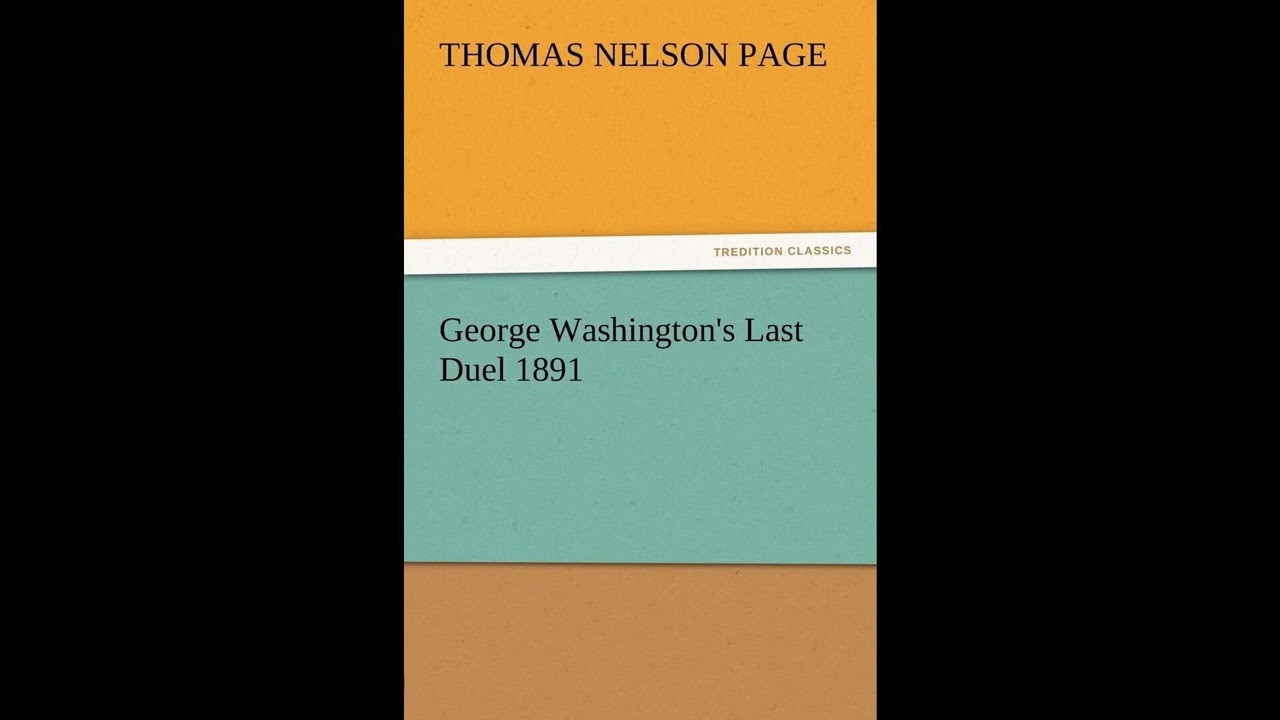
George Washington's Last Duel 1891
For a book titled George Washington's Last Duel 1891, listeners are immediately drawn into a compelling paradox. How could the revered Father of His Country, who died in 1799, participate in a duel nearly a century later? This intriguing question lies at the heart of Thomas Nelson Page's classic tale, offering not a forgotten historical footnote, but a powerful exploration of American myth, Southern honor, and the enduring shadows of the past. Published in an era when the nation was still wrestling with its foundational narratives and the raw wounds of civil conflict, this story asks us to consider how the spirit of a bygone age continues to shape the present, and how personal integrity can be tested against the grand sweep of history. It's a tale that challenges assumptions, invites speculation, and resonates today with anyone who understands the weight of legacy. The story opens in the twilight of the nineteenth century, precisely 1891, in the quiet, reflective mind of an elderly Southern gentleman, Colonel Richard Thorne. His days are spent in the grand but fading halls of his ancestral home, a testament to a world now lost. One rain-swept evening, spurred by a conversation about family honor and historical precedent, Colonel Thorne recounts a singular, almost unbelievable incident from his youth, one whispered about in hushed tones for decades. The narrative transports the listener back to the antebellum South, a time of rigid social codes and deeply ingrained traditions, where a perceived slight could escalate into a matter of life and death. The central conflict arises when a young, impetuous kinsman of the Colonel, a man named George Washington—a direct descendant of the legendary figure and bearing his illustrious name—finds his honor, and that of his beloved, grievously impugned by a cynical and influential rival. Bound by the strictures of Southern chivalry and the immense weight of his family name, young Washington feels he has no recourse but to issue a challenge. The impending duel is not merely a clash between two men; it is a collision of ideals, a confrontation where the very notion of Southern character and the legacy of its heroes are put to the ultimate test. As the fateful morning approaches, the tension mounts, drawing in the entire community and forcing them to confront the true meaning of courage, sacrifice, and the often-perilous pursuit of an abstract ideal. The story builds to a dramatic peak on the field of honor, a scene shrouded in mist and moral ambiguity, leaving an indelible mark on all who witness or hear of it. Thomas Nelson Page, born in 1853 on a Virginia plantation, experienced the Civil War and its tumultuous aftermath firsthand as a young boy. His formative years were spent amidst the grand traditions of the Old South and the subsequent devastation and social upheaval of Reconstruction. Trained as a lawyer, Page soon found his true calling in literature, becoming one of the most prominent voices of the "plantation tradition" in American letters. His work often romanticized the antebellum South, portraying a genteel society populated by chivalrous gentlemen, gracious ladies, and, controversially, loyal, contented enslaved people. Page's literary career truly blossomed with the publication of his short stories, most notably "Marse Chan" in 1884, and later expanded to novels like Red Rock (1898). His writing style, characterized by its nostalgic tone and use of dialect, aimed to preserve what he perceived as the virtues and beauty of a lost era. Beyond his literary pursuits, Page served his country as the United States Ambassador to Italy during President Woodrow Wilson's administration, a testament to his prominence in American public life. Despite the shifting historical perspectives that have critically re-evaluated his romanticized portrayal of the South, Page remains a significant figure in American literature, a key voice reflecting the sentiments and struggles of a region grappling with its past. This particular story masterfully enacts several resonant themes. Foremost among them is the pervasive and often rigid code of honor that defined the Southern gentleman. The willingness of young George Washington to risk his life over a perceived slight, and the community's solemn acceptance of this decision, vividly illustrates how personal reputation and the defense of one's word were paramount, even above personal safety. The duel, though steeped in tragic potential, becomes a dramatic stage for displaying unwavering adherence to this deeply ingrained moral framework. Another significant theme is the enduring power of historical legacy and the weight of a legendary name. The protagonist’s very identity as "George Washington" is not merely a name but a burden and an inspiration. The story subtly suggests that in defending his own honor, he is also, in a symbolic sense, defending the honor and ideals associated with the nation's founder—a powerful link between personal conduct and national heritage. This intertwining of individual fate with historical memory offers a compelling study of how the past continuously informs and challenges the present, particularly in a society attempting to reconcile its glorious and tragic narratives. The late nineteenth century, when George Washington's Last Duel 1891 was published, was a period of immense change in America. The Civil War was a generation past, but its scars remained deep, particularly in the South. The official end of Reconstruction in 1877 had left the region to rebuild itself economically and socially, often clinging to romanticized visions of its past. This era saw the rise of the "Lost Cause" narrative, a cultural and historical movement that sought to reframe the Confederate cause and its figures in a noble, honorable light. Literarily, this period was marked by a growing interest in realism and naturalism, yet there was also a strong appetite for regional literature and historical fiction, especially stories that spoke to the Southern experience. Thomas Nelson Page's work fit perfectly into this landscape, offering readers, both North and South, a glimpse into a world that, while perhaps idealized, spoke to enduring questions of character, tradition, and the struggle to maintain identity amidst profound societal shifts. The story emerged as a reflection of its time, providing a mirror to a generation attempting to understand its present through the lens of a revered, yet often reinterpreted, past. Listening to George Washington's Last Duel 1891 as an audiobook offers a particularly immersive experience. The story, delivered in the reflective cadence of an older Southern voice, lends itself naturally to oral narration, inviting listeners into Colonel Thorne's drawing-room as if he were recounting the tale directly to them. The "several hours" run length is ideal for extended listening sessions, allowing the listener to truly settle into the unfolding narrative without interruption. A skilled narrator can bring out the precise, formal language of the era, the subtle Southern cadences, and the mounting tension of the dramatic scenes. Listen for the careful pacing that builds towards the confrontation, the nuanced voice characterizations that define each player, and the palpable atmosphere of honor, nostalgia, and impending fate that permeates every word, making a distant past feel intimately present.
Enjoyed George Washington's Last Duel 1891? A few ways to support us
Audible & Amazon links are affiliate; we may earn a small commission at no extra cost.
About this production
Human narration by a volunteer reader from LibriVox.org, the public-domain audiobook project. LibriVox volunteers record literary works whose copyright has expired in the United States, releasing the resulting recordings into the public domain.
George Washington's Last Duel 1891 by Thomas Nelson Page. The underlying text is in the U.S. public domain. We do not republish any modern copyrighted edition, translation, or commentary.
The 4K cinematic visuals accompanying this audiobook are generated by an AI image model from prompts derived from the source text. No copyrighted photos, paintings, or stock footage are used. AI generation is disclosed on every video on our YouTube channel as required by YouTube's altered/synthetic content policy.
English subtitles are transcribed from the LibriVox recording with OpenAI Whisper. Translations into the 11 other supported languages are produced by Meta's NLLB-200 neural translation model. No human translator's copyrighted translation is used.
Questions about sourcing or rights? See our DMCA & Sourcing policy or contact us.
Enjoyed this audiobook?
If you'd like to own a copy of George Washington's Last Duel 1891 or hear a professionally produced edition, the links below help support free audiobook production at no extra cost to you.
As an Amazon Associate we earn from qualifying purchases. Audible / print links are affiliate.