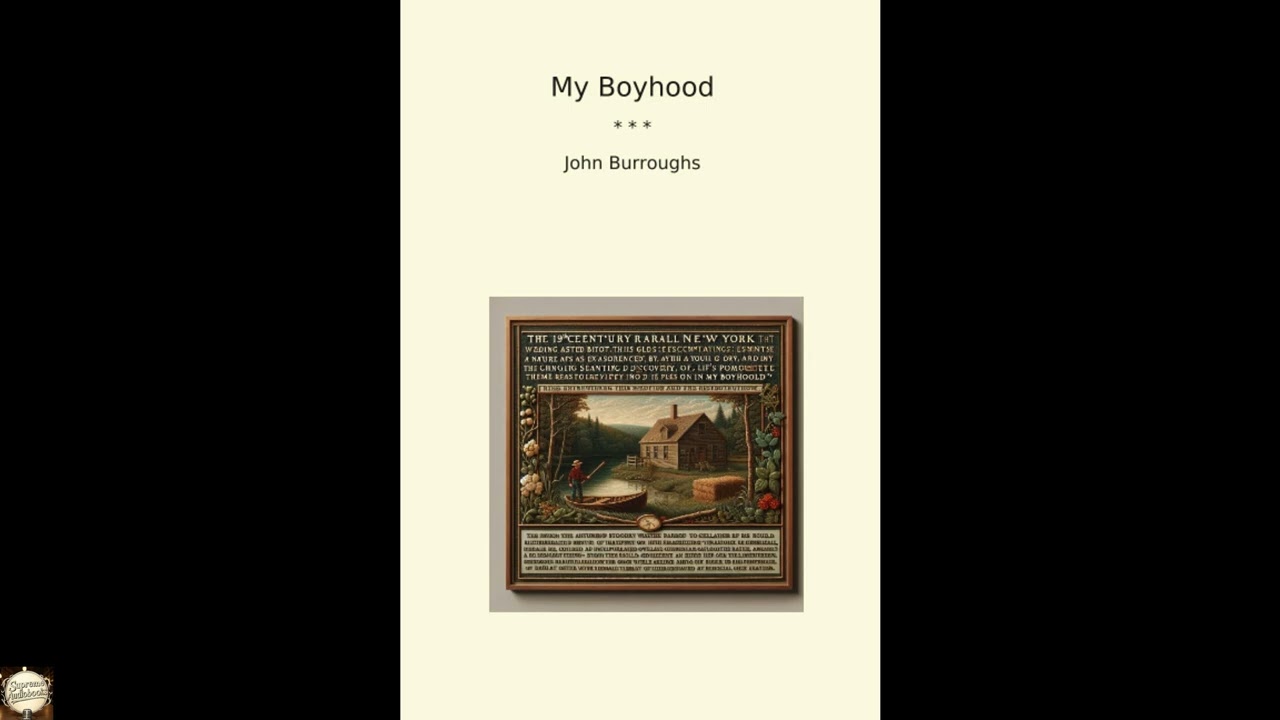
My Boyhood (Classic Books)
Step into a verdant, sun-drenched past with John Burroughs' My Boyhood, a cherished collection that offers more than just a glimpse into one man's formative years; it provides a profound connection to the natural world and a way of life that, while distant, resonates deeply with timeless truths. This isn't merely a memoir; it's an invitation to walk alongside one of America's most beloved naturalists as he recounts the simple, yet deeply impactful, experiences that shaped his soul and sharpened his unique vision. In an age of digital distraction and urban remove, Burroughs’ gentle prose acts as a restorative balm, reminding us of the enduring beauty and wisdom found in the rhythms of the earth, and why a childhood steeped in nature can forge a truly remarkable spirit. Set against the rugged, pastoral backdrop of the Catskill Mountains in nineteenth-century rural New York, My Boyhood immerses listeners in the daily realities of farm life through the eyes of a sensitive and observant young boy. We are introduced to the routines of the Burroughs family farm—the planting and harvesting, the care of animals, the simple joys and hardships that defined existence in an earlier era. The central character, the young John, isn't driven by grand ambitions or dramatic conflicts, but rather by an insatiable curiosity about the world around him. His days are filled with the quiet adventures of exploration: tracking wildlife through the woods, fishing in cold mountain streams, discovering the secret lives of birds and insects. The arc of the story isn't one of traditional narrative progression, but rather a lyrical unfolding of awareness and appreciation. We witness the boy's mind developing, learning to read the subtle signs of nature, understanding the interconnectedness of all living things. Each chapter, often a vignette or a series of reflections, paints a vivid picture of a particular season, a memorable encounter with an animal, or a specific farm task that instilled character. It's a testament to the power of environment in shaping identity, chronicling the subtle education that takes place when a child is left to his own devices in the wild, learning lessons far more profound than any textbook could impart. John Burroughs, born in 1837 in Roxbury, New York, grew to become one of America's most revered naturalists and essayists, leaving behind a substantial body of work that continues to inspire. His early life on the family farm, vividly recounted in My Boyhood, laid the foundation for a career dedicated to observing and interpreting the natural world. He began his professional life as a teacher, then worked for a time as a clerk in Washington D.C., where he formed a lasting friendship with the poet Walt Whitman, whose influence is subtly felt in Burroughs' clear, direct prose and his deep appreciation for the everyday. Later, Burroughs returned to the Hudson Valley, establishing his iconic Slabsides retreat, a rustic cabin where he wrote and hosted many notable figures of his time, including Theodore Roosevelt, Henry Ford, and Thomas Edison. Burroughs published over two dozen books, including seminal works such as Wake-Robin, his first major collection of nature essays, Birds and Poets, and Signs and Seasons. He was a pivotal figure in the burgeoning conservation movement of the late nineteenth and early twentieth centuries, advocating for the preservation of wild spaces and the appreciation of nature for its own sake. His writing style, often compared to that of Henry David Thoreau, possessed a unique blend of scientific precision and poetic lyricism, making him immensely popular with both general readers and serious naturalists. He carved out a distinct place in American letters as a voice of accessible wisdom and keen observation, bridging the gap between scientific study and literary art. Among the central themes running through My Boyhood is the profound connection to nature that shapes a young mind. Burroughs repeatedly illustrates how his experiences outdoors were his true education. For instance, he recounts hours spent observing a single bird's nest, patiently noting the parents' behaviors, the fledglings' growth, and the delicate dance of survival within the woods. These detailed observations were not just passive watching; they were active learning, instilling in him a deep respect for the intricate web of life. Another prominent theme is nostalgia for a lost world of rural simplicity and self-reliance. Burroughs describes the satisfaction of physical labor, the camaraderie of farmhands, and the intimate relationship between humans and the land, like when he recalls the specific scent of freshly cut hay or the taste of water from a cool spring, evoking a bygone era where life’s rhythms were inextricably tied to the seasons. The memoir also champions the value of quiet observation and solitude. Young John often sought out moments alone in the fields or by the stream, not out of loneliness, but to fully immerse himself in the natural symphony around him. He details how these solitary moments allowed him to notice the smallest details – a particular wildflower, an insect's burrow – fostering a contemplative spirit that would define his later writing. Finally, the book highlights education beyond the classroom, arguing that true wisdom often comes from direct experience. Burroughs rarely mentions formal schooling; instead, he emphasizes the lessons learned from chasing a fox, helping a cow calve, or simply sitting in silent contemplation of the stars. These experiences taught him patience, resilience, and a deep understanding of the natural laws governing life and death. My Boyhood emerged from a cultural moment in America marked by rapid industrialization and urbanization in the late nineteenth and early twentieth centuries. As cities grew and technology advanced, there was a growing yearning for the perceived purity and simplicity of rural life and the wilderness. Writers like Burroughs offered a vital antidote to the stresses of modernity, providing readers with literary escapes into serene natural settings. The era also saw the rise of the organized conservation movement, spurred by figures like President Theodore Roosevelt, who actively championed the preservation of natural resources. Burroughs’ writings contributed significantly to this movement, helping to cultivate a national appreciation for America's natural heritage and the importance of ecological stewardship, making his reflections on childhood in nature particularly resonant for a society grappling with its changing relationship to the land. To experience My Boyhood as an audiobook is to invite a tranquil and reflective presence into your day. With a running length of several hours, it offers ample opportunity for both concentrated listening and a more relaxed engagement, perfect for quiet evenings, long walks, or reflective moments. A skilled narrator's measured pacing and calm, clear voice can truly bring Burroughs' descriptive language to life, allowing the vivid imagery of the Catskill Mountains, the bustling farm, and the myriad creatures of the wild to unfold within your mind. Listen for the gentle shifts in tone as Burroughs transitions from detailed observations of nature to poignant reflections on childhood, and let the immersive atmosphere of his early years transport you to a simpler time, fostering a renewed appreciation for the world just beyond your window.
Enjoyed My Boyhood (Classic Books)? A few ways to support us
Audible & Amazon links are affiliate; we may earn a small commission at no extra cost.
About this production
Human narration by a volunteer reader from LibriVox.org, the public-domain audiobook project. LibriVox volunteers record literary works whose copyright has expired in the United States, releasing the resulting recordings into the public domain.
My Boyhood (Classic Books) by John Burroughs. The underlying text is in the U.S. public domain. We do not republish any modern copyrighted edition, translation, or commentary.
The 4K cinematic visuals accompanying this audiobook are generated by an AI image model from prompts derived from the source text. No copyrighted photos, paintings, or stock footage are used. AI generation is disclosed on every video on our YouTube channel as required by YouTube's altered/synthetic content policy.
English subtitles are transcribed from the LibriVox recording with OpenAI Whisper. Translations into the 11 other supported languages are produced by Meta's NLLB-200 neural translation model. No human translator's copyrighted translation is used.
Questions about sourcing or rights? See our DMCA & Sourcing policy or contact us.
Enjoyed this audiobook?
If you'd like to own a copy of My Boyhood (Classic Books) or hear a professionally produced edition, the links below help support free audiobook production at no extra cost to you.
As an Amazon Associate we earn from qualifying purchases. Audible / print links are affiliate.
![Children's Classics in Dramatic Form, Book Two. [1909] by Augusta Stevenson — free full audiobook](https://img.youtube.com/vi/h4bTKUeuO7U/maxresdefault.jpg)