Squirrels and Other Fur-Bearers
In an age often characterized by relentless digital noise and an increasing detachment from the natural world, there remains a profound human need for connection with the wild. John Burroughs's Squirrels and Other Fur-Bearers offers precisely that—a restorative invitation to slow down, observe, and rediscover the intricate lives unfolding just beyond our windows and beneath our feet. This collection of essays is more than just a historical curiosity; it is a timeless manual for looking closely, for finding wonder in the commonplace, and for fostering a deeper appreciation for the small, often overlooked creatures that share our planet. For anyone seeking a moment of quiet contemplation, a gentle reminder of nature's enduring presence, or simply a charming glimpse into the lives of the wilderness's busy inhabitants, Burroughs's unassuming wisdom continues to resonate with compelling clarity. The experience of Squirrels and Other Fur-Bearers is akin to joining Burroughs on a series of contemplative strolls through the woods and fields surrounding his home in the Hudson River Valley. The narrative unfolds not with a traditional plot, but through a sequence of vivid encounters and sustained observations. The "setting" is primarily the Northeast American landscape—its forests, orchards, and clearings—filtered through the author's perceptive eye across the seasons. The main characters are, of course, the various fur-bearers themselves: the nimble red squirrel, the industrious chipmunk, the secretive woodchuck, the cunning fox, and the elusive rabbit, among others. Each essay dedicates itself to an intimate portrait of a particular species, detailing their habits, their homes, and their interactions with their environment and with Burroughs himself. The central through-line of the book is Burroughs's patient, almost spiritual, quest to understand these animals on their own terms, to pierce the veil of human perception and glimpse their inner lives. There is no grand conflict in the conventional sense, but rather the subtle challenge of accurate observation—the effort to distinguish fact from popular myth, to track a fleeting movement, or to interpret a soft call. The "arc" of the story is the listener's own developing insight, guided by Burroughs's precise prose, into the rich complexities of these small lives. We witness the diligent nut-gathering of a squirrel preparing for winter, the playful antics of young chipmunks, and the silent vigilance of a fox on the hunt. Each observation builds upon the last, painting a composite picture of an ecosystem teeming with intelligence and purpose, often unnoticed by the hurried human world. John Burroughs, born in 1837 in the Catskill Mountains of New York, dedicated his life to interpreting the natural world for a burgeoning American audience. Growing up on a farm, he developed an early, profound connection to the land and its creatures. Though he briefly pursued a career as a teacher and even worked as a bank examiner in Washington D.C.—a role that surprisingly brought him into contact with Walt Whitman, whose literary secretary he became for a time—his true calling lay outdoors. Burroughs eventually returned to his native New York, settling on a farm near Esopus on the Hudson River, where he built a rustic cabin he called "Slabsides." It was here, and in his subsequent home, "Woodchuck Lodge" in Roxbury, that he produced the vast majority of his influential writings. Burroughs published over two dozen books of essays, beginning with Wake-Robin in 1871. His work played a significant role in popularizing nature writing in America, following in the tradition of Henry David Thoreau but presenting a more accessible and often more optimistic view of the wild. He was a close friend and companion to prominent figures such as Theodore Roosevelt and Henry Ford, often joining them on camping trips and advocating for conservation. Burroughs's literary contributions established him as a leading voice in American natural history and letters, making him one of the most widely read and beloved American authors of his era until his death in 1921. His work is generally associated with a realistic, observational approach to nature, a counterpoint to the more embellished "nature fakers" who emerged later. One of the prominent themes running through Squirrels and Other Fur-Bearers is the profound value of intimate observation. Burroughs repeatedly demonstrates how deep engagement with one's surroundings can reveal extraordinary detail in seemingly ordinary subjects. For instance, he meticulously describes the specific ways different squirrels carry and bury their nuts, or the particular chirps and scolds that punctuate a chipmunk's busy day. Through his patient watching, often over long periods, he uncovers the unique personalities and complex behaviors of each creature, inviting the listener to adopt a similar attentiveness in their own environment. This commitment to precise, sensory detail transforms simple descriptions into compelling insights. Another powerful theme is the interconnectedness of nature, subtly illustrated through the relationships Burroughs observes among the animals and their habitat. While he focuses on individual species, he never isolates them. He shows how the presence of a hawk influences the behavior of small mammals, or how the abundance of a certain berry crop impacts the winter survival of various fur-bearers. These essays emphasize that each creature plays a vital role within a larger, delicate system. Burroughs also articulates the theme of finding wonder in the ordinary, proving that one need not travel to exotic locales to encounter profound beauty and mystery. The common red squirrel or the humble field mouse, under Burroughs's gaze, become subjects of deep fascination and respect, reminding us that the extraordinary is often found in the accessible. This book emerged at a crucial juncture in American history, published at the turn of the twentieth century in 1900. The preceding decades had seen rapid industrialization and urbanization across the United States. Cities grew exponentially, railroads crisscrossed the continent, and technological advancements reshaped daily life. With this progress came a growing sense of detachment from the agrarian past and the natural world. In response, a cultural movement began to appreciate and conserve America's remaining wilderness and to encourage a reconnection with nature. Burroughs's writings, along with those of other naturalists like John Muir, provided accessible and engaging narratives that resonated with a public increasingly aware of environmental changes and longing for a simpler, more authentic experience of the land. His work built upon the legacy of earlier Transcendentalist thinkers like Ralph Waldo Emerson and Henry David Thoreau, but presented natural history in a more direct, less philosophical manner, appealing to a broader readership. Squirrels and Other Fur-Bearers perfectly encapsulated this spirit, offering concrete examples of the living world that could be found close to home, thus bridging the gap between scientific observation and popular appreciation. It contributed to a burgeoning conservation ethos and laid groundwork for the modern environmental movement by cultivating a sense of intimate stewardship and a profound admiration for the small wonders of the wild. Listening to Squirrels and Other Fur-Bearers as an audiobook transforms Burroughs's contemplative prose into an immersive aural experience. The gentle, measured pacing of a skilled narrator can perfectly capture the author's quiet observations, allowing the listener to absorb each detailed description and thoughtful reflection. The spoken word brings a warmth and immediacy to Burroughs's conversational style, making it feel as if he is speaking directly to you, sharing his discoveries from a quiet morning walk. The run length, several hours, is ideal for extended periods of focused listening or for breaking into shorter, meditative segments. It becomes a perfect companion for a walk in a local park, a drive through the countryside, or simply a quiet moment at home, allowing the narration to paint vivid pictures of rustling leaves, chattering animals, and the serene beauty of the natural world. The clarity of the narration can highlight Burroughs's precise vocabulary and the subtle rhythms of his sentences, drawing you deeper into his profound yet accessible world of discovery.
Enjoyed Squirrels and Other Fur-Bearers? A few ways to support us
Audible & Amazon links are affiliate; we may earn a small commission at no extra cost.
About this production
Human narration by a volunteer reader from LibriVox.org, the public-domain audiobook project. LibriVox volunteers record literary works whose copyright has expired in the United States, releasing the resulting recordings into the public domain.
Squirrels and Other Fur-Bearers by John Burroughs. The underlying text is in the U.S. public domain. We do not republish any modern copyrighted edition, translation, or commentary.
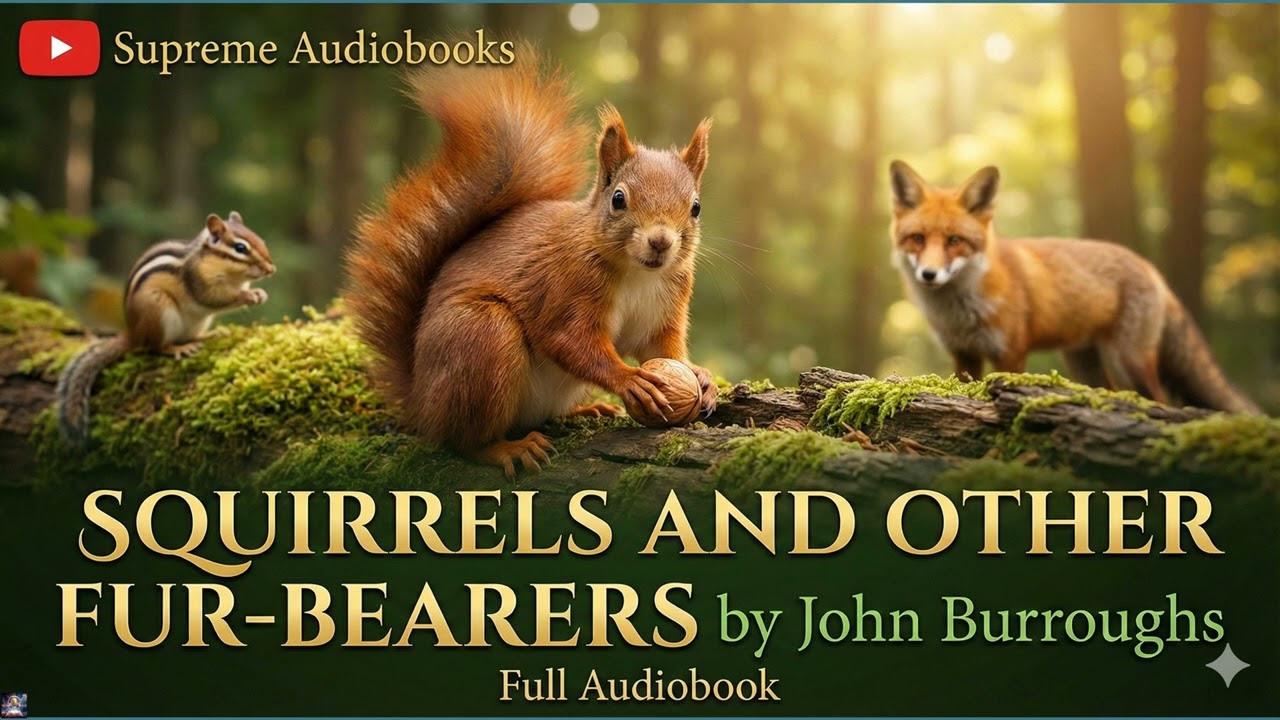
The 4K cinematic visuals accompanying this audiobook are generated by an AI image model from prompts derived from the source text. No copyrighted photos, paintings, or stock footage are used. AI generation is disclosed on every video on our YouTube channel as required by YouTube's altered/synthetic content policy.
English subtitles are transcribed from the LibriVox recording with OpenAI Whisper. Translations into the 11 other supported languages are produced by Meta's NLLB-200 neural translation model. No human translator's copyrighted translation is used.
Questions about sourcing or rights? See our DMCA & Sourcing policy or contact us.
Enjoyed this audiobook?
If you'd like to own a copy of Squirrels and Other Fur-Bearers or hear a professionally produced edition, the links below help support free audiobook production at no extra cost to you.
As an Amazon Associate we earn from qualifying purchases. Audible / print links are affiliate.