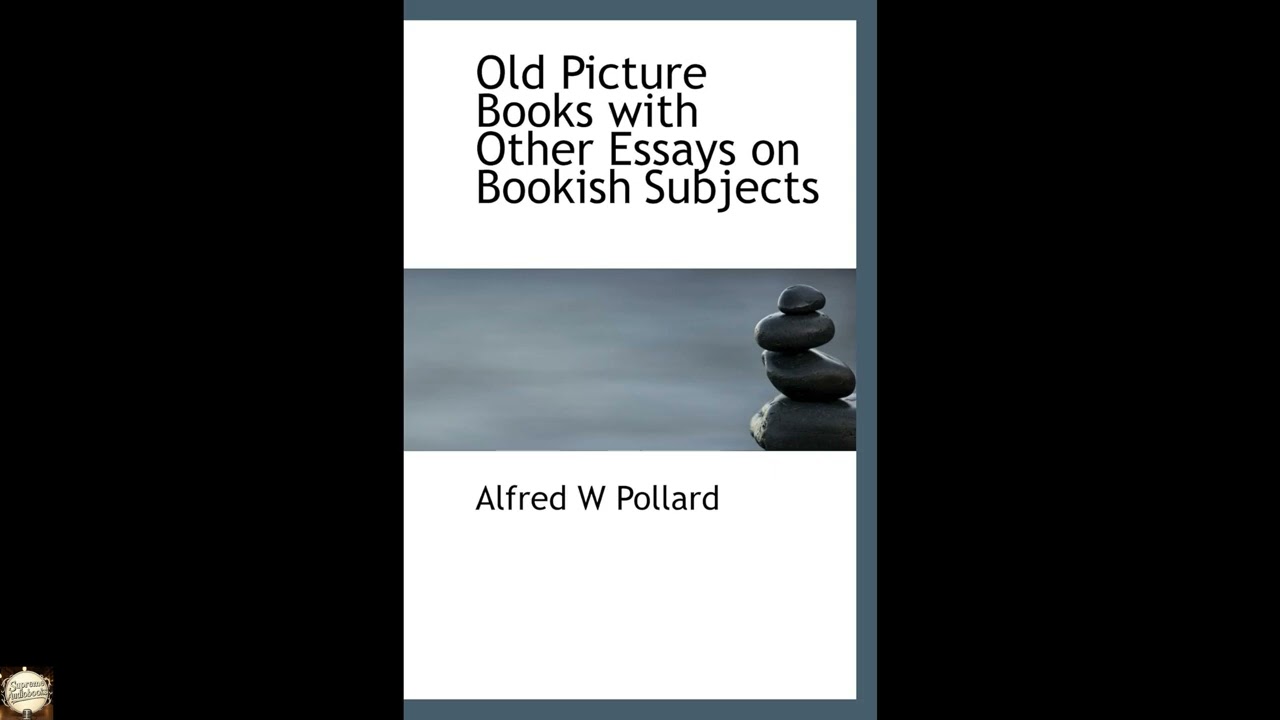
Old Picture Books with Other Essays on Bookish Subjects
Step into a world where books are not just carriers of stories, but stories themselves—objects of beauty, historical artifacts, and enduring testaments to human ingenuity. Alfred W. Pollard’s collection, Old Picture Books with Other Essays on Bookish Subjects, opens a rare window into this intricate realm, guided by one of the most distinguished bibliographers of the early twentieth century. This isn't merely a series of academic lectures; it’s an intimate conversation with a scholar whose profound love for the printed word breathes life into every page, illuminating the art, craft, and sometimes forgotten magic of early printing and illustration. For anyone who cherishes the tactile pleasure of a well-made book, who ponders the evolution of visual storytelling, or who finds satisfaction in the meticulous uncovering of historical truths, Pollard offers a rich and rewarding intellectual experience that resonates with contemporary concerns about preservation and access in the digital age. Instead of a traditional narrative arc, Pollard’s work unfolds as a scholarly expedition through the history and aesthetics of the book. The journey begins with a focused examination of early picture books, particularly those from the fifteenth and sixteenth centuries, unraveling the techniques of woodcut illustration and their profound impact on the visual culture of the nascent print era. We encounter the anonymous craftsmen whose hands carved the images, the printers who brought them to life, and the readers who first encountered these novel combinations of text and image. Pollard acts as a meticulous detective, tracing the provenance of illustrations, identifying reused blocks, and discerning regional stylistic differences between, for instance, early German and Italian examples. His observations are not dry academic pronouncements but vivid portrayals of how these visual elements shaped comprehension and delight for their original audiences, often revealing more about daily life and cultural values than the accompanying text alone. From the specific mechanics of picture books, Pollard expands his purview to other bookish subjects, each essay serving as a distinct chapter in the larger story of the printed word. He leads us through the fascinating history of English illustrated books, revealing how the art of pictorial embellishment developed over centuries, from rudimentary early examples to more sophisticated designs. We learn about the practices of early booksellers and publishers, the challenges they faced in production and distribution, and the evolving tastes of readers. Pollard also introduces us to the venerable tradition of book collecting, sharing insights into the motivations of famous bibliophiles and the intellectual thrill of building a library. Through these diverse investigations, he constructs a comprehensive picture of the book as a living entity, shaped by its creators, valued by its owners, and continually reinterpreted by posterity. There is no dramatic climax in the conventional sense, but rather a cumulative sense of wonder and understanding as each essay builds upon the last, deepening our appreciation for the enduring legacy of the book. Alfred W. Pollard (1859-1944) was an eminent British bibliographer and scholar, whose career at the British Museum defined much of his life's work and his lasting contributions to the study of books. Born in London, Pollard was educated at St John's College, Oxford, before joining the British Museum in 1883, where he quickly became a leading authority on early printed books. His rise through the ranks culminated in his appointment as Keeper of Printed Books, a position he held from 1919 until his retirement in 1924. During his tenure, he played a crucial role in cataloging, preserving, and making accessible the vast collections under his care, transforming the study of bibliography into a rigorous academic discipline. Pollard’s most monumental achievement was his collaboration with G.R. Redgrave on the Short-Title Catalogue of English Books, 1475-1640 (known simply as the STC), a groundbreaking work that provided an authoritative inventory of virtually all books printed in England or in English abroad during that formative period. This undertaking revolutionized textual criticism and literary scholarship, providing an indispensable tool for researchers worldwide. Beyond his work at the Museum and the STC, Pollard was also deeply involved with the Malone Society, an organization dedicated to publishing scholarly editions of early English dramatic texts. His profound knowledge, meticulous standards, and abiding passion for books established him as a cornerstone of modern bibliographical study, securing his place as one of the most significant figures in the history of book scholarship. His approach was never merely descriptive; he consistently sought to connect the physical book with its intellectual and cultural context. At the heart of Pollard's essays lies the profound theme of the materiality of the book. He insists that a book is not just its words, but also its paper, its typeface, its binding, and crucially, its illustrations. For instance, in discussing early woodcuts, he doesn't just describe their content; he scrutinizes the quality of the block, the wear and tear it exhibits over multiple printings, and even how it might have been transferred or copied across different presses. This focus shows how the physical object itself communicates vital information about its production, its journey through time, and the culture that created it, often revealing layers of meaning that a purely textual analysis would miss. His precise observations provide concrete examples of how the physical form directly influences interpretation and historical understanding. Another central theme is the history of printing and illustration as a technological and artistic evolution. Pollard meticulously traces the development from early, often crude, hand-carved woodcuts to more refined illustrative techniques, demonstrating how innovations in printing technology influenced artistic expression and vice versa. His essays provide concrete comparisons, such as noting the robust, often less subtle quality of German woodcuts compared to the more delicate and detailed Italian counterparts of the same era. He shows how these shifts were not arbitrary but reflected changing artistic tastes, economic realities, and the skills of the artisans involved, fundamentally shaping how stories and information were conveyed visually through the printed medium. He reveals the intricate dance between art and industry that characterized the early centuries of printing. The publication of Old Picture Books with Other Essays on Bookish Subjects in 1902 situates it firmly within the late Victorian and early Edwardian eras, a period marked by significant cultural and intellectual shifts. It was a time of burgeoning academic specialization, where disciplines like bibliography were becoming professionalized, moving beyond amateur enthusiasm to rigorous scientific inquiry. There was a growing interest in historical preservation and the systematic study of cultural heritage, spurred partly by rapid industrialization and modernization, which sometimes threatened older ways of life and craftsmanship. In the literary world, this era was a bridge between the grand narratives of Victorian literature and the experimental beginnings of Modernism, yet there was also a strong current of rediscovery and re-evaluation of earlier periods, particularly the medieval and Renaissance. Pollard's work emerged from and contributed to this intellectual climate, fulfilling a need for authoritative scholarship on the physical history of books. His position at the British Museum placed him at the nexus of a movement to catalog and understand the vast printed legacy of previous centuries. The essays also reflect a broader appreciation for craftsmanship and the aesthetic value of handmade objects, a counterpoint to the rise of mass-produced goods. His meticulous approach to bibliography helped establish standards for the study of early texts, ensuring that future generations could properly contextualize and interpret the foundational works of literature and knowledge. He provided a crucial bridge between the dusty archives and the living literary tradition. Listening to Old Picture Books with Other Essays on Bookish Subjects as an audiobook offers a uniquely engaging way to experience Pollard’s scholarship. The essays, while academically rigorous, are delivered in a conversational and accessible style, making them ideally suited for a narration that can convey both the precision of his research and the warmth of his passion for books. The "several hours" run length is perfect for extended listening, allowing for deep immersion during commutes, leisurely walks, or quiet evenings at home. A thoughtful narrator, with a voice that balances erudition with approachability, can truly bring Pollard’s insights to life, guiding the listener through complex historical details and bibliographical concepts with clarity. The pacing would likely be measured, inviting contemplation rather than rush, creating an atmosphere that transports one to the quiet halls of a venerable library, engaged in an intimate intellectual exchange with a true expert in the field.
Enjoyed Old Picture Books with Other Essays on Bookish Subjects? A few ways to support us
Audible & Amazon links are affiliate; we may earn a small commission at no extra cost.
About this production
Human narration by a volunteer reader from LibriVox.org, the public-domain audiobook project. LibriVox volunteers record literary works whose copyright has expired in the United States, releasing the resulting recordings into the public domain.
Old Picture Books with Other Essays on Bookish Subjects by Alfred W Pollard. The underlying text is in the U.S. public domain. We do not republish any modern copyrighted edition, translation, or commentary.
The 4K cinematic visuals accompanying this audiobook are generated by an AI image model from prompts derived from the source text. No copyrighted photos, paintings, or stock footage are used. AI generation is disclosed on every video on our YouTube channel as required by YouTube's altered/synthetic content policy.
English subtitles are transcribed from the LibriVox recording with OpenAI Whisper. Translations into the 11 other supported languages are produced by Meta's NLLB-200 neural translation model. No human translator's copyrighted translation is used.
Questions about sourcing or rights? See our DMCA & Sourcing policy or contact us.
View 10 famous quotes from this book →
Enjoyed this audiobook?
If you'd like to own a copy of Old Picture Books with Other Essays on Bookish Subjects or hear a professionally produced edition, the links below help support free audiobook production at no extra cost to you.
As an Amazon Associate we earn from qualifying purchases. Audible / print links are affiliate.