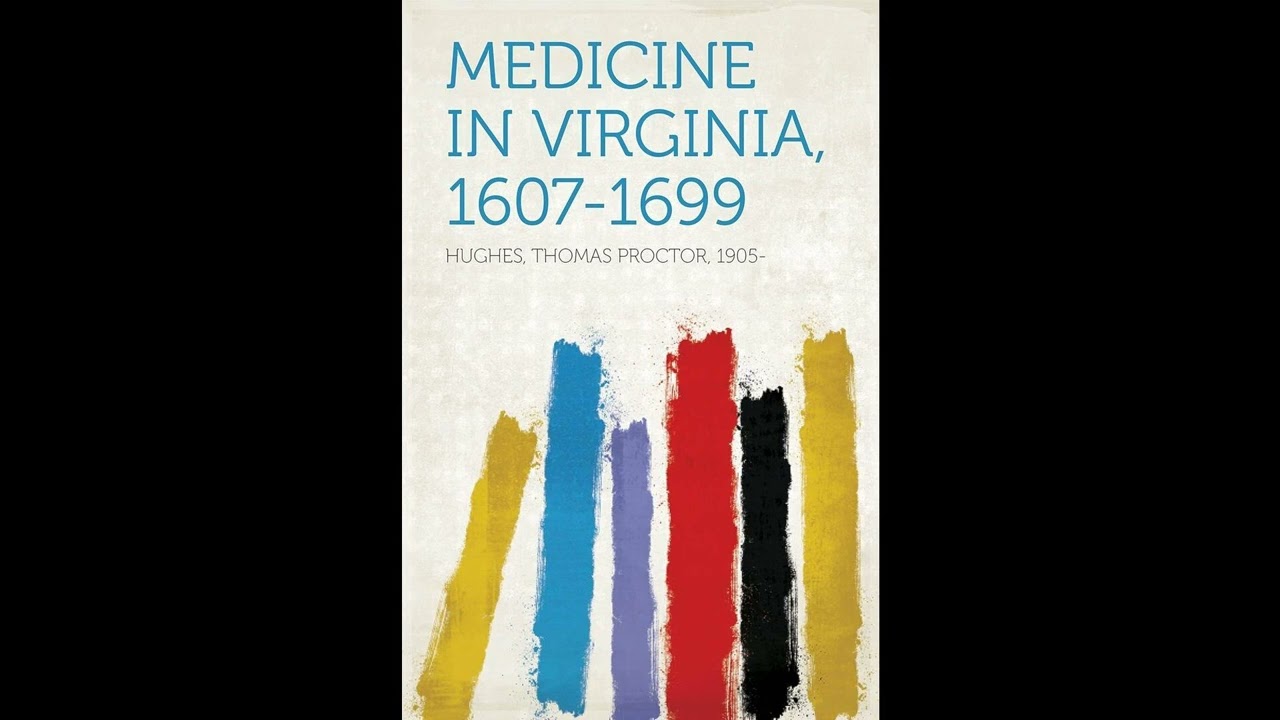
Medicine in Virginia, 1607-1699
Unearthing the untold saga of human struggle against illness in the earliest days of American settlement, Thomas Proctor Hughes’s “Medicine in Virginia, 1607-1699” stands as a foundational account. This volume transports listeners back to a period defined by overwhelming challenge and the nascent formation of a society grappling with the very basics of survival. More than a mere historical record, it is a testament to resilience, a sober examination of how early colonists, confronted by a brutal new environment and an absence of familiar medical infrastructure, pioneered methods of care and healing that laid the groundwork for future generations. For anyone seeking to understand the deep roots of American ingenuity and the enduring human spirit in the face of adversity, this book offers a crucial lens into a forgotten world, demonstrating that the fight for health is as old as the nation itself, and just as central to its identity. From the first tentative landings at Jamestown in 1607, a landscape both breathtaking and deadly, the listener is immersed in the precarious world of colonial Virginia. This is not a story of individual heroes in the conventional sense, but of a community—the settlers, indentured servants, and later enslaved Africans—united by the common threat of disease and the constant struggle for existence. Hughes meticulously charts the trajectory of early Virginia's health crises, beginning with the devastating "Starving Time" where malnutrition and unfamiliar pathogens claimed countless lives, pushing the nascent colony to the brink of collapse. The central conflict of these pages is the relentless, unseen enemy of sickness, aggravated by inadequate nutrition, poor sanitation, and the lack of sophisticated medical knowledge. The narrative arc follows the painstaking evolution of medical understanding and practice in the wilderness. Listeners witness the desperate improvisation of early practitioners, who were often laypeople—ministers, ship captains, or simply those with a modicum of practical experience—forced to contend with ailments ranging from malaria and dysentery to scurvy and mysterious fevers, alongside injuries from labor and conflict. The text reveals how European remedies, often ill-suited to the New World's conditions, slowly gave way to an uneasy adoption of indigenous knowledge concerning local flora and medicinal herbs, alongside the continuation of folk practices and superstitions. The chronicle progresses through decades of trial and error, charting the arrival of formally trained physicians, albeit few and far between, and the gradual, often agonizing, accumulation of practical experience that began to shape a distinctively colonial approach to health. It is a story of slow, hard-won adaptation, where every small victory against disease felt monumental. Thomas Proctor Hughes is remembered by scholars for his meticulous attention to primary sources and his dedication to illuminating overlooked aspects of early American history. Regarded as one of the preeminent colonial historians of his generation, Hughes spent decades poring over original documents—court records, personal letters, plantation inventories, and early colonial government decrees—to reconstruct the intricate fabric of life in the burgeoning colonies. While specific dates of his birth and passing are not widely circulated in common histories, his scholarly career flourished during a period when the rigorous, evidence-based study of America's origins was truly coming into its own. His methodology emphasized painstaking detail and a commitment to presenting the past without romantic embellishment, a hallmark of what might be termed the "scientific history" movement that gained prominence in the late nineteenth and early twentieth centuries. Hughes’s literary output, beyond this seminal work, often focused on the social and economic conditions that underpinned early American society. His other significant contributions include foundational studies on the agricultural practices of the Chesapeake region and careful analyses of demographic shifts in the seventeenth-century colonies. He was not merely an enumerator of facts but an interpreter of how these details shaped daily existence and long-term development. His writing style, characterized by its clarity and measured authority, made complex historical narratives accessible, earning him a lasting place in the canon of American historical scholarship. He is valued not just for the subjects he tackled but for the thoroughness with which he approached them, leaving a legacy of erudite and enduring contributions that continue to inform contemporary understanding. The book profoundly enacts several significant themes, beginning foremost with survival against overwhelming odds. The sheer struggle for existence is palpable on nearly every page, evidenced by the staggering mortality rates among early settlers, often reaching 50% or more in the first years. Hughes illustrates this through countless examples, such as the detailed accounts of individuals succumbing to unfamiliar illnesses, or the desperate measures taken to secure food and shelter amidst an unforgiving environment, where even a simple cut could prove fatal without proper care. A second powerful theme is adaptation and improvisation. Without the structured medical institutions of Europe, colonists were forced to innovate. Hughes provides compelling instances of planters blending traditional European herbalism with observed Native American remedies, or the creation of makeshift surgical tools from common implements, underscoring the colonists' pragmatic spirit in the face of acute necessity. Furthermore, the book highlights the cultural exchange and clash inherent in the colonial project. The interaction between European medical beliefs and indigenous healing practices is a recurrent motif. While European settlers often dismissed Native American medicine as primitive, the text also reveals instances where colonists grudgingly, or out of desperation, adopted local knowledge of medicinal plants, acknowledging their effectiveness where European remedies failed. This uneasy symbiosis, alongside the devastating impact of European diseases on Native populations, forms a sobering reminder of the complex interplay of cultures. Finally, the account underscores the primitive state of medicine in the seventeenth century itself. Hughes details the reliance on the humoral theory—the belief that the body was balanced by four humors—and practices like aggressive bloodletting or purging. These examples show how far medical understanding has advanced, providing a vivid contrast to the rudimentary and often harmful treatments that were commonplace, emphasizing the slow, incremental nature of scientific progress. When Thomas Proctor Hughes penned this historical record, the scholarly landscape was undergoing a significant transformation. The late nineteenth and early twentieth centuries saw a burgeoning interest in American history that moved beyond purely nationalistic narratives towards a more scientific, analytical approach. Universities were establishing dedicated history departments, and there was a growing emphasis on archival research and the professionalization of historical writing. This period also witnessed a shift from focusing solely on political and military history to examining social, economic, and cultural dimensions of the past. Hughes’s work emerged from this environment, a product of scholars seeking to rigorously document the daily lives and challenges faced by ordinary people, rather than just the actions of great figures. The urgency to understand the foundational elements of American society—including how its earliest inhabitants battled sickness and established health practices—was a natural outcome of this intellectual ferment, providing fertile ground for a work of this precise and enduring quality. Listening to "Medicine in Virginia, 1607-1699" as an audiobook transforms a meticulously researched historical text into an immersive experience. The several hours of narration allow ample time to absorb the intricate details of colonial life and the often-grim realities of early medicine. A skilled narrator, with a clear and authoritative voice, brings Hughes's careful prose to life, guiding the listener through the dense historical landscape without ever feeling rushed. Pay attention to the nuanced pacing; it is designed to allow complex information about disease vectors, medicinal plants, and societal structures to settle, creating a vivid mental picture of Virginia's first century. The spoken word adds a layer of solemnity and immediacy to the accounts of struggle and survival, making the listener feel intimately connected to the triumphs and tragedies of those who came before. It is an opportunity to let history unfold directly into your imagination, offering a deeper understanding of the human element behind the historical facts.
Enjoyed Medicine in Virginia, 1607-1699? A few ways to support us
Audible & Amazon links are affiliate; we may earn a small commission at no extra cost.
About this production
Human narration by a volunteer reader from LibriVox.org, the public-domain audiobook project. LibriVox volunteers record literary works whose copyright has expired in the United States, releasing the resulting recordings into the public domain.
Medicine in Virginia, 1607-1699 by Thomas Proctor Hughes. The underlying text is in the U.S. public domain. We do not republish any modern copyrighted edition, translation, or commentary.
The 4K cinematic visuals accompanying this audiobook are generated by an AI image model from prompts derived from the source text. No copyrighted photos, paintings, or stock footage are used. AI generation is disclosed on every video on our YouTube channel as required by YouTube's altered/synthetic content policy.
English subtitles are transcribed from the LibriVox recording with OpenAI Whisper. Translations into the 11 other supported languages are produced by Meta's NLLB-200 neural translation model. No human translator's copyrighted translation is used.
Questions about sourcing or rights? See our DMCA & Sourcing policy or contact us.
Enjoyed this audiobook?
If you'd like to own a copy of Medicine in Virginia, 1607-1699 or hear a professionally produced edition, the links below help support free audiobook production at no extra cost to you.
As an Amazon Associate we earn from qualifying purchases. Audible / print links are affiliate.