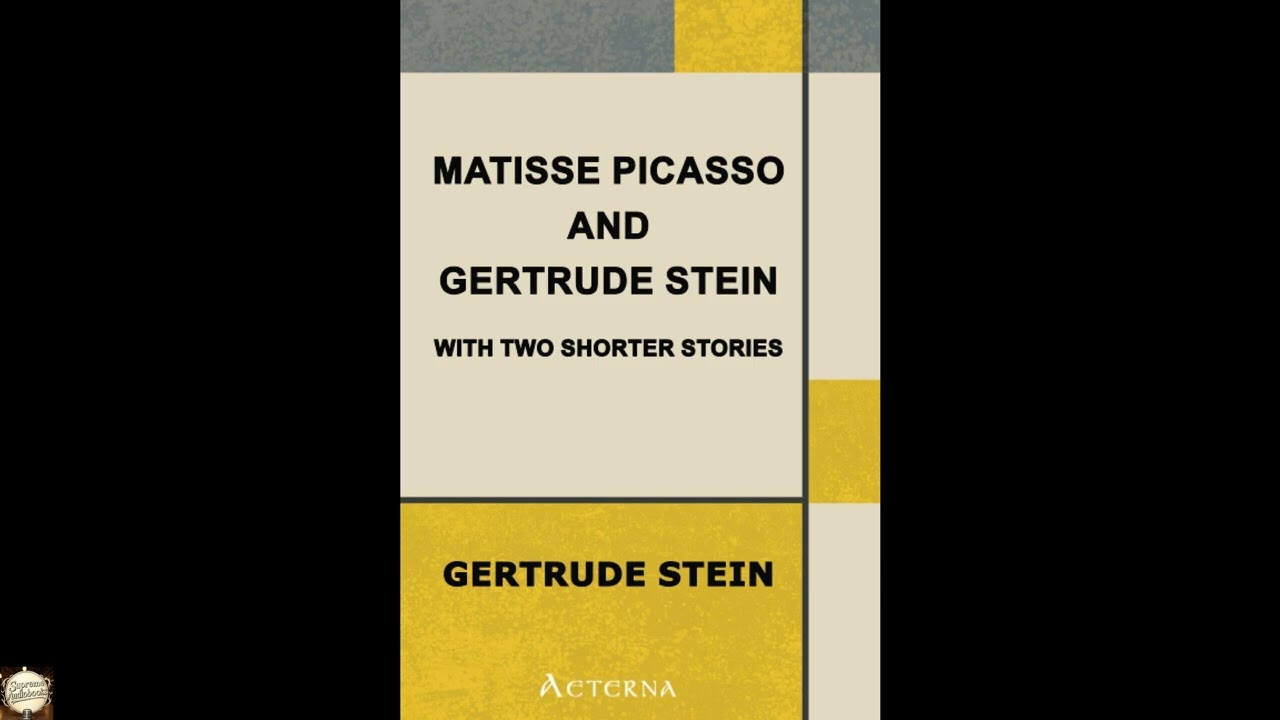
Matisse Picasso and Gertrude Stein. With Two Shorter Stories
Imagine stepping into a legendary Paris salon, not as an invited guest, but as an intimate confidante, privy to the quiet revolutions unfolding in art and thought. This is the singular experience awaiting listeners of Gertrude Stein’s incisive and utterly unique work, Matisse Picasso and Gertrude Stein. With Two Shorter Stories. Far from a dry academic treatise, this audiobook plunges you directly into the mind of one of the 20th century’s most influential literary figures as she dissects the very nature of genius, offering a profound commentary on two of the era’s most towering artistic minds, all while revealing her own pivotal role in shaping modernism. It’s a chance to hear history unfold through the discerning eyes and unparalleled voice of someone who not only witnessed the birth of modern art but actively fostered it. For anyone fascinated by the creative process, the dynamic between artist and patron, or the sheer audacity of breaking new ground, Stein’s observations resonate with startling clarity even today. The primary and titular essay, "Matisse Picasso and Gertrude Stein," is less a conventional narrative and more a sustained meditation, a literary portrait gallery rendered in words. Stein sets her stage in the vibrant, intellectually charged atmosphere of her Parisian apartment at 27 rue de Fleurus, where she and her brother Leo, and later her lifelong companion Alice B. Toklas, assembled one of the most significant collections of modern art in Europe. Here, artists, writers, and thinkers converged, forming a nexus for avant-garde ideas. The "main characters" are, of course, Henri Matisse and Pablo Picasso, but also Stein herself, a keen observer and a central, if often understated, participant in their unfolding stories. Stein’s approach is not biographical in the usual sense; instead, she scrutinizes their artistic processes, their personalities, and their contributions to the evolution of painting with an almost scientific rigor, yet filtered through her distinct literary sensibility. She charts their trajectories, noting Matisse’s steady, observational development versus Picasso’s restless, almost violent reinvention. She doesn't merely describe their work; she attempts to articulate the very essence of their creative drives. Her "story arc" involves understanding how these two titans, so different in temperament and method, each arrived at their revolutionary visions, and how their presence shaped not only the art world but also her own perception and writing. The "central conflict," if one can call it that, is the challenge of understanding and articulating artistic genius itself, of translating the visual into the linguistic without diminishing its impact. The companion pieces, "Two Shorter Stories," further illustrate Stein’s groundbreaking experimental prose. These are not tales with traditional plots or clear resolutions; rather, they are exercises in language, focusing on rhythm, repetition, and the immediate present moment, inviting the listener to experience words as objects, sounds, and textures, much as a painter might experience color and form. They serve as a direct demonstration of the linguistic theories she often discussed with her artist friends, offering intimate glimpses into domestic scenes or character studies filtered through her unique, unvarnished style. Gertrude Stein, born in Allegheny, Pennsylvania, in 1874, spent her formative years traveling through Europe before settling in Oakland, California. Her intellectual curiosity led her to Radcliffe College, where she studied psychology under the renowned philosopher William James, an experience that profoundly influenced her later investigations into consciousness and perception. After a brief period studying medicine, Stein moved to Paris in 1903, a move that would define the rest of her life and career. Her apartment soon became a legendary salon, a crucible for the modernist movement, hosting figures like Ernest Hemingway, F. Scott Fitzgerald, Juan Gris, and Georges Braque. It was here that she amassed her significant art collection and cultivated her unique literary voice. Stein's groundbreaking works include Three Lives (1909), which introduced her repetitive, rhythmic prose style, and the notoriously challenging Tender Buttons (1914), a collection of poems and prose that deconstructed language and meaning. However, her most widely known book remains The Autobiography of Alice B. Toklas (1933), a clever, self-referential memoir told from the perspective of her life partner, offering an insider's view of the Parisian avant-garde. Stein's place in the literary canon is that of a defiant innovator, a crucial bridge between European modernism and American literature, often categorized within the experimental tradition for her relentless pursuit of new ways of seeing and speaking. Her influence extended not only through her writing but also through her direct patronage and encouragement of younger artists and writers, firmly establishing her as a central figure in 20th-century cultural history until her death in 1946. A central theme woven throughout "Matisse Picasso and Gertrude Stein" is the very nature of artistic innovation and its reception. Stein articulates a clear distinction between these two giants, noting how Matisse "made pictures" while Picasso "made Cubism." She illustrates this by focusing on their distinct approaches to representing reality. Matisse, she suggests, was deeply concerned with the visual facts, observing the world with a patient, sensual eye to distill its essence onto the canvas, like his serene portraits or still lifes that simplified form and celebrated color. Picasso, by contrast, was driven by an almost destructive urge to dismantle and reconstruct, to represent multiple perspectives simultaneously, as seen in his groundbreaking Les Demoiselles d'Avignon or any number of his Cubist experiments. Stein shows how their individual temperaments informed their radical artistic departures. Another significant theme, especially evident in the shorter stories, is Stein's exploration of language as a material entity, an object to be manipulated and reformed, much like a sculptor works with clay or a painter with pigment. She demonstrates the idea of the "continuous present"—a way of writing that emphasizes the immediacy of experience, free from conventional narrative progression or psychological introspection. For instance, in one of her short pieces, she might repeat a phrase or a word, not for emphasis, but to allow the word itself to exist purely in the moment, to be apprehended freshly each time it appears, mirroring the way a viewer might repeatedly look at an art object from different angles to grasp its totality. This approach challenges the listener to abandon expectations of linear storytelling and instead immerse themselves in the rhythm and texture of the language itself, perceiving meaning through cumulative impression rather than direct declaration. This work emerged from the intellectual ferment of early 20th-century Paris, a period of unprecedented artistic and cultural upheaval. The belle époque was giving way to the shock of World War I, and traditional modes of expression in art, literature, and music were being shattered. Photography had already challenged painting's role as a mirror of reality, pushing artists to find new purposes for their medium. It was in this environment that movements like Fauvism, with its wild colors, and Cubism, with its fragmented forms, burst onto the scene, fundamentally altering how the world perceived visual art. Stein’s salon, situated in the heart of this artistic revolution, became a crucial space for these ideas to be debated, tested, and absorbed. The artists she championed were not merely painting; they were forging a new visual language. Stein, with her deep understanding of their struggles and triumphs, sought to develop a literary equivalent to their revolutionary visual language, to write in a way that captured the "is-ness" of things, free from sentimentality or conventional rhetoric, much as Picasso freed form from traditional representation or Matisse freed color from its descriptive function. This confluence of artistic innovation and intellectual curiosity provided the perfect ground for Stein's distinctive voice to emerge, offering her unparalleled insights into the minds of the men who were changing the face of art forever. To listen to Gertrude Stein's prose is to experience language anew, and the audiobook format proves to be an exceptionally fitting medium for this particular collection. Stein herself often spoke of wanting her writing to be heard, to have a "vibrating quality," and her distinctive use of repetition, subtle shifts in rhythm, and carefully chosen plain vocabulary truly come alive when narrated by a skilled voice. The several hours of this recording allow ample time for the listener to settle into Stein's unique cadence, letting her observations on Matisse and Picasso unfold with a quiet intensity, almost like a guided tour through her discerning consciousness. When listening, pay attention to the narrator's pacing, which can reveal the nuanced musicality of Stein’s sentences, transforming what might appear simple on the page into a complex interplay of sound and sense. The subtle pauses and inflections bring out the philosophical weight of her statements, particularly in her portraits of the artists, while the "shorter stories" offer an opportunity to fully immerse in the purely sonic qualities of her experimental writing, inviting an auditory experience that transcends mere information transfer and becomes an act of pure perception.
Enjoyed Matisse Picasso and Gertrude Stein. With Two Shorter Stories? A few ways to support us
Audible & Amazon links are affiliate; we may earn a small commission at no extra cost.
About this production
Human narration by a volunteer reader from LibriVox.org, the public-domain audiobook project. LibriVox volunteers record literary works whose copyright has expired in the United States, releasing the resulting recordings into the public domain.
Matisse Picasso and Gertrude Stein. With Two Shorter Stories by Gertrude Stein. The underlying text is in the U.S. public domain. We do not republish any modern copyrighted edition, translation, or commentary.
The 4K cinematic visuals accompanying this audiobook are generated by an AI image model from prompts derived from the source text. No copyrighted photos, paintings, or stock footage are used. AI generation is disclosed on every video on our YouTube channel as required by YouTube's altered/synthetic content policy.
English subtitles are transcribed from the LibriVox recording with OpenAI Whisper. Translations into the 11 other supported languages are produced by Meta's NLLB-200 neural translation model. No human translator's copyrighted translation is used.
Questions about sourcing or rights? See our DMCA & Sourcing policy or contact us.
View 10 famous quotes from this book →
Enjoyed this audiobook?
If you'd like to own a copy of Matisse Picasso and Gertrude Stein. With Two Shorter Stories or hear a professionally produced edition, the links below help support free audiobook production at no extra cost to you.
As an Amazon Associate we earn from qualifying purchases. Audible / print links are affiliate.