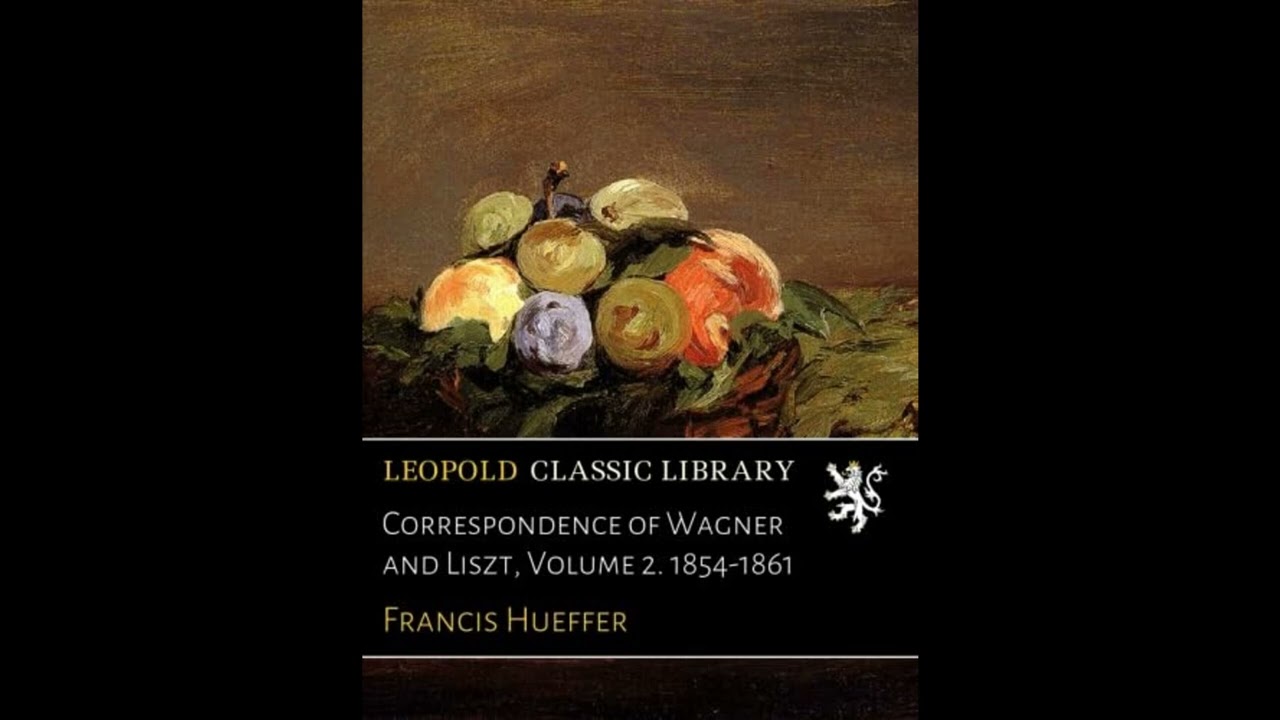
Correspondence of Wagner and Liszt, Volume 2. 1854-1861
Imagine standing at the very confluence of artistic genius, privy to the most intimate thoughts and desperate pleas between two of music's most colossal figures. This is the promise of Correspondence of Wagner and Liszt, Volume 2. 1854-1861, a remarkable collection brought to English readers through the meticulous work of Francis Hueffer. Far from a mere historical document, this volume opens a window onto the human drama behind the legends: the struggles, the triumphs, the unwavering support, and the profound vulnerabilities that shaped not only their individual destinies but the entire trajectory of European music. It is an essential accounting for anyone who seeks to understand the sacrifices demanded by creative vision, the power of a deep and complicated friendship, and the enduring relevance of their artistic battles in a world still grappling with innovation and tradition. The period covered in this second volume, from 1854 to 1861, represents a crucible for both Richard Wagner and Franz Liszt. Wagner, still exiled from Germany following his involvement in the Dresden uprising, found himself in a particularly precarious position. His letters reveal a man consumed by his grand operatic visions—the ongoing work on The Ring of the Nibelung and the nascent ideas for Tristan und Isolde—yet simultaneously tormented by financial insecurity, loneliness, and the constant battle against a conservative musical establishment. He writes with a potent mix of artistic fervor and exasperated despair, often outlining his grand theoretical manifestos alongside urgent requests for money or solace. Liszt, by contrast, had settled into his influential role as Kapellmeister in Weimar, a position he leveraged tirelessly to champion new music, particularly Wagner's. His replies, often brimming with practical advice, tireless encouragement, and unshakeable loyalty, paint a picture of a man burdened by administrative duties and the thankless task of advocating for a controversial colleague. He conducts Wagner's operas, mediates disputes, offers financial assistance, and provides a crucial emotional anchor. The central conflict within these letters is less a clash between the two men and more a shared struggle against the world's indifference or outright hostility to their revolutionary artistic ideals, exacerbated by Wagner's demanding personality and Liszt's infinite patience. The arc of this period, as chronicled through their exchanges, shows Wagner grappling with increasingly complex compositional challenges while Liszt navigates the political and social landscapes of European musical life, often at great personal cost, striving to pave the way for his friend's eventual, if still distant, vindication. The man responsible for bringing these crucial insights to the English-speaking world was Francis Hueffer. Born Franz Karl Eugen Hueffer in Münster, Germany, in the mid-nineteenth century, he later made his home in England, becoming a pivotal figure in British music criticism and scholarship. His early education in classical philology and a doctorate from Göttingen laid a rigorous foundation, but it was his passion for music, particularly the works of Wagner, that defined his career. Hueffer served as the music critic for The Times from 1878 until his death, a prominent platform from which he championed the New German School, advocating for composers like Liszt and Wagner at a time when their music was still viewed with suspicion by many in Britain. Hueffer’s dedication to Wagner was profound, leading him to translate libretti, write influential critical studies such as Richard Wagner and the Music of the Future (1874), and, most notably, to compile and translate these essential volumes of correspondence. His efforts significantly shaped the reception of Wagner in England, making complex German artistic ideas accessible to a wider audience. Beyond his musicological work, Hueffer was also a man of letters, connected to significant literary circles of his day. He married Catherine Madox Brown, daughter of the Pre-Raphaelite painter Ford Madox Brown, and was the grandfather of the celebrated novelist Ford Madox Ford, further illustrating his embeddedness within the cultural ferment of the late Victorian era. His work on this correspondence stands as a testament to his scholarly rigor and his unwavering belief in the historical importance of these two musical titans. This collection enacts several vital themes. One clear theme is the immense power and burden of artistic friendship and patronage. Liszt's tireless advocacy for Wagner, both financial and artistic, is palpable in every letter. For instance, Liszt's accounts of conducting Lohengrin and Tannhäuser in Weimar, often against considerable public and critical resistance, underscore his personal sacrifice. These were not merely professional favors; they were acts of profound belief and unwavering commitment that provided Wagner with crucial sustenance during his most desolate years. Another theme that emerges powerfully is the relentless struggle of the creative genius against an uncomprehending world. Wagner's letters often detail his frustration with the mundane realities of life—money, critics, political machinations—all of which he viewed as obstacles to his sacred artistic mission. His impassioned explanations of his operatic theories or his despair over public rejection illustrate the profound isolation that can accompany radical artistic vision. Furthermore, the letters illuminate the theme of artistic evolution and theoretical development. We witness Wagner's ideas for The Ring and Tristan taking shape, his discussions on Gesamtkunstwerk, and his philosophical musings on art's purpose. These provide a window into the intellectual crucible where modern operatic thought was forged. Finally, the collection highlights the changing nature of influence and legacy. As their careers progressed, the dynamic between the two shifted, with Liszt increasingly recognized for his own groundbreaking compositions while still supporting Wagner. Their correspondence shows how their mutual respect and shared belief in the future of music sustained them, even as their individual paths diverged. It offers a rare look at how two formidable wills collaborated and contended, ultimately shaping the soundscape of generations to come. The mid-nineteenth century, the era in which these letters were exchanged, was a time of immense cultural and political upheaval across Europe. The revolutions of 1848 had shaken old monarchies, fostering new nationalistic sentiments and challenging established social orders. In the arts, the Romantic movement was reaching its zenith, yet simultaneously giving way to more individualistic and often controversial forms of expression. Composers like Wagner and Liszt were at the vanguard of this change, pushing the boundaries of harmony, form, and dramatic content in music. Their work often faced fierce opposition from traditionalists, who saw their innovations as assaults on classical beauty and order. This volume reveals the pressures these artists faced from critics, the public, and even their own patrons, forcing them to articulate and defend their artistic philosophies with an urgency born of necessity, all within a rapidly shifting European landscape of ideas and power. Listening to Correspondence of Wagner and Liszt, Volume 2 as an audiobook offers an unparalleled sense of immediacy and intimacy. The narrator's voice, carefully chosen for its clarity and interpretive depth, becomes the conduit for the very "voices" of Wagner and Liszt themselves. Each letter, whether a passionate outpouring from Wagner or a thoughtful, measured reply from Liszt, takes on a new dimension when heard aloud, allowing the listener to absorb the nuances of tone, urgency, and underlying emotion that might be missed on the printed page. The generous length of several hours allows for a true immersion into their world, an unhurried unfolding of their relationship and artistic development. It becomes possible to appreciate the distinct personalities behind the prose: Wagner's fervent, sometimes dictatorial pronouncements; Liszt's unwavering, almost saintly patience. The listener can detect the shifting dynamics of their friendship, the weight of their artistic ambitions, and the raw human cost of their creative lives, all presented with a pacing that honors the historical gravity and personal drama contained within these extraordinary communications.
Enjoyed Correspondence of Wagner and Liszt, Volume 2. 1854-1861? A few ways to support us
Audible & Amazon links are affiliate; we may earn a small commission at no extra cost.
About this production
Human narration by a volunteer reader from LibriVox.org, the public-domain audiobook project. LibriVox volunteers record literary works whose copyright has expired in the United States, releasing the resulting recordings into the public domain.
Correspondence of Wagner and Liszt, Volume 2. 1854-1861 by Francis Hueffer. The underlying text is in the U.S. public domain. We do not republish any modern copyrighted edition, translation, or commentary.
The 4K cinematic visuals accompanying this audiobook are generated by an AI image model from prompts derived from the source text. No copyrighted photos, paintings, or stock footage are used. AI generation is disclosed on every video on our YouTube channel as required by YouTube's altered/synthetic content policy.
English subtitles are transcribed from the LibriVox recording with OpenAI Whisper. Translations into the 11 other supported languages are produced by Meta's NLLB-200 neural translation model. No human translator's copyrighted translation is used.
Questions about sourcing or rights? See our DMCA & Sourcing policy or contact us.
Enjoyed this audiobook?
If you'd like to own a copy of Correspondence of Wagner and Liszt, Volume 2. 1854-1861 or hear a professionally produced edition, the links below help support free audiobook production at no extra cost to you.
As an Amazon Associate we earn from qualifying purchases. Audible / print links are affiliate.