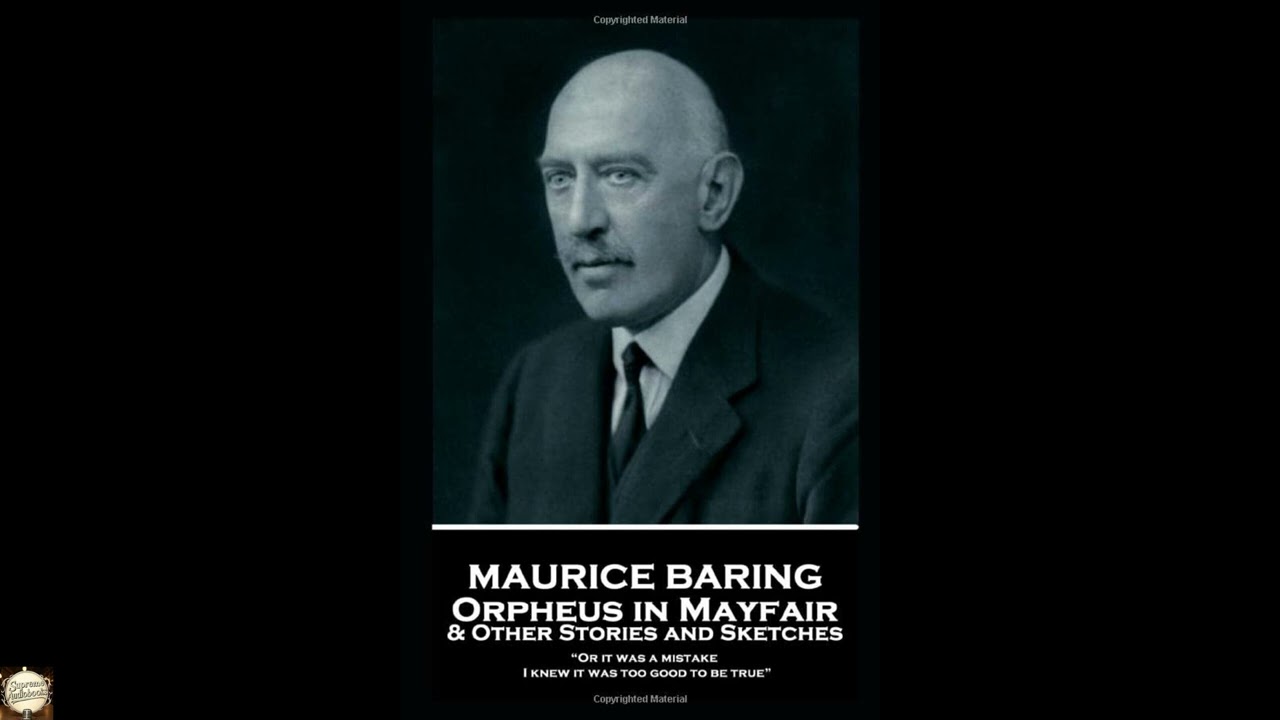
Maurice Baring - Orpheus in Mayfair and Other Stories and Sketches: “Or it was a mi
Step into the glittering, often absurd world of Edwardian Mayfair, a place where social ambition, artistic temperament, and the subtle dance of manners dictated every move. Maurice Baring’s collection, Orpheus in Mayfair and Other Stories and Sketches, offers an astute, often droll, and sometimes wistful look at a society on the cusp of profound change. This gathering of short narratives provides a window into the drawing rooms and minds of Britain’s upper crust and those who orbited their sphere, observing their foibles and fleeting triumphs with a keen eye and a compassionate heart. For anyone seeking to understand the inner lives and external pressures of a bygone era, or simply desiring the pleasure of finely crafted prose and sharp social commentary, Baring’s work remains as relevant and entertaining today as it was over a century ago. The title story, “Orpheus in Mayfair,” sets a resonant tone for the collection, hinting at the clash between genuine artistic sensibility and the often-superficial demands of high society. Listeners will encounter a parade of characters—from the earnest, slightly naive young artist attempting to navigate the labyrinthine expectations of wealthy patrons, to the jaded socialite who views all human interaction as a strategic game. Baring frequently stages his narratives in London’s most fashionable districts, as well as in country houses and sometimes even on the Continent, painting vivid pictures of the settings that shaped his characters' lives. The narratives do not follow a single, overarching plot, but rather present a series of vignettes and short stories, each a self-contained exploration of human nature within a specific social milieu. Across these diverse scenarios, a central theme emerges: the constant negotiation between individual desires and societal conventions. Characters grapple with romantic dilemmas, professional aspirations, and the ever-present pressure to conform to strict codes of behavior. A young man might pursue a woman whose social standing is just beyond his reach, or an artist might struggle to maintain his integrity while seeking financial support. The narratives often feature gentle irony, revealing the humor and pathos inherent in these situations without resorting to heavy-handed judgment. Baring excels at capturing the subtle nuances of conversation and gesture, allowing listeners to overhear the unspoken thoughts and hidden motives of his subjects. Maurice Baring (1874-1945) was a figure of remarkable breadth and accomplishment, a true polymath who moved effortlessly between diplomacy, journalism, and literature. Born into the influential Baring banking family, he received a classical education at Eton and Trinity College, Cambridge, before embarking on a diplomatic career that took him to Paris, Copenhagen, Rome, and St. Petersburg. His experiences abroad were instrumental in shaping his cosmopolitan outlook and his deep understanding of European cultures, which often subtly informs his English-centric stories. It was during his time as a foreign correspondent for the Morning Post in Russia, covering events like the Russo-Japanese War and the 1905 Revolution, that he honed his observational skills and developed a precise, evocative prose style. Baring converted to Catholicism in 1909, a spiritual turning point that added another dimension to his thoughtful examination of human existence. Upon returning to England, he served in the Royal Flying Corps during the First World War, an experience that provided further grist for his later writing. Throughout his life, Baring maintained friendships with many prominent literary figures of his time, including Hilaire Belloc, G.K. Chesterton, and Virginia Woolf, placing him firmly within the literary circles of the Edwardian and Georgian eras. His prolific output spanned novels such as C and Cat's Cradle, plays, poetry, literary criticism, and memoirs like The Puppet Show of Memory. Though perhaps less widely read today than some of his contemporaries, Baring consistently produced work characterized by its intelligence, wit, and profound human sympathy, securing his place as a nuanced chronicler of early 20th-century life. The collection deftly illustrates several recurring themes. One prominent thread is the critique of Edwardian social pretensions and snobbery. Baring frequently showcases characters who are more concerned with appearances and status than with genuine connection or merit. For instance, a sketch might satirize a hostess agonizing over guest lists or a young man attempting to marry into a higher social class solely for advantage, revealing the often-hollow core beneath the polished surface of Mayfair society. Another significant theme is the tension between artistic ideals and practical realities. The "Orpheus" of the title can be seen as representing the artist or the aesthetic impulse, striving for beauty and truth within a world increasingly driven by commerce and superficiality. A story might depict a poet struggling to find an audience that appreciates his work beyond its potential for fashionable novelty, or a painter whose vision is diluted by the demands of a wealthy, uncomprehending patron. Beyond these social observations, Baring often touches upon the universal themes of love, illusion, and disappointment. Romantic entanglements in his stories are rarely straightforward; they are often complicated by class distinctions, misunderstandings, or unfulfilled expectations. A character might pursue a love interest only to find the reality falls short of their idealized image, or a seemingly perfect match could dissolve under the weight of societal judgment. Underlying much of Baring’s writing is a gentle sense of nostalgia for a vanishing world. Published in 1909, just before the seismic shifts of the First World War, these stories carry a subtle awareness of a fading era, reflecting on traditions and social structures that were soon to undergo radical transformation. This quiet elegiac quality adds depth to his otherwise witty and observational narratives. This collection emerged during the Edwardian period (1901-1910), a relatively brief but distinct era characterized by its apparent stability and societal contrasts. While the aristocracy and upper classes enjoyed immense wealth and leisure, social unrest and calls for reform were simmering beneath the surface. Mayfair itself served as a microcosm of this world, a symbol of privilege and established order. Baring’s stories provide an intimate portrait of this specific cultural moment, capturing the delicate balance of power, the rigid social hierarchy, and the prevailing attitudes towards art, wealth, and marriage. It was a time when the echoes of Victorian morality still resonated, but the winds of modernity—in science, politics, and social thought—were beginning to blow with increasing force. Baring, with his international experience and keen literary sensibility, was uniquely positioned to document the nuances of this transitional age, reflecting both its charm and its inherent contradictions. His work stands alongside that of contemporaries like E.M. Forster and P.G. Wodehouse, offering its own distinctive voice to the chorus of writers chronicling British society on the eve of immense global upheaval. Listening to Orpheus in Mayfair and Other Stories and Sketches as an audiobook offers a singular pleasure. The collection’s episodic nature makes it perfect for dipping in and out, whether on a commute, while tending to chores, or during moments of quiet reflection. A skilled narrator can bring Baring's subtle humor and keen observations to life, giving distinct voices to the varied cast of characters, from the pompous dilettante to the quietly insightful observer. The conversational prose, laden with witty dialogue and understated irony, truly shines when read aloud. Pay attention to the pacing, which can emphasize the unhurried rhythm of Edwardian life, and the subtle shifts in tone that convey whether a situation is meant to be humorous, melancholic, or simply a truthful depiction of human behavior. The spoken word can underscore the atmospheric details—the rustle of silk in a ballroom, the clinking of teacups in a drawing-room—transporting you directly into the heart of Baring's beautifully rendered, half-remembered world.
Enjoyed Maurice Baring - Orpheus in Mayfair and Other Stories and Sketches: “Or it was a mi? A few ways to support us
Audible & Amazon links are affiliate; we may earn a small commission at no extra cost.
About this production
Human narration by a volunteer reader from LibriVox.org, the public-domain audiobook project. LibriVox volunteers record literary works whose copyright has expired in the United States, releasing the resulting recordings into the public domain.
Maurice Baring - Orpheus in Mayfair and Other Stories and Sketches: “Or it was a mi by Maurice Baring. The underlying text is in the U.S. public domain. We do not republish any modern copyrighted edition, translation, or commentary.
The 4K cinematic visuals accompanying this audiobook are generated by an AI image model from prompts derived from the source text. No copyrighted photos, paintings, or stock footage are used. AI generation is disclosed on every video on our YouTube channel as required by YouTube's altered/synthetic content policy.
English subtitles are transcribed from the LibriVox recording with OpenAI Whisper. Translations into the 11 other supported languages are produced by Meta's NLLB-200 neural translation model. No human translator's copyrighted translation is used.
Questions about sourcing or rights? See our DMCA & Sourcing policy or contact us.
Enjoyed this audiobook?
If you'd like to own a copy of Maurice Baring - Orpheus in Mayfair and Other Stories and Sketches: “Or it was a mi or hear a professionally produced edition, the links below help support free audiobook production at no extra cost to you.
As an Amazon Associate we earn from qualifying purchases. Audible / print links are affiliate.