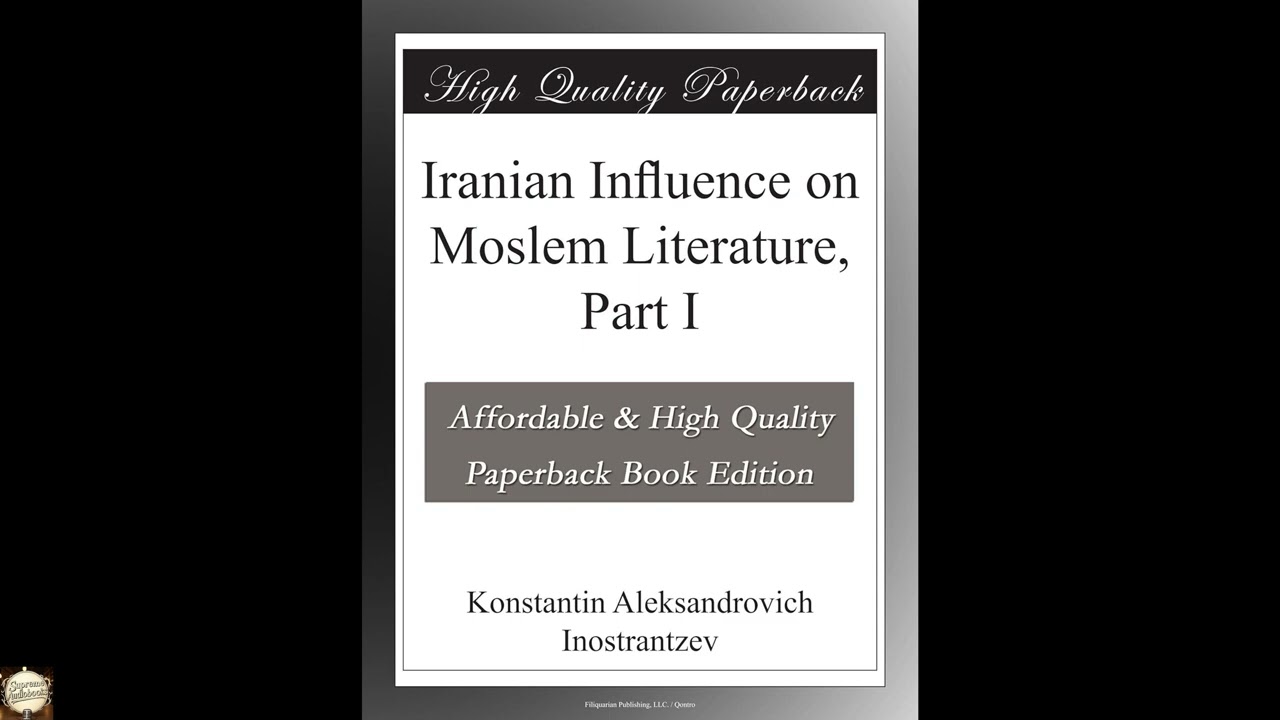
Iranian Influence on Moslem Literature, Part I
To understand the present, we must often look back to the intricate threads of the past, especially when it comes to the formation of culture and literature. Iranian Influence on Moslem Literature, Part I, by Konstantin Aleksandrovich Inostra, offers an essential and illuminating examination of how Persian thought, language, and artistic sensibilities profoundly shaped the literary landscape of the Islamic world. This scholarly work, initially published during a period of burgeoning interest in Eastern studies, is not merely a historical document; it is a foundational text that continues to inform our understanding of cultural exchange, the roots of shared literary heritage, and the enduring power of ideas to transcend borders and centuries. For anyone curious about the historical dynamics that forged some of the world's most enduring literary traditions, this meticulous analysis provides unparalleled insight into a dialogue between civilizations that began millennia ago and continues to resonate today. Inostra’s ambitious project sets out to chart the profound and often overlooked currents of Iranian influence across the vast sea of Moslem literature, beginning with the earliest periods of Islamic expansion. Part I establishes the foundational arguments, detailing the historical and linguistic context that made such an influence not just possible, but inevitable. The setting for this scholarly analysis spans the geographic sweep from Persia, across Mesopotamia, and into the emerging centers of Arabic learning, tracing the flow of intellectual and poetic forms from the Sasanian Empire through the early Abbasid Caliphate. We encounter the literary "characters" not as individuals in a fictional narrative, but as a succession of poets, scholars, and linguistic shifts—the Persian dihqans preserving ancient lore, the translators in Baghdad rendering Pahlavi texts into Arabic, and the early Arabic poets adapting Persian metrics and metaphors. The central intellectual "conflict" of the work is the complex interplay between indigenous Arabic literary traditions and the sophisticated, millennia-old Persian poetic and narrative heritage. Inostra meticulously presents evidence demonstrating how Persian administrative practices, courtly customs, and especially its rich storytelling tradition permeated the nascent Islamic literary output. He identifies the mechanisms of this cultural transmission, from direct translation and bilingualism among scholars to the subtle adoption of Persian rhetorical devices and philosophical concepts within Arabic prose and poetry. The "arc" of this initial volume carefully lays out the arguments for influence, moving from general historical conditions to specific linguistic and thematic examples, systematically building the case that much of what we recognize as characteristic of early Moslem literature bears an undeniable Iranian stamp. Listeners will follow as Inostra meticulously constructs his argument, providing examples of how specific narrative motifs, poetic forms like the qasida, and even philosophical paradigms found their way from the Persianate world into the broader Islamic intellectual sphere, reshaping it in fundamental ways without fully supplanting its existing structures. Konstantin Aleksandrovich Inostra (1876-1938) was a distinguished Russian Orientalist and Iranist, a scholar whose life was dedicated to the rigorous study of Persian language, literature, and history. Born in Saint Petersburg, he pursued his education at the Imperial University of Saint Petersburg, becoming a student of the renowned orientalist V. V. Barthold, who deeply influenced his scholarly trajectory. Inostra’s academic career saw him rise to prominence, first as a lecturer and later as a professor, contributing significantly to the fields of Iranian studies and Semitic philology during a period of intense academic interest in the Middle East within Russian intellectual circles. His extensive research involved detailed analysis of ancient Iranian languages, Zoroastrian texts, and the literary output of the Persianate world both before and after the advent of Islam. Beyond Iranian Influence on Moslem Literature, Inostra was a prolific author of numerous articles and monographs, many of which focused on the historical development of Persian literature, its connections to Central Asian cultures, and the textual criticism of classical Persian works. His scholarship was characterized by an exacting philological approach and a broad command of historical sources, positioning him as a leading figure in comparative literary studies and the academic understanding of cross-cultural literary transmission in the early 20th century. One of the primary themes running through Inostra's work is the concept of cultural synthesis, demonstrating that literary traditions are rarely hermetically sealed entities but are, instead, living systems that absorb, adapt, and transform external influences. He shows, for instance, how the pre-Islamic Persian storytelling tradition, rich with epics and moral tales, provided a vast reservoir of narratives that were later reinterpreted and integrated into Arabic literary forms. A concrete example appears in his discussion of the Kitab al-Taj, or "Book of the Crown," a Pahlavi text whose courtly etiquette and administrative wisdom found a new life and audience through Arabic translations, shaping the ideals of kingship and governance in the Abbasid Caliphate. Another significant theme is the linguistic evolution and a critical examination of translation as a conduit for cultural borrowing. Inostra meticulously illustrates how specific Persian vocabulary, literary metaphors, and even grammatical structures were adopted into Arabic, enriching its expressive capabilities. He might point to the adoption of certain poetic meters or the prevalence of specific rhetorical devices that were demonstrably Persian in origin, becoming naturalized within Arabic poetry. He also underscores the preservation of ancient knowledge, detailing how Persian scholars served as crucial intermediaries, translating Greek scientific and philosophical texts via Pahlavi into Arabic, thus playing a vital role in the intellectual flourishing of the Islamic Golden Age and impacting the literary-philosophical discourse. This work emerged during a fascinating period in intellectual history, the late 19th and early 20th centuries. It was an era marked by the rise of academic Orientalism, a field dedicated to the systematic study of Eastern languages, cultures, and histories. Within Europe, and particularly in Russia, there was a fervent academic drive to understand the vast and historically significant regions of Central Asia, Persia, and the broader Islamic world. Politically, this period coincided with heightened European interest and influence in the Middle East, leading to increased scholarly engagement with the region's cultural heritage. Academics like Inostra were part of a global movement in philology and comparative literature, where scholars sought to trace linguistic roots, analyze textual traditions, and understand the complex web of cultural interactions that shaped world civilizations. This intellectual environment, coupled with access to expanding collections of manuscripts, provided fertile ground for the kind of groundbreaking research Inostra undertook, challenging earlier assumptions about the "purity" of national literatures and instead emphasizing their interconnectedness. Listening to Iranian Influence on Moslem Literature, Part I as an audiobook offers a unique way to engage with its meticulously constructed arguments. The spoken word allows for a natural immersion into Inostra's scholarly prose, guiding you through his detailed historical surveys and linguistic analyses without the visual distraction of footnotes or cross-references. You can absorb the nuances of his reasoning, the methodical presentation of evidence, and the careful building of his thesis over several hours of attentive listening. The narration often brings to life the intricate connections between ancient texts and historical events, allowing the listener to follow the flow of intellectual discourse as if attending a master lecture. It provides an opportunity to appreciate the rhythm of academic thought, to connect the dots between distant literary periods, and to gain a profound appreciation for the silent, yet powerful, dialogue between cultures that shaped much of the world's literary legacy.
Enjoyed Iranian Influence on Moslem Literature, Part I? A few ways to support us
Audible & Amazon links are affiliate; we may earn a small commission at no extra cost.
About this production
Human narration by a volunteer reader from LibriVox.org, the public-domain audiobook project. LibriVox volunteers record literary works whose copyright has expired in the United States, releasing the resulting recordings into the public domain.
Iranian Influence on Moslem Literature, Part I by Konstantin Aleksandrovich Inostra. The underlying text is in the U.S. public domain. We do not republish any modern copyrighted edition, translation, or commentary.
The 4K cinematic visuals accompanying this audiobook are generated by an AI image model from prompts derived from the source text. No copyrighted photos, paintings, or stock footage are used. AI generation is disclosed on every video on our YouTube channel as required by YouTube's altered/synthetic content policy.
English subtitles are transcribed from the LibriVox recording with OpenAI Whisper. Translations into the 11 other supported languages are produced by Meta's NLLB-200 neural translation model. No human translator's copyrighted translation is used.
Questions about sourcing or rights? See our DMCA & Sourcing policy or contact us.
Enjoyed this audiobook?
If you'd like to own a copy of Iranian Influence on Moslem Literature, Part I or hear a professionally produced edition, the links below help support free audiobook production at no extra cost to you.
As an Amazon Associate we earn from qualifying purchases. Audible / print links are affiliate.