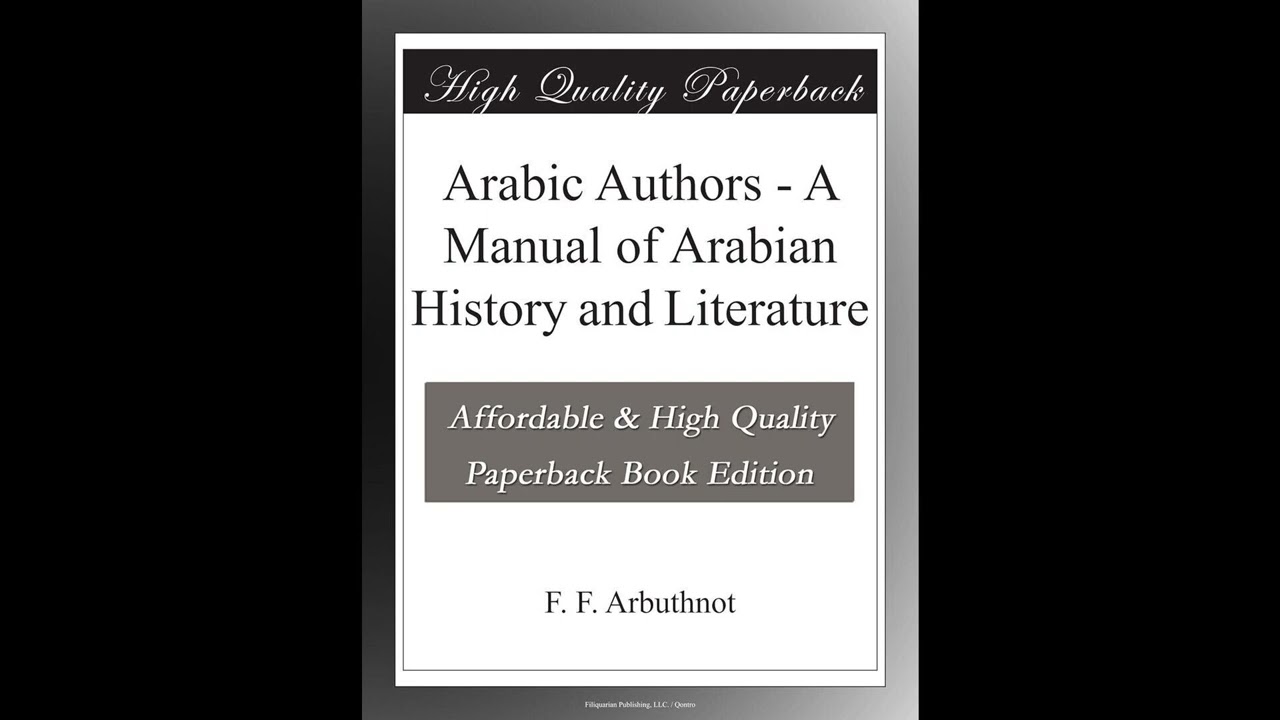
Arabic Authors - A Manual of Arabian History and Literature
To truly understand any culture, one must first grasp the narratives it tells about itself—its history, its poetry, its philosophical inquiries. F. F. Arbuthnot's Arabic Authors - A Manual of Arabian History and Literature offers a meticulously constructed portal into the intellectual and artistic achievements of the Arabic-speaking world, a realm often viewed through a veil of mystery by Western audiences in the late nineteenth century. This foundational work stands not merely as a compilation of facts, but as an invitation to engage with the voices and ideas that shaped vast civilizations. For the contemporary listener, it provides essential context, challenging preconceptions and illuminating the deep roots of a literary tradition that continues to influence global thought, art, and even scientific understanding. It is a work that asks us to broaden our horizons, urging a deeper appreciation for the multifaceted contributions of a rich and often misunderstood heritage. Arbuthnot’s manual unfolds systematically, beginning with the pre-Islamic period and tracing the currents of Arabian thought through the rise of Islam, the flourishing of the Abbasid Caliphate, and beyond. Rather than a linear "story" in the fictional sense, the book presents a grand chronological survey, where each chapter introduces a new epoch, its defining historical events, and the literary figures who rose to prominence within it. The central narrative arc is the progression of Arabian letters itself—from the stark poetry of the desert Bedouins, capturing the raw beauty and hardship of their existence, to the sophisticated prose and verse of courtly poets, historians, and scientists in Baghdad, Cairo, and Andalusia. Arbuthnot’s approach treats the major literary movements and influential authors as the "characters" of this expansive narrative, demonstrating how their works reflect, challenge, and contribute to the ongoing cultural discourse of their times. The "conflict," if one were to describe it, lies in the challenge of synthesizing centuries of diverse intellectual output into a cohesive and accessible volume for a non-specialist audience. Arbuthnot tackles this by categorizing authors by their genre and period, providing concise biographical sketches and often offering brief translations or summaries of their significant contributions. Listeners encounter celebrated poets like Al-Mutanabbi, whose verses became proverbial, and historians such as Ibn Khaldun, whose sociological insights were centuries ahead of their time. The book’s comprehensive scope extends to grammarians, lexicographers, philosophers, and even early scientists whose writings were crucial in preserving and advancing knowledge during Europe's Dark Ages. The story, then, is the careful reconstruction of a literary lineage, the charting of intellectual influence, and the celebration of the enduring power of the written word across different eras and geographical expanses. F. F. Arbuthnot, born Francis Freeling Arbuthnot in 1833, was a British civil servant whose career led him to India, a common trajectory for educated young men of his social standing during the height of the British Empire. This exposure to Eastern cultures likely fueled his academic interest in Arabic and Persian literature upon his return to England. Arbuthnot belonged to a generation of scholars and enthusiasts who, while often viewing non-Western cultures through a lens shaped by their own imperial context, genuinely dedicated themselves to the study and translation of classical Eastern texts. Beyond Arabic Authors, published in 1890, he is also remembered for his work on Sa'di's Gulistan (The Rose Garden), a seminal work of Persian literature, which he translated with notes. He was a member of various learned societies and continued to publish on Oriental subjects, contributing to the growing body of Western scholarship on the Middle East. Arbuthnot passed away in 1911, leaving behind a legacy as a diligent scholar whose efforts helped introduce complex literary traditions to a broader English-speaking readership. The themes woven throughout Arabic Authors speak directly to the intellectual currents of its time and retain relevance today. One prominent theme is the preservation and transmission of knowledge. Arbuthnot consistently highlights how Arab scholars meticulously preserved and built upon the wisdom of ancient Greece and Rome, translating texts and adding their own original commentaries and discoveries. For instance, he details the House of Wisdom in Baghdad, an institution dedicated to translation and scholarship, illustrating how the Arabic intellectual tradition acted as a vital bridge between classical antiquity and the European Renaissance. Another central theme is the interconnectedness of history and literature. The author shows how political upheavals, religious movements, and scientific advancements directly shaped the literary output of each era. He might present a passage from a court poet celebrating a caliph's victory, then transition to a philosopher's treatise on ethics written during a period of introspection, demonstrating how the literature of a time directly mirrors its social and intellectual climate. A third significant theme is the diversity within a cultural sphere, challenging any monolithic view of "Arabian literature." Arbuthnot presents authors from vastly different regions—from North Africa to Persia, from Egypt to Spain—all contributing to the shared literary heritage while maintaining distinct local flavors and perspectives. This is seen in his discussion of Hispano-Arabic poets, whose work often blended Arabic forms with the unique cultural landscape of medieval Iberia. Furthermore, the book subtly addresses the evolving Western understanding of the Middle East. While rooted in the "Orientalist" academic tradition of the late nineteenth century—a perspective sometimes criticized today for its generalizations—Arbuthnot's sincere attempt to systematically catalogue and appreciate the literary achievements of Arabic authors represents an early and significant effort towards cross-cultural understanding, seeking to bridge the divide through education and exposure to written works. The late nineteenth century, when Arabic Authors appeared, was a period marked by intense European interest in the non-Western world, driven by colonialism, expanding trade routes, and growing academic inquiry. Britain, in particular, was at the height of its imperial power, with significant influence in parts of the Middle East and India. This context created a demand for scholarship that could illuminate the histories and cultures of these regions for a Western audience. Works like Arbuthnot's emerged from this environment, serving both as academic contributions and as guides for administrators, scholars, and the curious public. It was a time when the systematic study of "Oriental" languages and literatures was formalized in universities, solidifying "Orientalism" as a distinct field. Arbuthnot's manual, therefore, is not just a book about Arabian literature, but also a product of its specific historical moment, reflecting the intellectual ambitions and perspectives prevalent at the close of the Victorian era. Listening to Arabic Authors as an audiobook transforms a scholarly manual into an auditory seminar, allowing the listener to absorb complex historical and literary information at a considered pace. The narrator's voice becomes a guiding presence, leading one through centuries of thought and artistic expression. The run length, several hours in total, is ideal for extended engagement, perhaps over a series of commutes, during quiet evenings, or while tending to tasks that allow for focused listening. Listen for the clarity of pronunciation when Arabic names and titles are mentioned, ensuring accessibility without sacrificing authenticity. The pacing will likely be measured and authoritative, allowing sufficient time for the detailed descriptions of authors and their works to settle, creating an atmosphere of calm intellectual discovery. This format fosters a unique connection to the material, making the vast sweep of Arabian literary history feel both intimate and grand.
Enjoyed Arabic Authors - A Manual of Arabian History and Literature? A few ways to support us
Audible & Amazon links are affiliate; we may earn a small commission at no extra cost.
About this production
Human narration by a volunteer reader from LibriVox.org, the public-domain audiobook project. LibriVox volunteers record literary works whose copyright has expired in the United States, releasing the resulting recordings into the public domain.
Arabic Authors - A Manual of Arabian History and Literature by F. F. Arbuthnot. The underlying text is in the U.S. public domain. We do not republish any modern copyrighted edition, translation, or commentary.
The 4K cinematic visuals accompanying this audiobook are generated by an AI image model from prompts derived from the source text. No copyrighted photos, paintings, or stock footage are used. AI generation is disclosed on every video on our YouTube channel as required by YouTube's altered/synthetic content policy.
English subtitles are transcribed from the LibriVox recording with OpenAI Whisper. Translations into the 11 other supported languages are produced by Meta's NLLB-200 neural translation model. No human translator's copyrighted translation is used.
Questions about sourcing or rights? See our DMCA & Sourcing policy or contact us.
Enjoyed this audiobook?
If you'd like to own a copy of Arabic Authors - A Manual of Arabian History and Literature or hear a professionally produced edition, the links below help support free audiobook production at no extra cost to you.
As an Amazon Associate we earn from qualifying purchases. Audible / print links are affiliate.