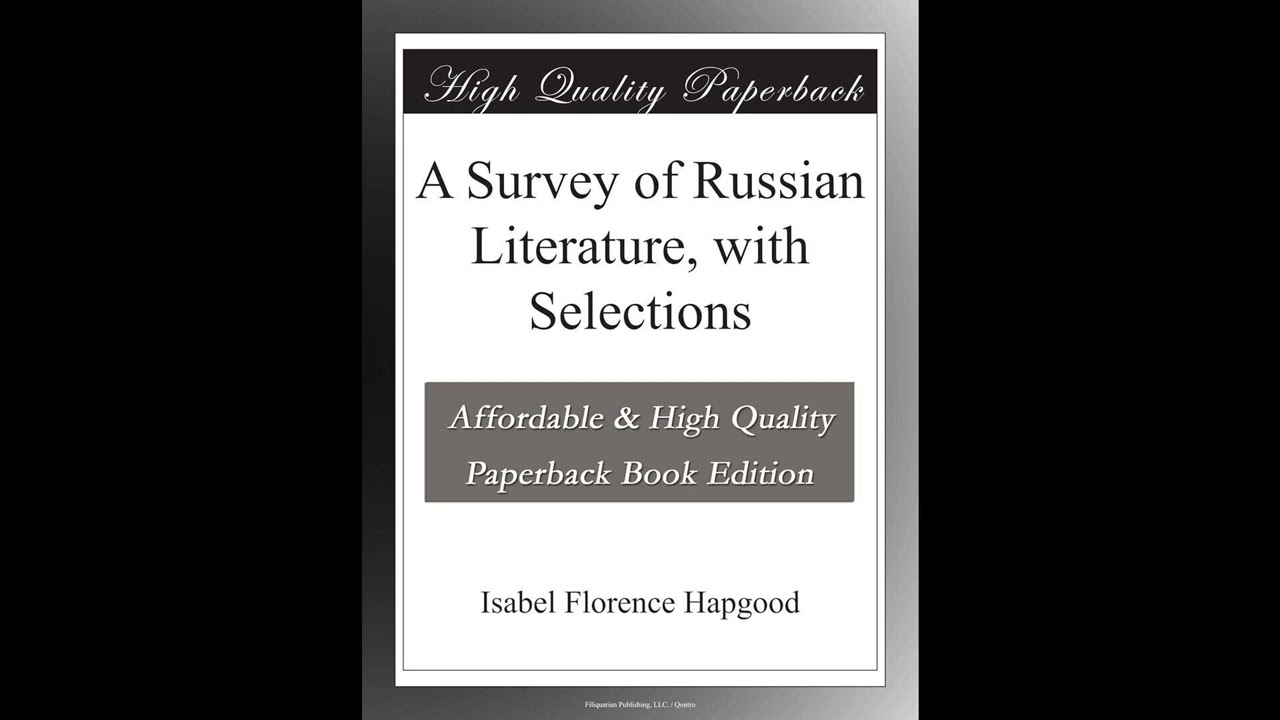
A Survey of Russian Literature, with Selections
Dive into the vast, often turbulent, and profoundly insightful world of Russian literature with Isabel Florence Hapgood's foundational work, A Survey of Russian Literature, with Selections. Far from a mere academic exercise, this audiobook offers a remarkable portal into the soul of a nation, as interpreted by one of its most dedicated and pioneering Western scholars. At a time when geopolitical forces continue to shape global understanding, the deep historical and cultural roots of Russia—as expressed through its literary giants—remain critically important. Hapgood’s work, originally published at a pivotal moment in the 20th century, provides not just an account of literary achievements but a window into the enduring human questions that artists from Pushkin to Tolstoy grappled with, questions that resonate with potent clarity even today. It stands as an invitation to understand a complex culture through the voices that defined it, curated and explained by an authority whose life’s work was dedicated to this very task. This extensive survey guides the listener through the rich landscape of Russian letters, beginning with its earliest forms and oral traditions before moving methodically into the celebrated Golden Age of the 19th century. Hapgood structures her account chronologically and thematically, introducing the figures who shaped Russian thought and expression. She begins by setting the stage with discussions of ancient Russian folklore, proverbs, and the religious literature that laid the groundwork for later secular works. The central progression of the story is the rise of a distinct national literature, moving from the anonymous singers of epic poems to the emergence of towering individual talents. The listener meets literary "characters" such as Alexander Pushkin, often considered the father of modern Russian literature, whose lyrical poetry and narrative verse established new standards. As the narrative progresses, Hapgood introduces Nikolai Gogol, whose satirical brilliance unmasked societal hypocrisies, and Ivan Turgenev, known for his nuanced depictions of the Russian intelligentsia and the changing rural landscape. The arc of the survey culminates in the literary titans of realism and spiritual inquiry: Leo Tolstoy, with his epic scope and moral philosophy, and Fyodor Dostoevsky, who plumbed the depths of human psychology and faith. Hapgood’s approach is not just a listing of names and works; she places each author within their historical and intellectual context, demonstrating how their creations responded to the unique challenges and aspirations of the Russian people. She does not simply present these writers; she unpacks their significance, showing how their collective output articulated a nation's conscience, its humor, its suffering, and its relentless search for meaning without revealing the specific conclusions of her analysis or the full scope of her critical judgments on individual works. Isabel Florence Hapgood was born in Boston in 1850, a time when interest in Russian culture in the West was just beginning to stir. Her early education provided a strong linguistic foundation, though she was largely self-taught in Russian, a testament to her formidable intellectual drive. She attended Radcliffe College, but her true education in Russian letters began with her first visit to Russia in 1887. This initial trip marked the beginning of a lifelong fascination and commitment, leading to numerous extended stays in the country, including during pivotal historical moments like the 1905 Revolution and World War I. Hapgood became more than just a scholar; she was an eyewitness to history and an unofficial cultural ambassador. Throughout her career, Hapgood established herself as one of the foremost translators of Russian literature into English, a monumental undertaking that profoundly shaped Western understanding of authors previously inaccessible to non-Russian speakers. Her translation of Tolstoy's War and Peace, for instance, was among the earliest complete renderings available to English readers, as were her versions of Dostoevsky's The Brothers Karamazov and Gogol's Dead Souls. Beyond translation, she authored original works like The Epic Songs of Russia (1886) and Russian Rambles (1895), which chronicled her personal observations of Russian life and culture. Hapgood's diligent work bridged a significant cultural gap, introducing generations of English speakers to the profound artistry and philosophical depth of Russian writers, securing her place as an indispensable figure in literary history. Hapgood’s Survey identifies and illustrates several core themes inherent in Russian literature. A recurring concern is the persistent questioning of Russian national identity and its relationship to both Western Europe and its own unique Slavic traditions. She shows how authors like Pushkin, in works like Eugene Onegin, wrestled with the "superfluous man" archetype—a Westernized Russian intellectual alienated from his own land. Another prominent theme is the role of suffering and redemption in the human experience. Dostoevsky, whom Hapgood translated, offers stark examples through his characters' intense psychological torments and their search for spiritual grace amidst moral degradation, vividly portrayed in scenes of poverty, crime, and religious fanaticism. Hapgood also highlights the pervasive theme of social critique and the search for justice, evident in Gogol's blistering satire of bureaucracy and corruption in works like The Inspector General, which used humor to expose the profound injustices of the serf system and official incompetence. Furthermore, Hapgood illuminates the tension between idealism and pragmatism that runs through much of 19th-century Russian writing. Turgenev, for example, frequently depicts the clash between older aristocratic values and the emerging radical nihilism of the younger generation in his novels, portraying characters caught between conflicting worldviews. Through these examples, Hapgood demonstrates how Russian literature served not merely as entertainment but as a profound reflection and interrogation of the nation's spiritual, moral, and political dilemmas. Her analysis provides concrete insights into how these writers used their craft to examine questions of freedom, fate, and the meaning of existence, often through detailed character studies and meticulously observed social dynamics. When A Survey of Russian Literature, with Selections was published in 1925, the world was a dramatically different place, especially concerning Russia. The October Revolution of 1917 had utterly transformed the country, replacing the Tsarist autocracy with the Soviet state. This seismic shift created an even greater Western hunger to understand the "Russian soul"—the unique cultural and psychological makeup that seemed to propel such radical change. Hapgood’s book emerged as a crucial resource in this period, providing a historical anchor to the literary past that had informed the present. It offered a lens through which to comprehend the profound spiritual and intellectual heritage of a nation that had just undergone one of history's most significant political upheavals. The work thus served a dual purpose: it celebrated the literary giants of the past while simultaneously offering a context for understanding the cultural forces at play in a newly formed global power. Listening to A Survey of Russian Literature, with Selections as an audiobook offers a unique way to engage with this substantial scholarly work. The narration provides a clear, steady voice, ideal for absorbing Hapgood's meticulous research and insightful interpretations over its several hours of listening time. This format allows the listener to process complex literary analysis and historical detail without the visual demands of print, making it perfect for sustained intellectual engagement during commutes, walks, or focused study sessions. Pay close attention to the narrator’s pacing, which thoughtfully allows for the assimilation of new concepts and the distinct atmosphere conjured when Hapgood quotes directly from the works she discusses. The auditory experience enhances the conversational yet authoritative tone of Hapgood's prose, making this extensive survey feel like a personal tutorial from an esteemed expert.
Enjoyed A Survey of Russian Literature, with Selections? A few ways to support us
Audible & Amazon links are affiliate; we may earn a small commission at no extra cost.
About this production
Human narration by a volunteer reader from LibriVox.org, the public-domain audiobook project. LibriVox volunteers record literary works whose copyright has expired in the United States, releasing the resulting recordings into the public domain.
A Survey of Russian Literature, with Selections by Isabel Florence Hapgood. The underlying text is in the U.S. public domain. We do not republish any modern copyrighted edition, translation, or commentary.
The 4K cinematic visuals accompanying this audiobook are generated by an AI image model from prompts derived from the source text. No copyrighted photos, paintings, or stock footage are used. AI generation is disclosed on every video on our YouTube channel as required by YouTube's altered/synthetic content policy.
English subtitles are transcribed from the LibriVox recording with OpenAI Whisper. Translations into the 11 other supported languages are produced by Meta's NLLB-200 neural translation model. No human translator's copyrighted translation is used.
Questions about sourcing or rights? See our DMCA & Sourcing policy or contact us.
Enjoyed this audiobook?
If you'd like to own a copy of A Survey of Russian Literature, with Selections or hear a professionally produced edition, the links below help support free audiobook production at no extra cost to you.
As an Amazon Associate we earn from qualifying purchases. Audible / print links are affiliate.