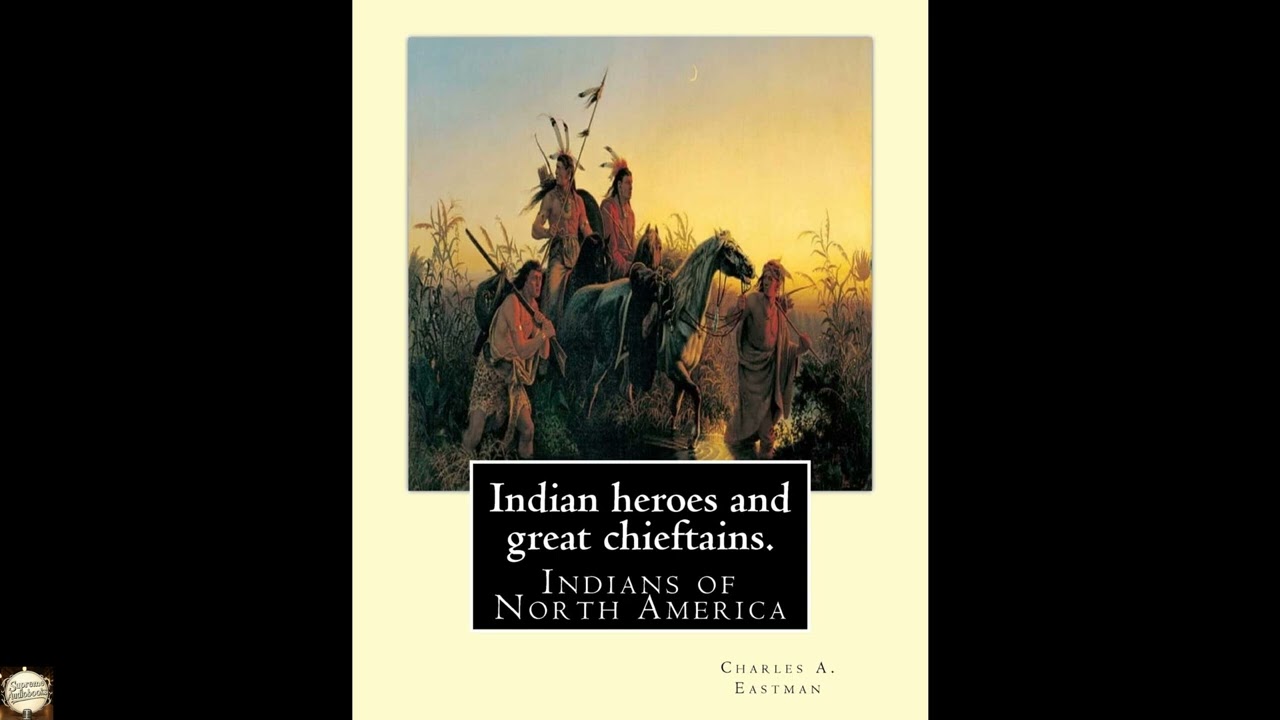
Indian heroes and great chieftains. By: Charles A. Eastman: Indians of North America -Full Audiobook
Step into a moment of history that ripples through our present, a narrative voice rarely heard in its original power and clarity. Indian Heroes and Great Chieftains by Charles A. Eastman is not merely a collection of historical sketches; it stands as a testament, a reclamation, and a vital counter-narrative to the dominant accounts of America's westward expansion. Through the intimate lens of a Santee Dakota physician and writer, we are granted an unprecedented perspective into the lives, philosophies, and struggles of the indigenous leaders who shaped an era. This is an opportunity to hear the stories of remarkable figures—men whose courage, wisdom, and resilience defined their peoples—from someone uniquely positioned to understand their world, their motives, and their profound place in American history. For anyone seeking a more complete, more human understanding of the foundational conflicts that forged a nation, this is essential listening. The book unfurls a panorama across the vast and contested landscapes of nineteenth-century North America, from the windswept plains to the forested valleys, where diverse Native American nations pursued their ways of life. It introduces us to an array of prominent figures, each a leader in his own right, navigating a world increasingly fractured by the encroachment of European-American settlers. These are not static portraits but dynamic accounts of men wrestling with impossible choices: whether to fight or negotiate, to preserve tradition or adapt to overwhelming change, to lead their people to war or seek peace in the face of insurmountable odds. The collective story woven through these biographies centers on the enduring clash of cultures. We encounter leaders like Sitting Bull, whose unwavering spiritual conviction and defiance became a symbol of resistance; Red Cloud, a strategic military genius who outmaneuvered the U.S. Army to secure a treaty; and Chief Joseph, renowned for his eloquence and his heartbreaking, valiant attempt to lead his people to freedom. The arc of these narratives follows the intensifying pressures faced by Native nations as their lands were encroached upon, their resources diminished, and their ways of life threatened. Eastman portrays their struggles with dignity and depth, presenting their actions not as mere reactions to invasion, but as deliberate choices rooted in cultural values, political acumen, and deep devotion to their communities. Each account contributes to a larger understanding of sovereignty, loss, and the unyielding human spirit. The author, Charles A. Eastman, born Hakadah (meaning "Pitiful Last") in 1858 in Redwood Falls, Minnesota, and later named Ohiyesa ("The Winner") after a lacrosse victory, lived a life that uniquely bridged two worlds. Raised in the traditional Santee Dakota manner until his teenage years, experiencing the aftermath of the Dakota War of 1862 and living as a refugee in Canada, he later embraced Western education. His father, Jacob Eastman, having converted to Christianity and served time in prison, encouraged Ohiyesa to attend white schools, believing it was the only path for survival. This led him through institutions like Dartmouth College and eventually to Boston University School of Medicine, where he became one of the first Native American physicians trained in Western medicine. Eastman's career was a fascinating blend of medicine, activism, and literary endeavor. He served as a government physician on Pine Ridge Reservation during the aftermath of the Wounded Knee Massacre, an experience that deeply affected him and spurred his commitment to advocating for his people. He later became involved with the YMCA, helped found the Boy Scouts of America, and worked to improve conditions on reservations. Through all this, his pen became a powerful tool. Beginning with his autobiography, From the Deep Woods to Civilization (1916), and continuing with works like Old Indian Days (1907) and The Soul of the Indian (1911), Eastman became one of the most significant early Native American authors. His writing sought to correct misconceptions about indigenous peoples, preserve their oral traditions, and interpret their cultures for a broad audience, positioning him as a crucial voice in both Native American and American literary traditions. This work powerfully enacts several enduring themes, most notably the complex nature of leadership and honor. Eastman meticulously details how these chiefs embodied the ideals of their respective nations—courage in battle, wisdom in counsel, generosity towards their people, and unwavering devotion to cultural tenets. For instance, he illustrates Sitting Bull's profound spiritual authority, not just as a war leader, but as a holy man whose visions guided his people and instilled confidence in their traditions against overwhelming odds. We also see how cultural preservation versus assimilation played out in the lives of these men. While some, like Red Cloud, demonstrated strategic brilliance in negotiating treaties that preserved land and rights for a time, others faced the stark choice of resistance or forced adaptation, often sacrificing individual comfort for the collective survival of their heritage. The narrative also highlights the themes of resistance and resilience in the face of profound injustice. The very existence and actions of these heroes stand as a testament to the persistent spirit of Native Americans during a period of relentless pressure and conflict. Chief Joseph's famous surrender speech, though not quoted directly in its entirety, is evoked by Eastman's recounting of his people's desperate flight and his poignant summation of their suffering, which underscores the painful compromises demanded of proud people. Moreover, the book implicitly addresses the theme of misunderstanding and injustice, offering a vital counterpoint to the often one-sided historical accounts of the "Indian Wars." Eastman presents these chiefs as complex individuals with rational motives, deep loyalties, and strategic minds, challenging the prevailing stereotypes of his era and advocating for a recognition of their humanity and dignity. Indian Heroes and Great Chieftains emerged in 1918, a pivotal moment in American history and Native American affairs. The "Indian Wars" had largely concluded, and the reservation system was firmly established, often accompanied by policies aimed at forced assimilation, such as the Dawes Act which sought to break up tribal lands. Culturally, there was a widespread belief among many non-Native Americans in the "vanishing race" —a romanticized but ultimately destructive idea that Native cultures were inevitably fading away. It was within this context that Eastman, uniquely positioned as both an insider to Dakota traditions and an accomplished Western-educated intellectual, took up his pen. His work was a deliberate effort to record and celebrate the lives of these leaders before their stories were fully subsumed or distorted by prevailing narratives. He sought to educate his contemporaries, offering a necessary humanization of figures often demonized or misunderstood, and to preserve for future generations the legacy of a proud and resilient people. Listening to Indian Heroes and Great Chieftains as an audiobook offers a particularly immersive and resonant experience. The narrative voice, steeped in Eastman's singular perspective, feels even more immediate when delivered orally, allowing his insights into these legendary figures to flow directly to the listener. With several hours of content, this audiobook provides ample time for contemplation, making it suitable for extended drives, quiet evenings, or moments of focused reflection. Listen for the thoughtful pacing of the narration, which allows the weight of each chieftain's story to settle. Notice how the voice subtly shifts to convey the gravity of historical events or the solemnity of personal reflections. The absence of actual recorded dialogue from the period is transcended by a narrative style that aims to capture the spirit and essence of these figures, creating an atmosphere that honors the oral traditions from which many of these histories were first born. This audio presentation breathes new life into accounts that are as relevant today as they were over a century ago.
Enjoyed Indian heroes and great chieftains. By: Charles A. Eastman: Indians of North America -Full Audiobook? A few ways to support us
Audible & Amazon links are affiliate; we may earn a small commission at no extra cost.
About this production
Human narration by a volunteer reader from LibriVox.org, the public-domain audiobook project. LibriVox volunteers record literary works whose copyright has expired in the United States, releasing the resulting recordings into the public domain.
Indian heroes and great chieftains. By: Charles A. Eastman: Indians of North America -Full Audiobook by Charles A. Eastman. The underlying text is in the U.S. public domain. We do not republish any modern copyrighted edition, translation, or commentary.
The 4K cinematic visuals accompanying this audiobook are generated by an AI image model from prompts derived from the source text. No copyrighted photos, paintings, or stock footage are used. AI generation is disclosed on every video on our YouTube channel as required by YouTube's altered/synthetic content policy.
English subtitles are transcribed from the LibriVox recording with OpenAI Whisper. Translations into the 11 other supported languages are produced by Meta's NLLB-200 neural translation model. No human translator's copyrighted translation is used.
Questions about sourcing or rights? See our DMCA & Sourcing policy or contact us.
Enjoyed this audiobook?
If you'd like to own a copy of Indian heroes and great chieftains. By: Charles A. Eastman: Indians of North America -Full Audiobook or hear a professionally produced edition, the links below help support free audiobook production at no extra cost to you.
As an Amazon Associate we earn from qualifying purchases. Audible / print links are affiliate.