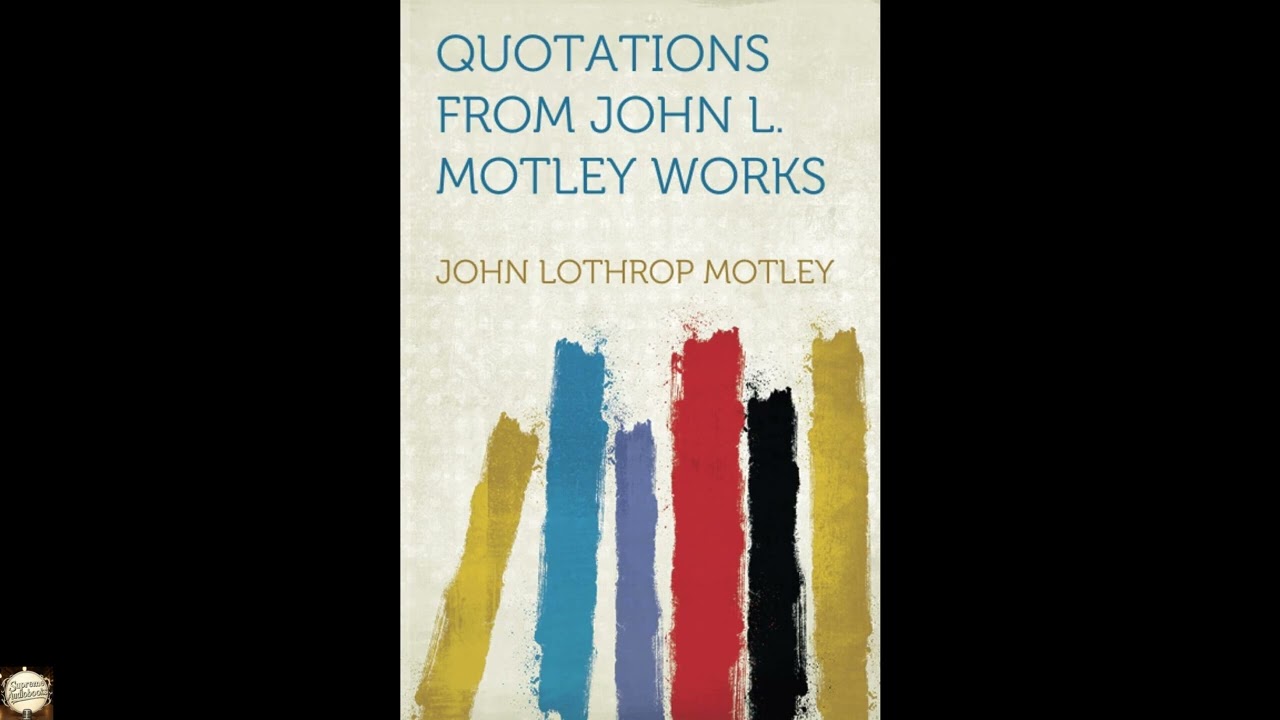
Quotations from John L. Motley Works
For those who find inspiration in the grand sweep of history, in the epic tales of nations forging their identity, and in the enduring power of human will, Quotations from John L. Motley Works offers a concentrated draught from the wells of one of America's most celebrated nineteenth-century historians. This compilation distills the potent observations, dramatic narratives, and profound insights of John Lothrop Motley, whose dedication to chronicling the birth of the Dutch Republic brought to life a pivotal struggle for freedom against overwhelming tyranny. It is a chance to hear the very voice of history, filtered through the eloquent prose of a scholar who believed that the past held vital lessons for the present, especially regarding the perennial conflict between liberty and oppression. Listeners today will find remarkable resonance in Motley's focus on self-determination, religious tolerance, and the moral courage required to stand against injustice. The core of Motley's historical ambition, from which these selections are drawn, was to narrate the gripping saga of the Low Countries during the sixteenth century, particularly the Eighty Years' War. This tumultuous period saw the various provinces of what is now the Netherlands and Belgium rise in revolt against the oppressive rule of the Spanish Empire. Motley paints a vivid picture of a deeply religious and fiercely independent people, initially under the distant, iron-fisted control of Philip II of Spain, whose unwavering commitment to Catholic orthodoxy led to relentless persecution of Protestants through the infamous Spanish Inquisition. The conflict escalates from civil unrest and brutal suppression, exemplified by the arrival of the Duke of Alva and his Council of Blood, to a full-scale war for independence. At the heart of this struggle stands William of Orange, often known as William the Silent, who emerges as the central figure. Motley presents him as a complex, pragmatic, and ultimately heroic leader who, despite personal losses and constant betrayal, dedicated his life to the cause of his people's freedom. The narrative arc, as captured in Motley's original volumes, follows William's strategic brilliance, his diplomatic maneuvers, and his unwavering resolve in the face of Spain's immense military might and seemingly inexhaustible resources. Listeners will encounter glimpses of dramatic sieges, fierce battles, acts of incredible bravery, and moments of profound despair, all culminating in the gradual, agonizing emergence of a new sovereign state built on republican principles. While these quotations offer fragments, they powerfully evoke the intensity of this defining struggle without revealing the ultimate resolution of the protracted war itself. John Lothrop Motley, born in Dorchester, Massachusetts, in 1814, was a figure of significant intellectual curiosity and tireless dedication. After graduating from Harvard and briefly studying law, he realized his true calling lay not in the courtroom but in the archives of history. Dissatisfied with early attempts at fiction, he found his life's purpose in immersing himself in the forgotten records of the Dutch revolt. This led him to spend years living abroad in Europe, notably in Dresden, Brussels, The Hague, and London, meticulously poring over original manuscripts, state papers, and contemporary chronicles. His monumental work, The Rise of the Dutch Republic, published in 1856, immediately established his reputation as a major historian. He followed this with the equally ambitious History of the United Netherlands (1860-1867) and The Life and Death of John of Barneveld (1874), cementing his place among the era's leading scholars. Motley was not merely a historian; he was also a diplomat, serving as the United States Minister to Austria from 1861 to 1867 and later as Minister to the United Kingdom from 1869 to 1870. His historical writings place him squarely within the tradition of the "Boston Brahmins," a group of distinguished New England authors and intellectuals who, in the mid-19th century, sought to combine rigorous scholarship with compelling narrative artistry. Alongside contemporaries such as William Hickling Prescott and Francis Parkman, Motley championed a style of history that was both deeply researched and dramatically engaging, often imbuing his narratives with a moralistic fervor and a clear admiration for the principles of liberty and Protestant self-governance. He died in 1877, leaving behind a legacy of scholarship that continues to inform our understanding of European history. The works of John Lothrop Motley, from which these quotations are drawn, resonate with several powerful and enduring themes. Foremost among them is the struggle for freedom and national self-determination. Motley vividly portrays the Dutch provinces, a collection of disparate cities and regions, uniting in a common cause against the overwhelming might of the Spanish Empire. For instance, the descriptions of the siege of Leiden, where citizens faced starvation rather than surrender, embody this theme, illustrating the relentless spirit of a people determined to carve out their own destiny. Another significant theme is the clash between religious liberty and dogmatic persecution. Motley’s narrative repeatedly highlights the horrors of the Spanish Inquisition and the relentless efforts to suppress Protestantism, presenting William of Orange as a champion of religious tolerance in an age of fanaticism. Quotations reflecting the courage of individuals to uphold their conscience against overwhelming pressure powerfully illustrate this. Additionally, Motley examines the power of individual leadership in shaping historical events. William the Silent emerges as a figure of remarkable political acumen, moral integrity, and unwavering dedication. Passages that highlight his strategic patience, his capacity to inspire loyalty, and his personal sacrifices for the greater good serve as a testament to the impact a single person can have on the course of a nation. Conversely, Motley also explores the nature of tyranny and its corrosive effects, showing how the distant cruelty of Philip II and the brutal governance of figures like the Duke of Alva bred resentment and ultimately fueled the very rebellion they sought to crush. The quotations capture the stark contrast between oppressors and the oppressed, offering insights into the human cost of unchecked power and the mechanisms of resistance. Motley composed his major historical works during a crucial period in American history, from the years leading up to the Civil War through the Reconstruction era. Culturally and politically, America was grappling with its own identity as a republic, debating the meaning of freedom, unity, and governance. Motley’s passionate accounts of the Dutch struggle for independence, their establishment of a republic, and their commitment to religious tolerance found a receptive audience in a nation that saw itself as a spiritual heir to these republican ideals. His work provided historical validation for concepts of self-rule and resistance against oppression, resonating deeply with the American experience. Within the literary world of the mid-19th century, Motley was a prominent figure in what is sometimes called the "Romantic History" movement. Historians of this era, including Thomas Babington Macaulay in Britain and Motley’s American counterparts, believed that history should not only be factual but also dramatic, engaging, and imbued with moral purpose. They aimed to tell a compelling story, using vivid characterizations, rich descriptive prose, and an often patriotic or Whiggish (progress-oriented) interpretation of events. Motley's commitment to rigorous archival research, combined with his dramatic storytelling prowess, perfectly exemplified this approach, making history accessible and exciting to a broad readership and establishing his works as central to the period's intellectual discourse. Listening to Quotations from John L. Motley Works as an audiobook offers a singular opportunity to connect directly with the powerful prose and penetrating intellect of this celebrated historian. A thoughtful narration brings Motley's carefully constructed sentences and compelling arguments to life, allowing his distinct voice and rhetorical flourishes to truly resonate. The measured pacing of an audiobook is particularly well-suited for a collection of quotations, providing ample space for each selection to be fully absorbed and considered. Listeners can appreciate the cadence of Motley's language, his ability to craft memorable aphorisms, and the underlying passion that infused his scholarly endeavors. It provides an immersive experience, akin to having Motley himself present his most compelling observations and insights, allowing the listener to reflect on his grand historical perspective and its enduring relevance in today’s world.
Enjoyed Quotations from John L. Motley Works? A few ways to support us
Audible & Amazon links are affiliate; we may earn a small commission at no extra cost.
About this production
Human narration by a volunteer reader from LibriVox.org, the public-domain audiobook project. LibriVox volunteers record literary works whose copyright has expired in the United States, releasing the resulting recordings into the public domain.
Quotations from John L. Motley Works by John Lothrop Motley. The underlying text is in the U.S. public domain. We do not republish any modern copyrighted edition, translation, or commentary.
The 4K cinematic visuals accompanying this audiobook are generated by an AI image model from prompts derived from the source text. No copyrighted photos, paintings, or stock footage are used. AI generation is disclosed on every video on our YouTube channel as required by YouTube's altered/synthetic content policy.
English subtitles are transcribed from the LibriVox recording with OpenAI Whisper. Translations into the 11 other supported languages are produced by Meta's NLLB-200 neural translation model. No human translator's copyrighted translation is used.
Questions about sourcing or rights? See our DMCA & Sourcing policy or contact us.
Enjoyed this audiobook?
If you'd like to own a copy of Quotations from John L. Motley Works or hear a professionally produced edition, the links below help support free audiobook production at no extra cost to you.
As an Amazon Associate we earn from qualifying purchases. Audible / print links are affiliate.