Herodias
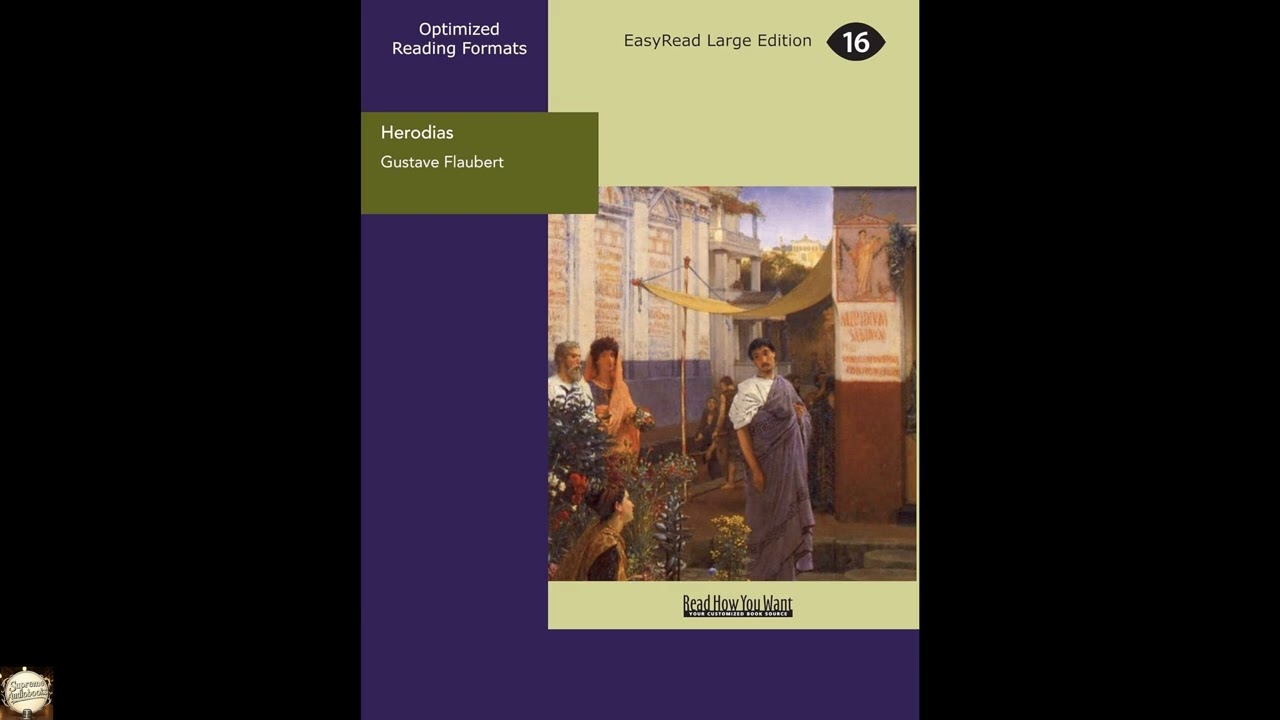
Gustave Flaubert’s Herodias pulls back the curtain on an ancient world, a land seething with political intrigue, religious fervor, and the dangerous currents of human desire. More than just a retelling of a familiar biblical episode, this novella, part of his later collection Three Tales, plunges listeners into the sweltering, claustrophobic atmosphere of the fortress of Machaerus in first-century Judea. It’s a story about the clashing forces of power, faith, and personal vengeance, a stark drama whose echoes of fanaticism and moral compromise resonate with unsettling clarity even in our own time. Why should we care about this story of Herod, Herodias, Salome, and John the Baptist today? Because Flaubert, with his characteristic precision and psychological depth, strips away the familiar to reveal the raw, human motivations behind actions that shaped history and continue to provoke thought about the cost of conviction and the allure of forbidden pleasure. The sun-baked ramparts of Machaerus serve as the stage for this grim spectacle. Tetrarch Herod Antipas, a man perpetually caught between the demands of Rome, the clamor of his own people, and the unsettling pronouncements of prophets, is the central figure. He is married to Herodias, a woman of ruthless ambition and cold determination, who has left her former husband to join him. Into this precarious court is brought John, a gaunt, fiery prophet who rails against their union as incestuous and unlawful, a voice of uncompromising moral judgment echoing from the desert. His imprisonment within Machaerus becomes the focal point for a gathering storm. John’s disciples gather outside, while within the fortress, Herodias schemes for his execution, seeing him as a threat to her position and her honor. Herod, meanwhile, finds himself strangely fascinated by the prophet, even as he dreads the political fallout of silencing him. The narrative meticulously details the arrival of various dignitaries, merchants, and soldiers for Herod’s birthday feast, each with their own agenda, their own loyalties. Parthian envoys, Roman officials, Galilean peasants – all converge, highlighting the volatile geopolitical landscape of the era. The tension mounts as the evening progresses, with John’s presence, though unseen, a constant, oppressive weight. Herodias manipulates her husband and uses the innocent appeal of her daughter, Salome, as a deadly instrument. The famous dance, executed with a disturbing blend of sensuality and childlike obedience, becomes the pivotal moment, a spectacle designed to extract a promise from Herod Antipas, a promise he cannot easily retract once given. The story expertly builds towards this singular, fateful request, laying bare the motivations and fears of all involved, leaving the listener on the precipice of a terrible decision. Gustave Flaubert, born in Rouen, France in 1821, and passing away in 1880, dedicated his life with monastic rigor to the craft of writing. The son of a surgeon, his childhood was marked by a fascination with the macabre and the theatrical. After a brief, unsuccessful attempt at legal studies, he committed himself entirely to literature, living largely in seclusion at his country estate in Croisset. Flaubert was a relentless perfectionist, notorious for his agonizing search for le mot juste – the precisely right word – and for spending days on a single paragraph. This meticulousness defined his literary output and left an indelible mark on modern prose. His works established him as a towering figure of realism, though his individual style often transcended the strictures of any single movement. His groundbreaking novel, Madame Bovary (1856), led to an obscenity trial, ultimately acquitted, cementing his reputation as a controversial but significant voice. Other notable works include Salammbô (1862), an epic historical novel set in ancient Carthage, Sentimental Education (1869), a sprawling commentary on French society, and his unfinished satirical masterpiece, Bouvard and Pécuchet. Herodias, published in 1877 as part of Three Tales, showcases his continuing interest in historical reconstruction and psychological drama, employing the same objective, detached narration that made him so influential. He is widely considered one of the greatest French novelists, a master stylist whose influence on subsequent generations of writers is immeasurable. Several powerful themes emerge from the precise, objective narrative of Herodias. One is the theme of power and corruption, illustrated by Herod Antipas's constant struggle to maintain his fragile authority. We see him attempting to appease Roman officials and Parthian emissaries, while simultaneously fearing the popular uprising that John the Baptist might incite. His vacillation, his desperate attempts to juggle competing interests—his wife’s demands, his own desires, the threat of religious revolt—show the corrosive effects of a power held tenuously and without true moral conviction. For instance, his internal debate over John, viewing him both as a holy man and a dangerous political nuisance, perfectly encapsulates this tension. Another central theme is the clash between religious conviction and political expediency. John the Baptist stands as an unyielding beacon of moral absolute, his voice a stark contrast to the shifting loyalties and pragmatic compromises of the court. His pronouncements, even from his prison cell, have a profound impact, drawing crowds and unsettling the powerful. Flaubert shows us how John’s unwavering condemnation of Herod’s marriage is not just a theological dispute, but a direct challenge to the very legitimacy of Herod’s rule, forcing the Tetrarch to choose between personal piety and the practical necessities of maintaining order. Finally, the story powerfully renders desire and obsession. Herodias's desire for revenge against John is a cold, calculated fury, while Herod's own complex desires—his attraction to Salome, his conflicted feelings for Herodias, his fear of John—create a volatile mix that drives the narrative towards its tragic conclusion. The depiction of Salome's dance, designed to inflame Herod's lust and secure a terrible boon, stands as a chilling example of desire being weaponized. When Herodias was published in 1877, Flaubert was nearing the end of his illustrious career. France in the late nineteenth century was a nation grappling with its identity in the wake of the Franco-Prussian War and the Paris Commune, an era marked by shifting political landscapes and a growing interest in historical scholarship and archeological discovery. Flaubert himself was known for his rigorous research, a trait evident in the richly detailed ancient settings of both Salammbô and Herodias. This was a period when authors were increasingly looking to history, not just for exotic backdrops, but for a deeper understanding of human nature and societal forces. Flaubert’s work emerged from a literary context where Realism had become dominant, yet he always pushed its boundaries, marrying his objective observation with a profound sense of stylistic artistry and psychological penetration. Herodias reflects this era’s fascination with antiquity and the reinterpretation of religious narratives through a more secular, psychologically astute lens, presenting a biblical tale with an almost documentary-like precision and detachment. Listening to Herodias as an audiobook offers a unique opportunity to immerse oneself fully in Flaubert’s meticulously crafted world. A skilled narrator can bring to life the oppressive heat of the Judean desert, the clanking armor of soldiers, the murmur of the crowds, and the stifling atmosphere of the banquet hall. Flaubert’s prose, celebrated for its musicality and rhythm, truly shines when read aloud. The narrative's pacing, building inexorably towards its dramatic climax over several hours of listening, allows for a focused engagement with the subtle shifts in character, the unspoken tensions, and the richly detailed historical backdrop. Pay close attention to how the narrator articulates the stark contrast between John’s uncompromising pronouncements and Herod’s hesitant, often self-serving reflections, or the chillingly calm determination of Herodias. The spoken word allows the listener to truly savor the carefully chosen descriptions and dialogue, transforming the ancient tragedy into a visceral, immediate experience.
Enjoyed Herodias? A few ways to support us
Audible & Amazon links are affiliate; we may earn a small commission at no extra cost.
About this production
Human narration by a volunteer reader from LibriVox.org, the public-domain audiobook project. LibriVox volunteers record literary works whose copyright has expired in the United States, releasing the resulting recordings into the public domain.
Herodias by Gustave Flaubert. The underlying text is in the U.S. public domain. We do not republish any modern copyrighted edition, translation, or commentary.
The 4K cinematic visuals accompanying this audiobook are generated by an AI image model from prompts derived from the source text. No copyrighted photos, paintings, or stock footage are used. AI generation is disclosed on every video on our YouTube channel as required by YouTube's altered/synthetic content policy.
English subtitles are transcribed from the LibriVox recording with OpenAI Whisper. Translations into the 11 other supported languages are produced by Meta's NLLB-200 neural translation model. No human translator's copyrighted translation is used.
Questions about sourcing or rights? See our DMCA & Sourcing policy or contact us.
Enjoyed this audiobook?
If you'd like to own a copy of Herodias or hear a professionally produced edition, the links below help support free audiobook production at no extra cost to you.
As an Amazon Associate we earn from qualifying purchases. Audible / print links are affiliate.