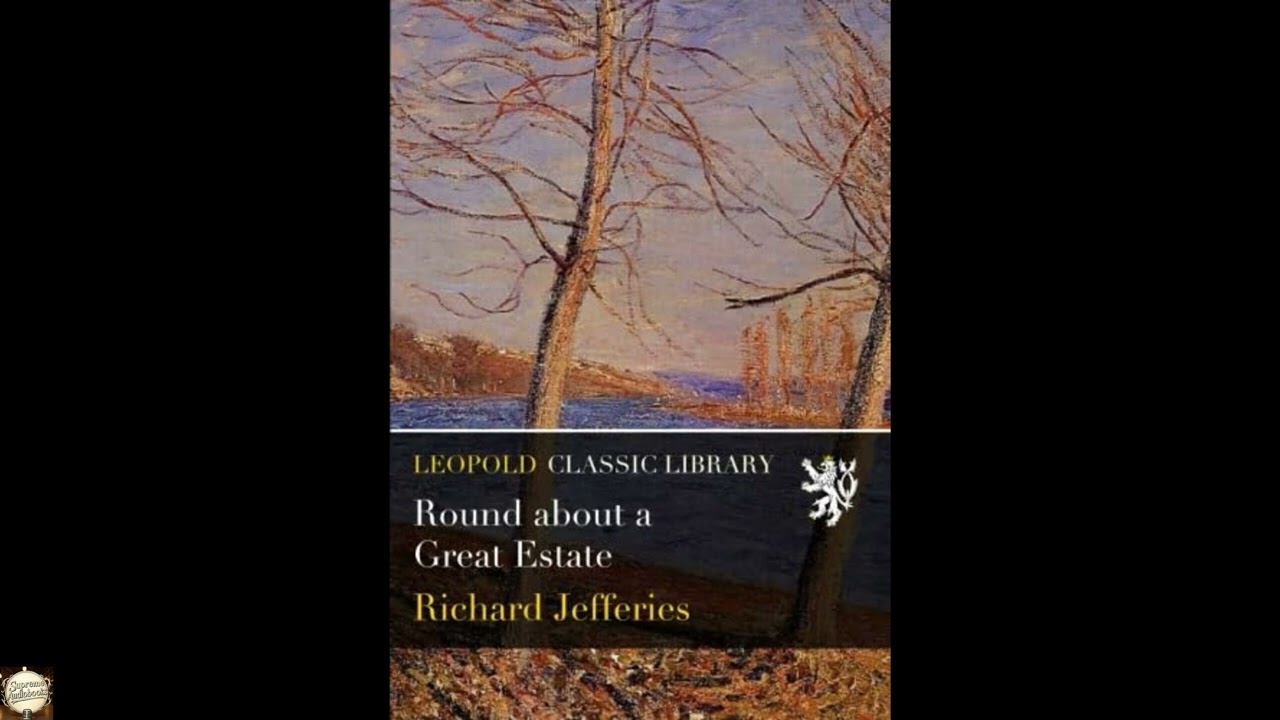
Round about a Great Estate
Richard Jefferies's Round about a Great Estate offers listeners a rare invitation: a chance to step into a meticulously observed world that, even in his own time, was already beginning to vanish. More than a simple pastoral account, this audiobook functions as a finely etched time capsule, preserving the sights, sounds, and rhythms of rural England in the late Victorian era. It is a work that speaks to our contemporary fascination with nature, the delicate balance of ecosystems, and the quiet dignity of a life lived close to the earth. For anyone seeking solace from the clamor of modern existence, or a deeper understanding of the foundations upon which our landscapes and communities were built, this book presents a profound and utterly unique experience, allowing us to bear witness to an older, slower pace of life, and reflect on what has been lost and what endures. The book unfurls not as a linear narrative with a dramatic climax, but as a series of interconnected vignettes and reflections, all centered on a substantial landed estate in the English countryside—a place Jefferies knew intimately. Through the eyes of a sensitive, observant narrator, listeners are introduced to the various inhabitants and natural cycles that define this world. There are the great house and its aristocratic occupants, whose influence extends over acres of land and the lives of countless individuals; the tenant farmers, bound by tradition and the uncertainties of weather and market; the laborers in their humble cottages, whose days are marked by the toil of the fields and the changing seasons; and the often-overlooked figures of the gamekeepers, poachers, and villagers, each playing their distinct part in the intricate social and economic web. The central narrative arc, if one can call it that, is the passage of time itself – the turning of the seasons, the ebb and flow of daily life, and the subtle shifts in the landscape and its human population. The narrator acts as an almost invisible chronicler, detailing everything from the specific calls of birds in the hedgerows to the intricacies of agricultural practices, the customs of the local folk, and the deep, unspoken connection between people and the land they work. While no single major conflict drives the story, a continuous tension exists between the enduring natural world and the ephemeral, often challenging lives of the people trying to carve out an existence within it, all observed with a keen, empathetic eye that hints at both admiration and a quiet melancholy for what is slowly slipping away. Richard Jefferies was born in 1848 at Coate Farm, just outside Swindon, Wiltshire, a landscape that would forever inform his writing. The son of a struggling farmer, he grew up immersed in the rhythms of the countryside, developing an almost preternatural sensitivity to the natural world around him. His childhood was spent roaming fields and woods, cultivating a deep knowledge of local flora and fauna, and observing human life with a keen, often solitary, intelligence. This early immersion laid the groundwork for his distinctive voice, which blends the precise observation of a naturalist with the poetic insight of a mystic. After a largely self-taught education, Jefferies initially pursued a career in journalism, contributing articles to local newspapers. However, it was his shift to nature writing that brought him widespread recognition. His breakthrough came with The Gamekeeper at Home in 1878, a collection of essays that vividly portrayed the life of a rural gamekeeper and the natural environment he inhabited. This work cemented his reputation as a leading voice in English nature prose. Despite a prolific output, including works like Wild Life in a Southern County, the deeply spiritual and autobiographical The Story of My Heart, and the proto-apocalyptic novel After London, Jefferies battled ill health throughout much of his adult life, suffering from tuberculosis and other ailments. He died prematurely in 1887 at the age of 38, leaving behind a body of work that continues to resonate with readers and secures his place as a foundational figure in English nature writing and ecological thought. Round about a Great Estate beautifully enacts several profound themes. One primary concern is the permanence and cyclical nature of the land versus the transient lives of its inhabitants. Jefferies repeatedly draws attention to the ancient oaks and immemorial fields, which have witnessed generations of human struggle and joy. He describes, for instance, a particularly gnarled hawthorn bush, a sentinel on a hill, that has seen countless dawns and dusks, remaining unchanged while the families working the land beneath it come and go, highlighting humanity's small scale against the backdrop of geological time. Another strong current is the intricate social hierarchy and the dignity of rural labor. The book details the relationships between the lord of the manor, the tenant farmer, and the daily laborers, often illustrating the stark realities of their lives. We see a farmer meticulously tending his sheep through a harsh winter, his survival dependent on his skill and resilience, a clear example of the interdependence and sometimes harsh realities of Victorian rural class structures. A pervasive sense of nostalgia and the passing of an older way of life also permeates the prose. Jefferies wrote during a period of rapid industrialization and urbanization, and his observations often carry an undertone of lament for a disappearing world. He captures traditional farming methods and village customs with an almost archaeological precision, as if preserving them against the tide of change. For example, he might describe the specific, now-forgotten tools used for harvesting or the traditional songs sung during a seasonal festival, indicating a profound appreciation for practices that were already becoming obsolete. Finally, the book stands as a testament to the power of sensory observation and an almost spiritual intimacy with the natural world. Jefferies’s writing is filled with precise, evocative details: the exact hue of sunlight filtering through autumnal leaves, the specific smell of rain on dry earth, or the intricate markings on a beetle's carapace. He invites us to look closer, to listen more carefully, and to feel the pulse of the living world with an intensity rarely matched. When Round about a Great Estate was published in 1880, England was undergoing significant transformations. The latter half of the Victorian era saw an accelerating impact from the Industrial Revolution, drawing people from the countryside into burgeoning factory towns and cities. Agricultural practices were mechanizing, and an agricultural depression was affecting many rural areas, leading to poverty and displacement. Jefferies, living in the heart of this changing landscape, felt a deep urgency to record the vanishing rural England he knew and loved. His work emerged from a specific cultural moment marked by both a scientific interest in natural history and a growing romanticized yearning for an idealized, simpler past. It served as both a social commentary on the realities of rural life—often far from idyllic—and a powerful elegy for a landscape and a way of life that he recognized were fast receding into history. Listening to Round about a Great Estate as an audiobook offers a singular opportunity to fully immerse oneself in Jefferies's rich, descriptive prose. The extended run length makes it an ideal companion for long walks through the countryside, quiet evenings at home, or reflective drives, allowing the listener to truly settle into the rhythm of the narrative. A skilled narrator can bring Jefferies's keen observations to life, giving voice to the gentle rustling of leaves, the distant call of a cuckoo, or the subtle inflections in a farmer's speech. The meditative pacing, filled with detailed descriptions of the natural world and the quiet lives of its human inhabitants, allows the listener to absorb the atmosphere and contemplate the themes at their own pace, transforming the act of listening into an act of mindful presence and connection to a world both distant and surprisingly resonant.
Enjoyed Round about a Great Estate? A few ways to support us
Audible & Amazon links are affiliate; we may earn a small commission at no extra cost.
About this production
Human narration by a volunteer reader from LibriVox.org, the public-domain audiobook project. LibriVox volunteers record literary works whose copyright has expired in the United States, releasing the resulting recordings into the public domain.
Round about a Great Estate by Richard Jefferie. The underlying text is in the U.S. public domain. We do not republish any modern copyrighted edition, translation, or commentary.
The 4K cinematic visuals accompanying this audiobook are generated by an AI image model from prompts derived from the source text. No copyrighted photos, paintings, or stock footage are used. AI generation is disclosed on every video on our YouTube channel as required by YouTube's altered/synthetic content policy.
English subtitles are transcribed from the LibriVox recording with OpenAI Whisper. Translations into the 11 other supported languages are produced by Meta's NLLB-200 neural translation model. No human translator's copyrighted translation is used.
Questions about sourcing or rights? See our DMCA & Sourcing policy or contact us.
Enjoyed this audiobook?
If you'd like to own a copy of Round about a Great Estate or hear a professionally produced edition, the links below help support free audiobook production at no extra cost to you.
As an Amazon Associate we earn from qualifying purchases. Audible / print links are affiliate.