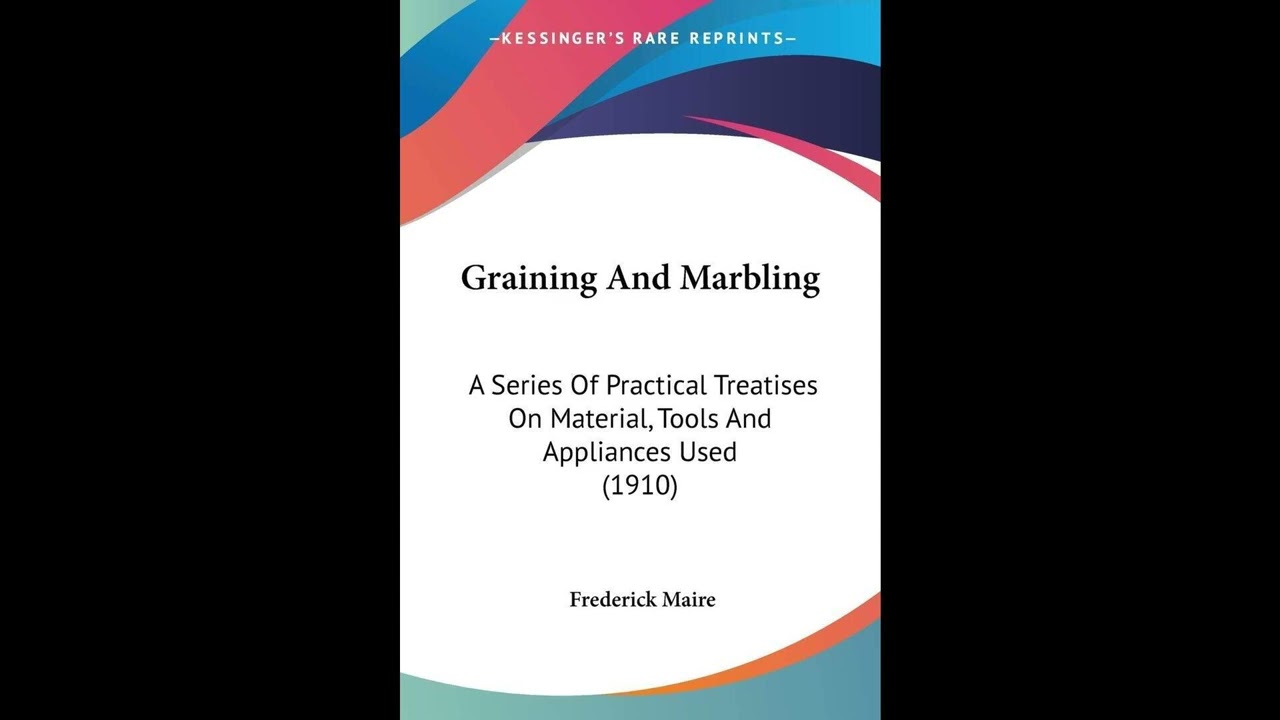
Graining And Marbling: A Series Of Practical Treatises On Material, Tools And Applia- Full Audiobook
"Graining And Marbling: A Series Of Practical Treatises On Material, Tools And Applia-" is not merely an instruction manual; it is a profound echo from a bygone era, preserving the secrets of an almost forgotten art form. Imagine a time when true craftsmanship transformed ordinary surfaces into illusions of unparalleled beauty. This comprehensive guide, now brought to life as an audiobook, offers listeners a unique opportunity to connect with the dedication and ingenuity of artisans who, with brush and pigment, conjured the grandeur of exotic wood and polished stone. Far from being a dry technical read, it stands as a testament to the enduring human desire to beautify our surroundings, offering not just instruction but an immersive window into the meticulous handwork that once graced stately homes and public buildings. For anyone fascinated by historical crafts, the aesthetics of illusion, or the sheer artistry of transformation, this detailed account promises a deeply satisfying and illuminating experience, revealing the historical roots of visual deception and the enduring allure of skilled imitation. The "story" within these treatises unfolds through the methodical, step-by-step transformation of inert matter. Its "setting" is manifold: the humble workshop where pigments are ground, the blank canvas of a plain wall or door awaiting metamorphosis, and finally, the elegant drawing-room where the finished illusion will reside. Its "characters" are the materials themselves—plain wood, plaster, versatile brushes, and paints holding the promise of deception. A core conflict arises from the inherent challenge of creating a convincing imitation. How does one, with human hands, replicate the organic randomness of an oak slice or the intricate veining of a marble slab? The treatises present this as a series of problems to be solved, each demanding precision, observation, and an understanding of nature's own design principles. The arc of this narrative begins with fundamental preparation: cleaning surfaces, mixing specific shades, and selecting the correct tools. It progresses through the meticulous application of base coats, the layering of glazes, and the delicate art of "graining"—pulling a comb or dragging a brush to simulate wood's natural growth rings. The listener is guided through mastering basic strokes, learning to distinguish a passable imitation from a truly convincing one. Each practical lesson builds upon the last, moving from simpler wood grains like deal or maple to the complex patterns of satinwood and mahogany. The tension is sustained by the promise of achieving perfect verisimilitude, of crafting an illusion so complete that the eye struggles to discern the faux from the genuine. Later sections elevate the craft to intricate marbling. Here, the artisan confronts the formidable task of reproducing the swirling depths and mineral striations of various marbles—Rosso Antico, Siena, Vert Antique. The conflict intensifies as techniques become more elaborate: floating colors on water, stippling, veining with fine pencils, and polishing to a stone-like sheen. There is no traditional resolution or sudden twist, but rather a culmination in mastery. This "story" concludes not with a dramatic revelation, but with the quiet satisfaction of skill honed and knowledge imparted, leaving the listener equipped to confront their own surfaces and transform them with newfound expertise, thereby perpetuating the art itself. The authorship of "Graining And Marbling" remains uncredited, typical for a period when many practical guides were compiled by anonymous masters or represented collective wisdom. This anonymity, far from diminishing the work, elevates it to a representative voice of an entire tradition. It speaks for the countless unnamed craftsmen and artisans who perfected these skills over generations, passing down techniques through apprenticeships rather than formal literary publication. The absence of a single author allows the treatises to embody a broader, more communal understanding of the craft, reflecting a shared heritage of decorative artistry. These treatises likely coalesced during the late nineteenth and early twentieth centuries, a golden age for decorative arts when an expanding middle class sought to emulate the grandeur of the elite. Manuals such as this served as crucial educational tools, democratizing access to skills that had once been closely guarded secrets. They provided aspiring decorators, house painters, and even enthusiastic amateurs with the detailed instructions necessary to elevate ordinary interiors. The work stands not as an individual literary statement, but as a foundational text in the canon of decorative painting, defining standards and methodologies widely adopted and practiced throughout the Western world. It represents a significant moment in the history of technical instruction, demonstrating a structured approach to artistic learning before widespread establishment of formal art schools focused on commercial crafts. At its core, "Graining And Marbling" is a meditation on the powerful theme of illusion versus reality. The entire premise of the craft is to create a visual deception so convincing that a painted surface appears to be genuine wood or stone. The instructions meticulously detail how to mimic the "pores" of hard wood or the "shattered" effect of a geological fault in marble. One instruction might describe the precise flick of a badger hair brush to soften a grain line, ensuring it appears naturally formed. This constant striving for authentic reproduction asks the practitioner, and by extension the listener, to consider the nature of truth in appearances. Another prominent theme is the democratizing power of art and craftsmanship. In an age when genuine exotic woods and rare marbles were prohibitively expensive, graining and marbling offered an accessible alternative, allowing even modest homes to achieve a degree of elegance and sophistication previously reserved for the wealthy. The treatises provide step-by-step guidance on transforming plain pine into rich mahogany, or simple plaster into luxurious Siena marble, making high-end aesthetics attainable for a broader segment of society. This impulse speaks to a human desire for beauty transcending economic barriers. A specific instruction on creating the distinctive "eyes" in bird's-eye maple, for instance, offers a path for anyone with skill and patience to produce what would otherwise be a costly material. The work therefore holds significant literary value as a document of cultural aspiration and the human ingenuity employed to meet it, elevating a practical manual into a reflection on societal values and aesthetic accessibility. This type of instructional manual emerged from a specific confluence of cultural and economic forces that characterized the late 19th and early 20th centuries. The rapid expansion of industrial production led to a greater availability of raw building materials, but also an increased desire among a growing middle class for decorative finishes that could elevate their homes beyond simple utility. There was a burgeoning interest in interior design, often influenced by the grandeur of Victorian and Edwardian styles, which heavily favored ornate and "natural" finishes. Yet, the cost of importing rare woods or quarrying exotic marbles remained prohibitive for most. "Graining And Marbling" directly addresses this demand. Its appearance reflects an era when education in practical arts was highly valued, not just for vocational training but also for personal enrichment. It aligned with the broader Arts and Crafts movement's emphasis on skilled handiwork and a return to traditional techniques, even as it served a parallel desire for decorative embellishment in a time of mass production. The detailed instructions represent a codification of knowledge that might previously have been passed down orally, signifying a shift towards making such expertise widely available through printed—and now audio—media. It is a product of an age that simultaneously embraced industrial progress and retained a deep appreciation for the beauty and skill of artisanal creation, acting as a bridge between the manufactured and the artfully handcrafted. Listening to "Graining And Marbling" as an audiobook transforms a potentially dense technical text into an immersive and accessible experience. The careful narration allows each precise instruction, each mixing ratio, and each delicate brushstroke technique to unfold with clarity and measured pace, akin to a master artisan speaking directly to an apprentice. The run length, extending over several hours, is perfectly suited for absorbing complex sequences of operations, allowing the listener to visualize the stages of transformation without the distraction of a printed page. One can absorb the subtle distinctions between different wood grains, the nuanced descriptions of color blending, or the detailed steps for replicating specific marble patterns, all while perhaps engaged in other contemplative tasks. The narrator's voice becomes a calm, guiding presence, bringing a tangible atmosphere of quiet concentration and skilled craft to the modern listener, allowing the historical methods to resonate with newfound immediacy and perhaps even inspire their own creative endeavors.
Enjoyed Graining And Marbling: A Series Of Practical Treatises On Material, Tools And Applia- Full Audiobook? A few ways to support us
Audible & Amazon links are affiliate; we may earn a small commission at no extra cost.
About this production
Human narration by a volunteer reader from LibriVox.org, the public-domain audiobook project. LibriVox volunteers record literary works whose copyright has expired in the United States, releasing the resulting recordings into the public domain.
Graining And Marbling: A Series Of Practical Treatises On Material, Tools And Applia- Full Audiobook. The underlying text is in the U.S. public domain. We do not republish any modern copyrighted edition, translation, or commentary.
The 4K cinematic visuals accompanying this audiobook are generated by an AI image model from prompts derived from the source text. No copyrighted photos, paintings, or stock footage are used. AI generation is disclosed on every video on our YouTube channel as required by YouTube's altered/synthetic content policy.
English subtitles are transcribed from the LibriVox recording with OpenAI Whisper. Translations into the 11 other supported languages are produced by Meta's NLLB-200 neural translation model. No human translator's copyrighted translation is used.
Questions about sourcing or rights? See our DMCA & Sourcing policy or contact us.
Enjoyed this audiobook?
If you'd like to own a copy of Graining And Marbling: A Series Of Practical Treatises On Material, Tools And Applia- Full Audiobook or hear a professionally produced edition, the links below help support free audiobook production at no extra cost to you.
As an Amazon Associate we earn from qualifying purchases. Audible / print links are affiliate.
More by Unknown

Cattle and Their Diseases Embracing Their History and Breeds, Crossing and Breeding,- Full Audiobook

Studies in the Life of the Christian Church
New York At The Louisiana Purchase Exposition, St. Louis, 1904: Report Of The New Y