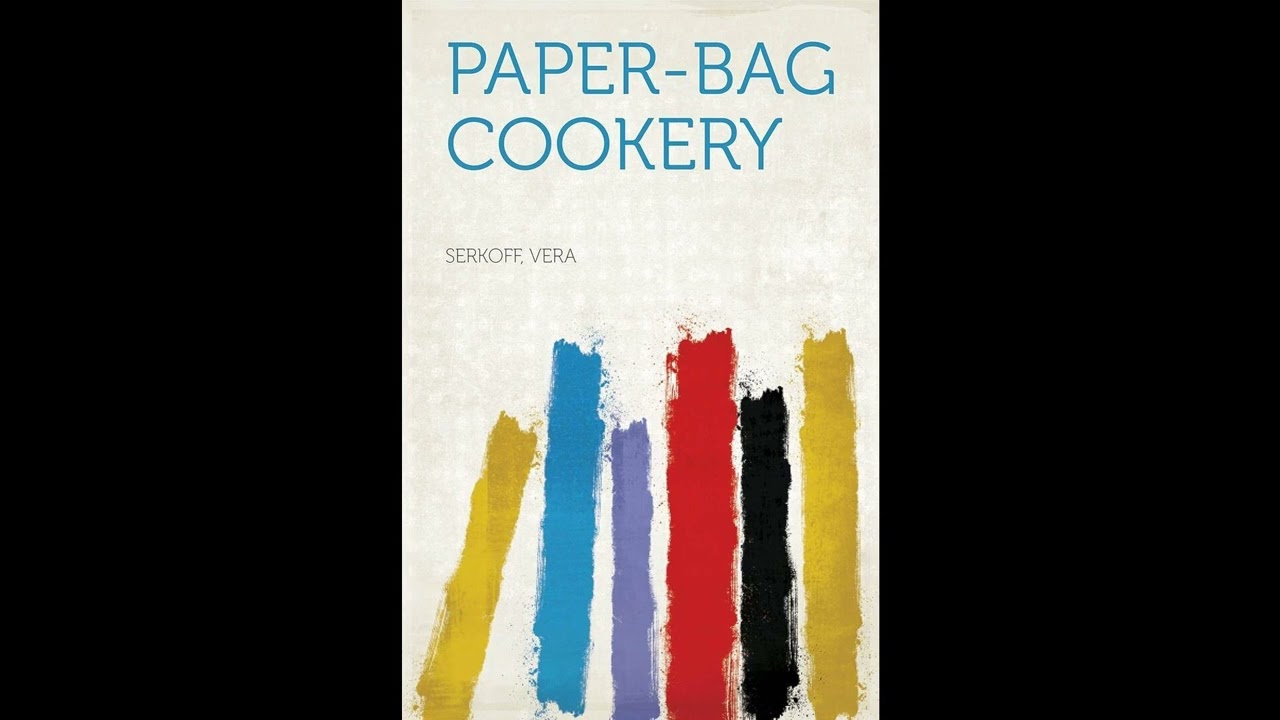
Paper-Bag Cookery
"Paper-Bag Cookery." The title itself conjures images both quaint and revolutionary, hinting at a domestic ingenuity that transcends mere recipe instruction. From the elegant pen of Countess Vera Serkoff comes not merely a practical guide, but a compelling look into a moment when the home kitchen became a laboratory for efficiency, economy, and quiet liberation. This classic text, far more than its unassuming title suggests, offers a profound glimpse into a bygone era's approach to everyday challenges, transforming the mundane act of meal preparation into a testament to resourcefulness. It stands today as a fascinating artifact of its time, a testament to the enduring human spirit of innovation, and an unexpected source of inspiration for modern listeners navigating their own domestic spheres with an eye towards simplicity and mindful living. The narrative arc of Paper-Bag Cookery unfolds not through conventional character drama, but through the exposition and demonstration of a revolutionary culinary method designed to transform the daily grind of the kitchen. Countess Serkoff establishes her setting implicitly, painting a vivid picture of the early twentieth-century domestic landscape—a world often burdened by the time-consuming demands of cooking, fuel scarcity, and the ever-present challenge of producing nourishing meals within a household budget. The central "character" is arguably the innovative technique itself: paper-bag cookery, introduced as a beacon of hope for the beleaguered homemaker. Serkoff presents the "conflict" as the struggle against culinary inefficiency, the waste of energy and ingredients, and the pervasive misconception that fine dining requires elaborate efforts. Listeners are guided through the initial skepticism surrounding this novel approach, as the Countess meticulously outlines the principles and benefits of baking and roasting within parchment or paper bags. The story progresses from the simple theoretical introduction to practical application, detailing how this method locks in moisture, concentrates flavors, and drastically reduces cleaning time—a significant advantage in an era without modern conveniences. We follow, through Serkoff's elegant instruction, the transformation of raw ingredients into perfectly cooked dishes, witnessing the quiet triumph of scientific principles applied to the everyday art of sustenance. The arc culminates in the reader's own potential mastery of the technique, demonstrating how seemingly humble materials can lead to culinary excellence and, by extension, a more harmonious and efficient household. Countess Vera Serkoff, a name synonymous with early twentieth-century domestic innovation and the quiet reform of the household, was a figure of intriguing duality. Born into European aristocracy, likely in the late 19th century, Serkoff’s life straddled the traditional expectations of her noble lineage and a forward-thinking engagement with the burgeoning field of domestic science. While precise biographical details often remain veiled by time, her writings suggest a woman intimately familiar with both the grand kitchens of the elite and the more constrained realities faced by average households. She was not merely a theorist but appears to have been a practical experimenter, driven by a desire to bring efficiency and elegance to everyday life. Her work emerged during a period when intellectual women, often from privileged backgrounds, began to turn their attention to improving societal conditions, including the home. Serkoff, through Paper-Bag Cookery, positioned herself among the advocates for intelligent domestic management, a movement that sought to elevate household tasks from drudgery to a respected science. While she may not have been a part of a formal literary movement in the traditional sense, her writings resonate with the era’s progressive spirit, reflecting an optimistic belief in the power of applied knowledge to improve quality of life. Paper-Bag Cookery thus stands as her most recognized contribution, cementing her place not just as a culinary innovator, but as a chronicler of a specific social and intellectual current. Several compelling themes emerge from Serkoff’s ostensibly simple guide, elevating it beyond a mere recipe collection. One prominent theme is empowerment through efficiency. The Countess consistently frames paper-bag cookery not just as a method, but as a tool for liberating the homemaker from excessive kitchen labor. For instance, her detailed descriptions of how an entire meal—meat, vegetables, and even dessert—can be cooked simultaneously in individual bags within a single oven highlights a profound desire to maximize output with minimal effort, thereby granting precious time back to the individual. Another central theme is resourcefulness and economy. Serkoff continually emphasizes how this technique makes the most of available ingredients and fuel. A scene describing the preparation of a humble cut of meat, often tough when cooked conventionally, becoming tender and succulent within its paper casing illustrates the art of transforming the inexpensive into the exquisite. This speaks to a broader societal concern for thrift and anti-waste, especially relevant in the economic climate of the early twentieth century. Furthermore, the book subtly champions innovation over tradition, presenting a fresh, scientific approach to cooking that challenges long-held, often less efficient, culinary practices, suggesting a quiet revolution brewing within the domestic sphere. The emergence of Paper-Bag Cookery around the turn of the twentieth century was no accident; it perfectly encapsulates a period defined by rapid industrialization, social change, and a burgeoning interest in scientific management. This era witnessed the rise of the "domestic science" movement, a concerted effort to apply principles of chemistry, nutrition, and engineering to the running of the household. Women, increasingly seeking roles beyond purely decorative ones, championed these advancements, seeing them as avenues for intellectual engagement and social contribution. Technological advancements, such as more reliable ovens and the widespread availability of specialized parchment paper, also provided the practical foundation for Serkoff's methods. Moreover, the economic realities of the time, including fluctuating food prices and the need for households to manage resources wisely, made economical and efficient cooking methods highly desirable. Paper-Bag Cookery thus landed in a receptive cultural landscape, offering a tangible solution to everyday problems while simultaneously reflecting the era’s broader fascination with progress, efficiency, and the modernization of daily life. Listening to Paper-Bag Cookery as an audiobook offers a singular opportunity to connect with the past in a uniquely intimate way. The narration, ideally delivered with a clear, calm, and authoritative tone, transforms Serkoff's practical instructions into a soothing and informative fireside chat. Listeners can absorb the detailed techniques and philosophical underpinnings of her method at their own pace, perhaps while engaged in their own kitchen tasks, allowing the wisdom of a century past to inform contemporary practice. The several hours of content allow for a gradual immersion, lending itself perfectly to segmented listening, whether during a commute, while tidying, or even as a calming background presence. The measured pacing of the prose, devoid of modern haste, provides ample room for reflection, inviting consideration of the deeper implications of Serkoff's work: not just how to cook in a paper bag, but why such an ingenious solution emerged, and what it tells us about ingenuity, economy, and the enduring art of home-making.
Enjoyed Paper-Bag Cookery? A few ways to support us
Audible & Amazon links are affiliate; we may earn a small commission at no extra cost.
About this production
Human narration by a volunteer reader from LibriVox.org, the public-domain audiobook project. LibriVox volunteers record literary works whose copyright has expired in the United States, releasing the resulting recordings into the public domain.
Paper-Bag Cookery by Countess Serkoff, Vera. The underlying text is in the U.S. public domain. We do not republish any modern copyrighted edition, translation, or commentary.
The 4K cinematic visuals accompanying this audiobook are generated by an AI image model from prompts derived from the source text. No copyrighted photos, paintings, or stock footage are used. AI generation is disclosed on every video on our YouTube channel as required by YouTube's altered/synthetic content policy.
English subtitles are transcribed from the LibriVox recording with OpenAI Whisper. Translations into the 11 other supported languages are produced by Meta's NLLB-200 neural translation model. No human translator's copyrighted translation is used.
Questions about sourcing or rights? See our DMCA & Sourcing policy or contact us.
Enjoyed this audiobook?
If you'd like to own a copy of Paper-Bag Cookery or hear a professionally produced edition, the links below help support free audiobook production at no extra cost to you.
As an Amazon Associate we earn from qualifying purchases. Audible / print links are affiliate.