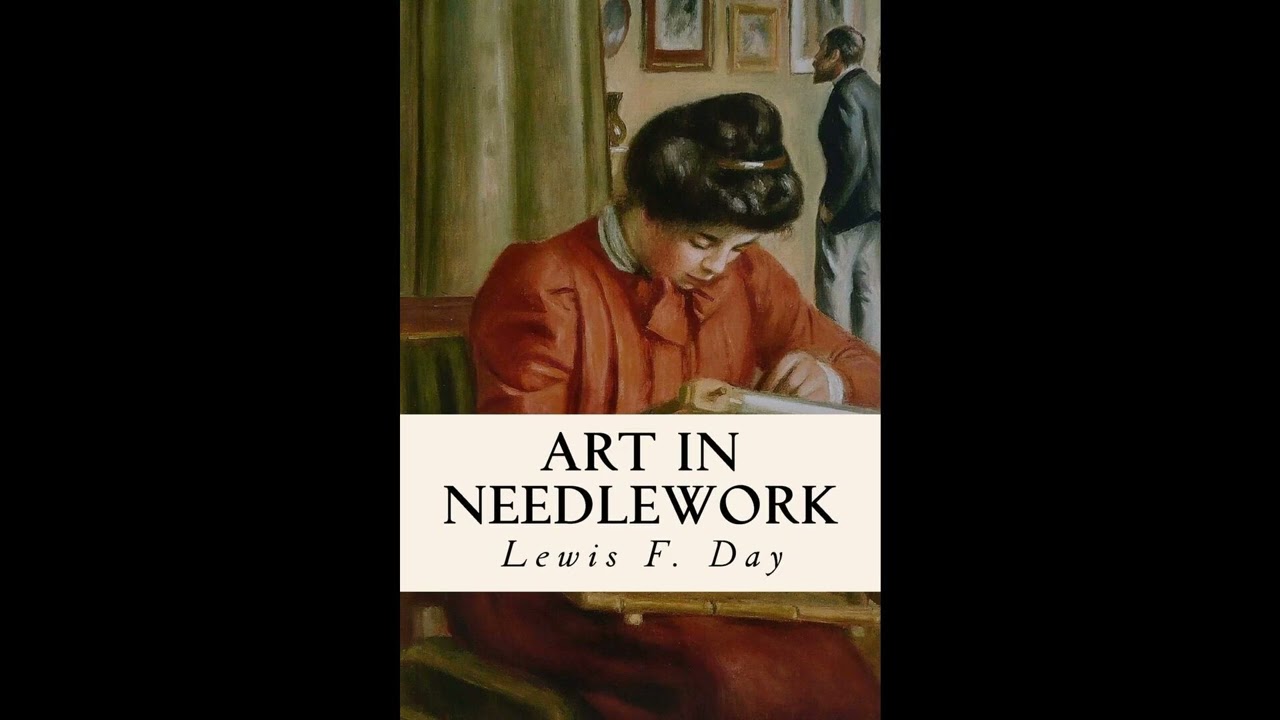
Art in Needlework
In a world increasingly dominated by the fleeting and the mass-produced, a quiet revolution is happening: a renewed appreciation for the handmade, the considered, and the beautiful object crafted with intention. This modern sensibility finds its roots in foundational texts that sought to elevate everyday crafts to genuine art forms, and among these, few shine as brightly as Lewis F. Day and Mary Buckle’s Art in Needlework. First published at the turn of the twentieth century, this remarkable volume offers more than just instructions; it presents a philosophy of design that remains profoundly relevant. It is an invitation to understand the fundamental principles that govern beauty and structure in any creative endeavor, making it a crucial resource for anyone seeking a deeper connection to the aesthetics of human creation, whether they wield a needle or simply admire thoughtful design. The progression of Art in Needlework is less a narrative of characters and events and more an intellectual unfolding, guiding the reader through the foundational elements that define excellent design. The setting is not a physical location, but the mental space where aesthetics meet utility, where historical precedent informs contemporary practice. Day and Buckle introduce us to the core concepts of line, form, space, and repetition, presenting them not as abstract theories but as living forces that shape every successful piece of needlework. We are shown how these elements interact, how balance is achieved, and why certain arrangements please the eye while others fall flat. The authors act as our insightful guides, moving from the simplest decorative motifs to the complexities of larger compositions, illustrating each point with clear, persuasive argument. The central challenge faced within these pages is the ongoing struggle to distinguish between mere imitation and truly creative design. Day and Buckle illuminate the pitfalls of thoughtless copying, where a design might be replicated without understanding its underlying principles, resulting in a lifeless reproduction. Their goal is to empower the craftsperson to transcend this, to understand why certain designs work, and how to adapt or invent new patterns with intelligence and artistic integrity. The arc of the book leads us from recognizing poor design to appreciating informed design, equipping the listener with the tools to critically evaluate and skillfully create. It is a methodical, almost forensic, examination of what constitutes good taste and lasting beauty in the world of decorative arts. Lewis F. Day was a towering figure in British design reform during the late nineteenth and early twentieth centuries. Born in 1845, he became a central proponent of the Arts and Crafts movement, a significant cultural shift advocating for quality handcraft, traditional materials, and artistic integrity in opposition to industrial mass production. Day was not merely a theorist; he was a prolific designer himself, creating patterns for textiles, stained glass, ceramics, and metalwork. His influential writings, including Everyday Art (1882) and Pattern Design (1903), cemented his position as a leading aesthetician and educator, shaping the discourse around decorative art for generations. He served as a director for the Arts and Crafts Exhibition Society and held a prominent role at the Royal College of Art, tirelessly championing the elevation of crafts to the status of fine art. Mary Buckle, Day’s co-author on Art in Needlework, was a skilled craftswoman and his pupil. While less extensively documented than Day, her practical expertise and deep understanding of the technicalities of needlework were indispensable to the clarity and authority of the book. Her contributions ensured that Day’s broad aesthetic theories were grounded in the realities of thread and fabric, making the volume not only intellectually stimulating but also eminently practical. Together, they created a work that synthesized broad artistic principles with precise, actionable advice, bridging the gap between high art theory and the hands-on practice of the artisan. Art in Needlework stands as a testament to their combined vision, securing Day’s place as a seminal voice in design history and recognizing Buckle’s crucial role in articulating their shared philosophy. The book articulates several enduring themes that resonate far beyond the specifics of needle and thread. One significant theme is the insistence on the integrity of materials and process. Day and Buckle repeatedly emphasize that design should respect the medium in which it is executed. For instance, they show how a pattern intended for weaving, with its inherent grid and interlace, would look awkward and ill-suited if simply transferred to embroidery without considering the unique qualities of stitching. This focus on "truth to materials" is a cornerstone of good design, advocating for an honest relationship between the artist's vision and the practical limitations and strengths of their chosen craft. Another central idea is the intelligent adaptation of historical precedent. The authors do not advocate for blind copying of past styles, but rather for understanding the underlying principles that made historical designs successful. They might, for example, analyze the rhythmic flow of a medieval border or the balanced asymmetry of a Renaissance motif, extracting the universal aesthetic truths rather than merely reproducing the surface decoration. Furthermore, Art in Needlework champions the idea of art in everyday life. It reflects the Arts and Crafts ideal that beauty should not be confined to galleries but should permeate domestic spaces and common objects. By focusing on needlework – a craft often associated with home and women's work – the authors elevate it as a legitimate and profound avenue for artistic expression. This democratizes art, making good design accessible and achievable for a wider audience. They illustrate, through examples of historical and contemporary pieces, how thoughtful consideration of form, color, and texture can transform a simple domestic item into an object of lasting aesthetic pleasure, emphasizing that true beauty lies in purposeful creation, not merely in embellishment. Art in Needlework emerged during a fascinating period of cultural and artistic ferment in Britain, specifically around the year 1900. It was a time when the rapid industrialization of the Victorian era had led to a backlash among artists and thinkers. Critics like John Ruskin and William Morris lamented the decline in craftsmanship, the proliferation of shoddy machine-made goods, and the separation of the artist from the artisan. This discontent fueled the Arts and Crafts movement, which advocated for a return to handmade production, a respect for materials, and the integration of art into daily life. Lewis F. Day was at the forefront of this movement, and his collaboration with Mary Buckle directly addresses its core concerns, seeking to re-educate both producers and consumers about the principles of good design. The book served as a vital educational tool, providing a much-needed theoretical and practical foundation for those committed to raising the standard of decorative arts amidst a changing industrial landscape. Listening to Art in Needlework as an audiobook offers a unique opportunity to absorb its thoughtful instruction. The clarity of the narration becomes paramount in conveying complex design principles and differentiating between numerous historical examples. A skilled reader can maintain an even, considered pacing, allowing the listener ample time to visualize the patterns and concepts described without the distraction of flipping through pages. The voice can bring a didactic yet encouraging atmosphere to the listening experience, much like attending a lecture by an esteemed and patient professor. Without visual aids, the narrator’s precision in describing motifs, stitches, and compositional structures becomes the central focus, guiding the mind's eye to construct the elements discussed. This format encourages a deep, meditative engagement with the ideas, making it ideal for those who prefer to contemplate design theory while engaged in their own creative pursuits or simply seeking intellectual enrichment.
Enjoyed Art in Needlework? A few ways to support us
Audible & Amazon links are affiliate; we may earn a small commission at no extra cost.
About this production
Human narration by a volunteer reader from LibriVox.org, the public-domain audiobook project. LibriVox volunteers record literary works whose copyright has expired in the United States, releasing the resulting recordings into the public domain.
Art in Needlework by Lewis F. Day and Mary Buckle. The underlying text is in the U.S. public domain. We do not republish any modern copyrighted edition, translation, or commentary.
The 4K cinematic visuals accompanying this audiobook are generated by an AI image model from prompts derived from the source text. No copyrighted photos, paintings, or stock footage are used. AI generation is disclosed on every video on our YouTube channel as required by YouTube's altered/synthetic content policy.
English subtitles are transcribed from the LibriVox recording with OpenAI Whisper. Translations into the 11 other supported languages are produced by Meta's NLLB-200 neural translation model. No human translator's copyrighted translation is used.
Questions about sourcing or rights? See our DMCA & Sourcing policy or contact us.
Enjoyed this audiobook?
If you'd like to own a copy of Art in Needlework or hear a professionally produced edition, the links below help support free audiobook production at no extra cost to you.
As an Amazon Associate we earn from qualifying purchases. Audible / print links are affiliate.