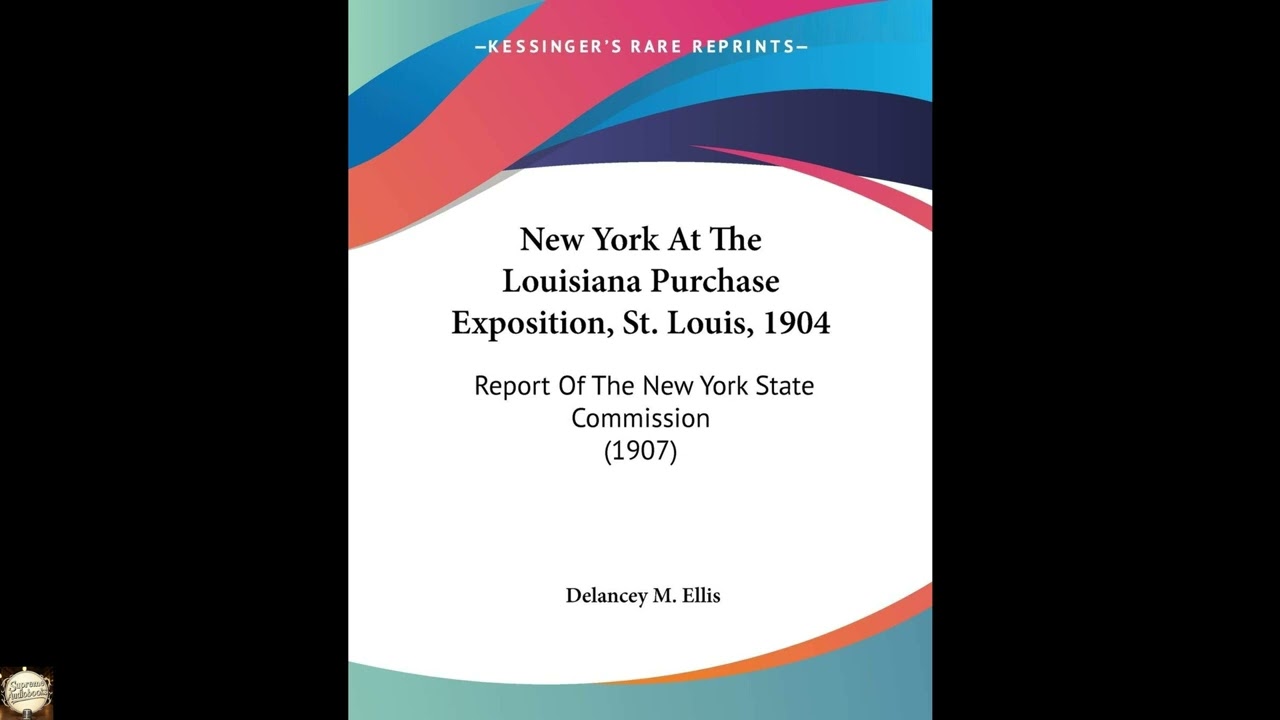
New York At The Louisiana Purchase Exposition, St. Louis, 1904: Report Of The New Y
Imagine a moment when an entire nation gathered to parade its technological marvels, cultural achievements, and economic might for the world to see. That moment was the Louisiana Purchase Exposition in St. Louis, 1904—one of America's grandest World's Fairs. At its heart, individual states competed for attention and prestige, each striving to define its identity and assert its significance on a global stage. New York At The Louisiana Purchase Exposition, St. Louis, 1904: Report Of The New Y is not a work of fiction, but a fascinating, detailed account of New York State's colossal effort to do just that. It's a vital snapshot of turn-of-the-century America, a period of immense change, innovation, and national self-discovery, offering a unique opportunity to understand how a powerful state projected its image and what values it chose to highlight. The narrative within this report unfolds against the sprawling, meticulously planned backdrop of the St. Louis fairgrounds, a temporary city built from dreams of modernity and progress. From its initial pages, the report details the enormity of constructing a dedicated New York State Building and curating a comprehensive display encapsulating the state's diverse contributions. The central 'figures' are not individual characters in the conventional sense, but rather the various commissions, committees, and state departments charged with this monumental task. We follow their collective 'story' as they navigate the logistical complexities of the exposition—from securing prime exhibit space to budgeting for elaborate displays and gathering the finest examples of New York's agriculture, education, industry, and arts, each a testament to the state's preeminence. The arc of this official narrative moves from initial planning and construction through the opening ceremonies and the bustling daily life of the fair. It chronicles the procession of dignitaries, the hosting of special New York Days, and specific events organized to promote state interests. There is a palpable sense of internal competition—not a dramatic conflict, but a striving to outshine other states, to garner the most awards, and to leave an indelible impression. The report meticulously lists the prizes and accolades bestowed upon New York's exhibits, effectively demonstrating the state's success in achieving its promotional goals. It concludes with an accounting of the fair's overall impact on New York, reflecting on the connections forged and the future prospects envisioned for the state. The designation 'Unknown' for this report's author points to its intrinsic nature as a collective, official document rather than the singular vision of an individual writer. This is not a personal memoir or a novel driven by an author's distinct voice, but a public record commissioned and compiled by the State of New York itself. In the early twentieth century, such comprehensive reports were common practice, serving as official chronicles of significant governmental undertakings and public events. They were typically assembled by a dedicated commission or committee, drawing on the contributions of numerous officials, statisticians, and department heads. The 'author' then, is effectively the State of New York—its bureaucracy, its elected representatives, and the collective will of its citizens as expressed through its institutions. These types of reports stand as important primary sources for historians, providing invaluable insight into the administrative processes, public relations strategies, and societal values of their time. They are often meticulously detailed, presenting facts, figures, expenditures, and lists of personnel with an authoritative tone. While lacking a specific author's personal narrative, they offer a unique window into the institutional mindset of an era, revealing the goals, perceived successes, and self-image a state wished to project. This particular report, in its exhaustive detail, aligns with a tradition of governmental documentation aimed at transparency, accountability, and the commemoration of significant public endeavors. This report, though not literature in the conventional sense, nevertheless enacts several potent themes. Foremost among them is the pervasive theme of American Progress and Modernity. The very purpose of the World's Fair was to showcase the march of innovation, and New York's report mirrors this perfectly. We see this enacted in descriptions of new agricultural machinery developed in the state, advancements in educational pedagogy presented by its universities, or the innovative industrial processes detailed by manufacturers. The meticulous accounting of patents granted to New Yorkers and the awards won for cutting-edge technologies serve as concrete examples of this forward-looking national identity. Another prominent theme is State Pride and Regional Identity. The report is a declaration of New York's unique contributions and its ambition to be recognized as a leader. This is demonstrated through the elaborate design of the New York State Building itself, meant to symbolize the state's grandeur and history. The specific exhibits, from the display of award-winning apples grown in the Hudson Valley to the showcasing of prominent New York artists, underscore a deliberate effort to differentiate New York from other participating states and nations. Furthermore, the theme of Public Display and Persuasion runs through the entire document. It’s a carefully constructed argument for New York's preeminence, designed not just to inform but to impress and attract, laying bare the official strategies used to shape public perception and promote economic interest. The Louisiana Purchase Exposition itself was a monumental event, commemorating the centennial of the Louisiana Purchase. Beyond its historical marker, the fair served as a powerful declaration of America's emergence as a global industrial and cultural force. Held during the height of the Progressive Era, a period marked by social reform, scientific management, and a belief in human perfectibility through organized effort, the exposition was a grand stage for these ideals. Rapid industrialization, massive immigration waves reshaping urban centers, and the United States' increasing presence on the international stage all contributed to an atmosphere of nationalistic pride and an eagerness to demonstrate American ingenuity and capability. The fair was a direct reflection of these dynamic forces. In this context, New York's detailed report offers a microcosm of these larger national trends. The state, already a powerhouse of commerce, industry, and culture, seized the opportunity to solidify its position not just within the union, but globally. The document is steeped in the optimism and confidence that characterized the early twentieth century, a time when technological progress seemed limitless and the future appeared bright with possibility. It speaks to an era when public education was expanding, when conservation efforts were beginning to take root, and when the arts were increasingly seen as essential to national character. This report, therefore, isn't just about New York at a fair; it's a primary source for understanding the prevailing mood and ambitions of a nation at a pivotal moment in its history. To engage with this report as an audiobook transforms a potentially dense historical document into an accessible and compelling experience. A skilled narrator brings a steady, authoritative voice, allowing the listener to absorb the intricate details without getting lost in the formality of the original text. The run length, several hours in total, is ideal for sustained periods of listening—whether on a long drive, during daily chores, or dedicated study. You can immerse yourself in the official pronouncements, the meticulous inventory of exhibits, and the careful accounting of public engagement, letting the rhythm of the prose transport you back to 1904. The narration makes the bureaucratic ambition and the era's grand vision come alive, providing a unique auditory window into the past that illuminates the spirit of American progress and state identity at a truly defining moment.
Enjoyed New York At The Louisiana Purchase Exposition, St. Louis, 1904: Report Of The New Y? A few ways to support us
Audible & Amazon links are affiliate; we may earn a small commission at no extra cost.
About this production
Human narration by a volunteer reader from LibriVox.org, the public-domain audiobook project. LibriVox volunteers record literary works whose copyright has expired in the United States, releasing the resulting recordings into the public domain.
New York At The Louisiana Purchase Exposition, St. Louis, 1904: Report Of The New Y. The underlying text is in the U.S. public domain. We do not republish any modern copyrighted edition, translation, or commentary.
The 4K cinematic visuals accompanying this audiobook are generated by an AI image model from prompts derived from the source text. No copyrighted photos, paintings, or stock footage are used. AI generation is disclosed on every video on our YouTube channel as required by YouTube's altered/synthetic content policy.
English subtitles are transcribed from the LibriVox recording with OpenAI Whisper. Translations into the 11 other supported languages are produced by Meta's NLLB-200 neural translation model. No human translator's copyrighted translation is used.
Questions about sourcing or rights? See our DMCA & Sourcing policy or contact us.
Enjoyed this audiobook?
If you'd like to own a copy of New York At The Louisiana Purchase Exposition, St. Louis, 1904: Report Of The New Y or hear a professionally produced edition, the links below help support free audiobook production at no extra cost to you.
As an Amazon Associate we earn from qualifying purchases. Audible / print links are affiliate.
More by Unknown
Copyright Law of the United States and Related Laws Contained in Title 17 of the Uni- Full Audiobook
Stories of The Prophets Before The Exile
Notes and Queries, Index of Volume 2, May-December, 1850 (Classic Books)