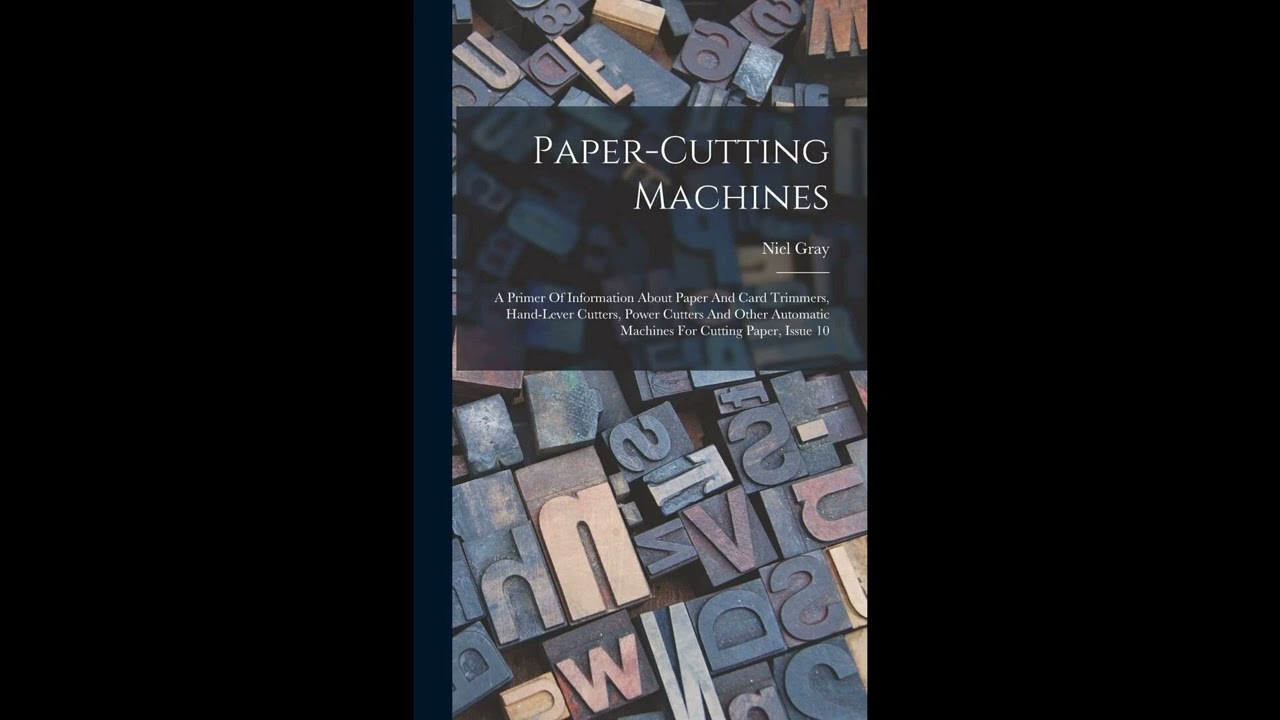
Paper-cutting Machines: A Primer Of Information About Paper And Card Trimmers, Hand-- Full Audiobook
At first glance, the title "Paper-cutting Machines: A Primer Of Information About Paper And Card Trimmers, Hand--" might suggest a dry, purely utilitarian text. Yet, to dismiss it as such would be to overlook a quietly profound work that, over time, has earned its place as a fascinating example of classic literature. Far from a mere instruction manual, this book offers a unique window into the human mind's enduring quest for efficiency, precision, and mastery over the physical world. It stands as a testament to an era when detailed craftsmanship and mechanical ingenuity were celebrated, and when the very act of describing complex machinery could become an art form. For contemporary listeners, it offers not only a glimpse into industrial history but also a surprising meditation on the beauty of function and the often-unseen poetry of utility. The narrative of "Paper-cutting Machines" is not one of characters and dramatic conflict, but rather an unfolding story of human endeavor and mechanical evolution. It establishes its setting within the bustling world of print shops, binderies, and offices—spaces where the precise handling of paper was paramount. The main "protagonists" are the machines themselves: the array of trimmers, cutters, and guillotines, each described with an almost reverential attention to detail. Listeners follow the development from the simplest hand-operated levers designed for a few sheets to the more formidable, industrial-grade apparatus capable of shearing through thick stacks of cardstock. The central 'conflict' of the book is the age-old challenge of converting raw material into a finished product with absolute accuracy and minimal waste, a struggle in which human ingenuity repeatedly triumphs through elegant design. The arc of this fascinating text progresses systematically, guiding the listener through the principles and applications of various cutting mechanisms. It begins with an examination of basic tools—the foundational designs that first brought efficiency to the task of paper trimming—and then moves through a logical escalation of complexity. We hear descriptions of the precise mechanics of a compound leverage system, the careful calibration of a blade's angle for a clean cut, and the ingenious methods devised for clamping paper securely to prevent slippage. The unfolding 'plot' is one of increasing sophistication, a journey from the initial spark of an idea to its realization in robust, functional machinery. The book's engaging explanations reveal the subtle engineering that underpins what might appear, on the surface, to be a simple operation, culminating in a comprehensive understanding of these essential devices. The author of "Paper-cutting Machines" remains unknown, a common occurrence for many technical and instructional works of its era. This anonymity does not diminish the work's standing; rather, it elevates it to a collective statement from an age defined by invention and detailed craft. Such texts often emerged from the accumulated wisdom of master craftsmen, engineers, or trade societies, published to disseminate crucial practical knowledge across industries. The meticulous detail and clear, authoritative prose suggest an author deeply immersed in the world of paper processing and machine manufacturing, someone with firsthand experience not only in operating these devices but also in understanding their inner workings and maintenance. The tradition of such anonymous primers speaks to a time before individual celebrity became paramount, when the utility and clarity of the information itself were the highest virtues, ensuring that practical skills and technical understanding could be passed efficiently from one generation of artisans and industrialists to the next. "Paper-cutting Machines" enacts several significant themes. Foremost among them is the celebration of human ingenuity and the quest for precision. Every page, every description of a lever or a blade, reflects an abiding desire to conquer inefficiency and achieve perfect accuracy. Consider, for instance, the detailed explanations of various clamping mechanisms—from simple screw-presses to more sophisticated cam-and-lever systems—each designed to hold paper absolutely still during cutting. This focus shows a deep appreciation for the subtle difference between a good cut and a perfect one. Another theme is the hidden beauty and elegance found in pure utility. The book reframes what might seem like a mundane industrial process into an object of intellectual fascination. The rhythmic description of a treadle-operated guillotine, its moving parts working in synchronous harmony to produce a clean edge, reveals the functional aesthetics inherent in well-designed machinery. Furthermore, the work highlights the pervasive theme of industrialization and technological progress. It stands as a snapshot of a specific historical moment when specialized machines were rapidly transforming traditional crafts and ushering in an era of mass production and standardization. The clear progression from simpler, hand-powered devices to larger, more robust machines for commercial use directly illustrates the relentless march of technological advancement. Finally, the act of creating and disseminating such a thorough "primer" underscores the importance of documenting knowledge and preserving practical expertise. The author’s painstaking efforts to categorize, explain, and illustrate these machines ensure that vital information—how they work, how they are maintained, and how they contribute to a larger industry—is codified and accessible, a crucial endeavor in any evolving field. This text likely emerged during a period of rapid industrial growth, perhaps in the late 19th or early 20th century, a time when the printing and publishing industries were expanding dramatically. The demand for books, newspapers, and printed materials of all kinds was surging, necessitating more efficient and precise methods for handling paper. Culturally, this was an era defined by a fascination with mechanics and a belief in progress through invention. Politically, the industrial revolutions across Europe and America were driving societal shifts, with an emphasis on mass production, standardization, and the scientific management of labor. Works like "Paper-cutting Machines" were essential products of this environment, meeting a real need within the burgeoning trades for comprehensive, accessible information about the tools that powered their operations. It reflects a time when specialized knowledge was actively being organized and distributed to foster greater efficiency and professionalization across industries. Listening to "Paper-cutting Machines" as an audiobook offers a surprisingly immersive and meditative experience. The narration brings a unique rhythm to the detailed explanations, allowing the listener to absorb the intricacies of each mechanism without the distraction of visual diagrams. The run length, measured in several hours, provides ample time to settle into the descriptive prose, which unfolds with a deliberate and clear pacing. Listen for the precise vocabulary used to describe gears, levers, blades, and clamps; the narrator's voice transforms what might be dry technical terms into engaging sonic textures. The absence of traditional dialogue means that the atmosphere is one of focused instruction, almost a lecture from a bygone era, delivered by a knowledgeable guide. It is an opportunity to slow down, to appreciate the quiet genius embedded in mechanical design, and to hear the story of human ingenuity told through the workings of simple, yet utterly essential, machines.
Enjoyed Paper-cutting Machines: A Primer Of Information About Paper And Card Trimmers, Hand-- Full Audiobook? A few ways to support us
Audible & Amazon links are affiliate; we may earn a small commission at no extra cost.
About this production
Human narration by a volunteer reader from LibriVox.org, the public-domain audiobook project. LibriVox volunteers record literary works whose copyright has expired in the United States, releasing the resulting recordings into the public domain.
Paper-cutting Machines: A Primer Of Information About Paper And Card Trimmers, Hand-- Full Audiobook by Niel Gray, Jr.. The underlying text is in the U.S. public domain. We do not republish any modern copyrighted edition, translation, or commentary.
The 4K cinematic visuals accompanying this audiobook are generated by an AI image model from prompts derived from the source text. No copyrighted photos, paintings, or stock footage are used. AI generation is disclosed on every video on our YouTube channel as required by YouTube's altered/synthetic content policy.
English subtitles are transcribed from the LibriVox recording with OpenAI Whisper. Translations into the 11 other supported languages are produced by Meta's NLLB-200 neural translation model. No human translator's copyrighted translation is used.
Questions about sourcing or rights? See our DMCA & Sourcing policy or contact us.
Enjoyed this audiobook?
If you'd like to own a copy of Paper-cutting Machines: A Primer Of Information About Paper And Card Trimmers, Hand-- Full Audiobook or hear a professionally produced edition, the links below help support free audiobook production at no extra cost to you.
As an Amazon Associate we earn from qualifying purchases. Audible / print links are affiliate.