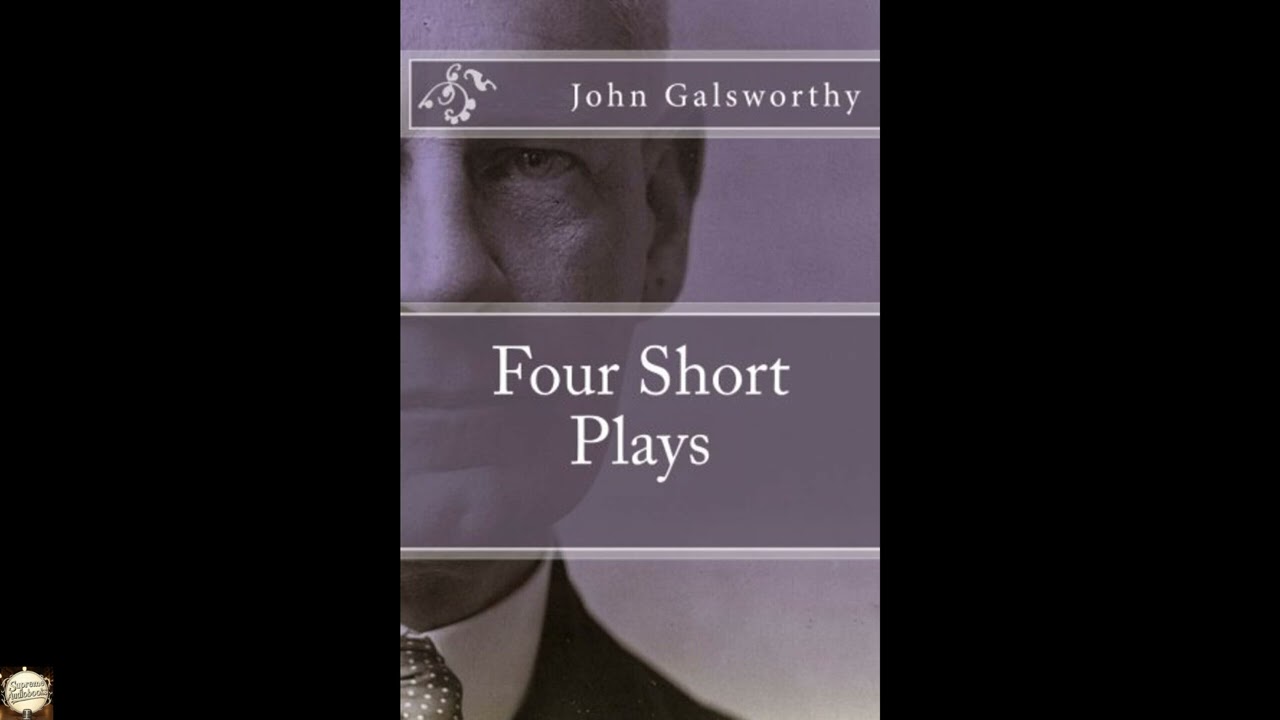
Four Short Plays
John Galsworthy’s Four Short Plays provides a potent window into the social and moral complexities of early 20th-century Britain, concerns that resonate today. This collection—"The Little Man," "Hall-Marked," "Defeat," and "The First and the Last"—distills human dilemmas into taut, single-act dramas. These plays confront questions of class, justice, responsibility, and the struggles of ordinary people caught in society's unforgiving machinery. Each piece acts as a sharp lens, examining how individuals navigate the pressures of convention, prejudice, and conscience, inviting listeners to reflect on their own roles in a world still grappling with similar inequalities. The collection opens with "The Little Man," a comedic yet thought-provoking play set aboard a train. When a baby is accidentally dropped, the scramble for blame and responsibility exposes a cross-section of society. Passengers—from an American tourist to a "Little Man"—react with a mix of self-interest, prejudice, and reluctant duty. Galsworthy critiques arbitrary social judgments and the human tendency to shirk responsibility, revealing underlying currents of xenophobia and class-consciousness. Another profound piece, "Defeat," shifts to London after World War I. An English soldier encounters a destitute German woman, struggling amidst wartime resentment. Their brief, poignant interaction highlights the human cost of conflict, transcending nationalistic hatred to reveal shared vulnerability. The collection also includes "Hall-Marked," which examines a young woman's struggle against Edwardian social expectations, and "The First and the Last," a darker narrative concerning two brothers, a crime, and the stark choices made in its aftermath, questioning guilt and justice. John Galsworthy (1867-1933), born in Surrey, England, was educated at Harrow and Oxford, studying law before turning to writing. Influenced by extensive travels and a friendship with Joseph Conrad, he rejected his legal background to become a prominent author. His personal life, including a controversial relationship with his cousin's wife, Ada Pearson, sharpened his critique of societal hypocrisies. Galsworthy became a leading figure in the Edwardian literary scene, celebrated for his monumental novel series The Forsyte Saga. He also made significant contributions to theatre, a key proponent of the "new drama" movement. His acclaimed plays, including Strife, Justice, and Loyalties, were noted for their naturalistic dialogue and unsparing examination of class conflict and social prejudices. His humanist vision and sharp critique of societal ills earned him the Nobel Prize in Literature in 1932. The plays distill several profound themes. One central theme is social class and its inherent injustices. In "The Little Man," the inclination to blame the lower-class governess for a dropped baby, despite a lack of evidence, highlights ingrained prejudice. "The First and the Last" contrasts a respectable barrister with his impoverished brother, showcasing how societal perceptions dictate lives and lead to tragic outcomes. Galsworthy consistently critiques the arbitrary nature of these divisions. Another prominent theme is moral responsibility and the individual's conscience. Each play demands a moral choice. In "The Little Man," the dilemma of who takes responsibility reveals a spectrum of human responses. "Defeat" quietly stages a profound moral question: how does one respond to an adversary, a vulnerable one, after a brutal war? The English soldier's kindness towards the German girl underscores compassion over animosity, suggesting humanity can transcend prejudice. Galsworthy uses these scenarios to ask: where does responsibility truly lie, and what dictates our empathy? These plays emerged from a period of social and political upheaval, particularly around World War I, and were published in 1920. The preceding Edwardian era had already seen discontent with rigid class structures. Playwrights like Galsworthy, influenced by Ibsen, used the stage for "problem plays," presenting social issues for public debate. The devastation of World War I intensified this critical lens. "Defeat" confronts post-war xenophobia towards Germans, pleading for universal understanding. Societal questioning of old certainties and growing awareness of the working class's plight fueled Galsworthy's social realism, reflecting a society grappling with rapid change and individual dignity against institutional power. Listening to Four Short Plays as an audiobook offers an immersive experience, honoring dramatic writing. Dialogue, the primary vehicle for characters and conflicts, truly comes alive. A skilled narrator brings each distinct voice to life, differentiating tones and accents. Pacing builds tension and allows poignant moments to settle. Without visual cues, listeners become attuned to subtle emotional inflections and unspoken subtexts. This format makes Galsworthy's astute observations on human nature and social structures feel direct and impactful, as if in a theatre.
Enjoyed Four Short Plays? A few ways to support us
Audible & Amazon links are affiliate; we may earn a small commission at no extra cost.
About this production
Human narration by a volunteer reader from LibriVox.org, the public-domain audiobook project. LibriVox volunteers record literary works whose copyright has expired in the United States, releasing the resulting recordings into the public domain.
Four Short Plays by John Galsworthy. The underlying text is in the U.S. public domain. We do not republish any modern copyrighted edition, translation, or commentary.
The 4K cinematic visuals accompanying this audiobook are generated by an AI image model from prompts derived from the source text. No copyrighted photos, paintings, or stock footage are used. AI generation is disclosed on every video on our YouTube channel as required by YouTube's altered/synthetic content policy.
English subtitles are transcribed from the LibriVox recording with OpenAI Whisper. Translations into the 11 other supported languages are produced by Meta's NLLB-200 neural translation model. No human translator's copyrighted translation is used.
Questions about sourcing or rights? See our DMCA & Sourcing policy or contact us.
Enjoyed this audiobook?
If you'd like to own a copy of Four Short Plays or hear a professionally produced edition, the links below help support free audiobook production at no extra cost to you.
As an Amazon Associate we earn from qualifying purchases. Audible / print links are affiliate.