JUSTICE
John Galsworthy's play, Justice, lays bare the cold, unyielding machinery of the law and challenges us to question whether its pursuit of fairness truly serves humanity. First performed in 1910, this potent drama remains startlingly relevant in an era still grappling with prison reform, social inequality, and the sometimes devastating consequences of a system designed to punish rather than rehabilitate. It is a story that compels us to look beyond statutes and precedents, asking instead where compassion fits into the legal equation and what truly constitutes justice for individuals caught in its relentless grip. This is not merely a tale of crime and punishment; it is a profound social commentary that resonates with anyone concerned about the individual's place within the larger structures of society. The story unfolds in early twentieth-century London, primarily within the austere confines of a solicitor's office, the dramatic tension of a courtroom, and the isolating walls of a prison. We are introduced to William Falder, a sensitive and unassuming young clerk working for the reputable firm of James and Walter How. Under immense personal strain, driven by a desperate desire to rescue a woman he loves from an abusive marriage and to flee with her, Falder commits an act of forgery, altering a check to gain a small sum of money. His crime is quickly discovered, setting in motion a chain of events that exposes the stark contrast between the rigid letter of the law and the complex, often tragic, realities of human motive and suffering. As Falder faces trial, the play meticulously details the legal process, showcasing the arguments of the prosecution and the impassioned defense mounted by Hector Frome, a sympathetic barrister. Frome’s defense centers not on denying the act, but on illuminating the profound extenuating circumstances and the immense pressure that led Falder to his desperate deed. Despite the legal arguments, Falder is convicted and sentenced to a period of penal servitude, including a stretch in solitary confinement. The narrative then follows his harrowing experience within the prison system, depicting the psychological toll of incarceration and the profound challenges he faces upon his release as he attempts to rebuild a life forever marked by his past, struggling against a society seemingly unwilling to offer a second chance. John Galsworthy, born in 1867 into a well-established upper-middle-class family of solicitors in Kingston Hill, Surrey, was an English novelist and playwright whose work often scrutinized the social injustices and class divisions of his time. Educated at Harrow School and New College, Oxford, where he studied law, Galsworthy was called to the bar in 1890 but never actually practiced, choosing instead to travel extensively and pursue his growing passion for writing. His early literary efforts were slow to gain recognition, but by the turn of the century, he began to develop the distinctive voice that would characterize his socially conscious realism. His most famous work, The Forsyte Saga, a series of novels chronicling the lives of a wealthy Victorian family, solidified his reputation as a keen observer of societal norms and the emotional lives constrained by them. Beyond prose, Galsworthy penned several significant plays, including Strife (1909), which examines industrial disputes, and Loyalties (1922), a drama about anti-Semitism and class prejudice. He was a prominent figure in the Edwardian literary scene, known for his commitment to social critique through art, advocating for humanitarian causes and prison reform. This dedication culminated in him being awarded the Nobel Prize in Literature in 1932, a year before his death in 1933. Justice stands as a powerful indictment of the legal system's inflexibility and its often-unintended cruelty, enacting several profound themes. Primarily, it dissects the conflict between the strictures of law and the demands of true justice, posing the question of whether a system built on statutes can ever fully account for human fallibility and circumstance. Falder's desperate act, committed out of what he perceives as love and necessity, clashes violently with the law's black-and-white definition of crime, highlighting the human cost when compassion is overlooked in the name of procedure. The play also starkly illustrates the devastating consequences of incarceration, particularly through Falder’s experience in solitary confinement, where the psychological torment of isolation is so severe it breaks his spirit, showing how prison can transform a human being into something unrecognizable rather than rehabilitating them. A further central theme is the unforgiving nature of society and the profound difficulty of reintegration for those who have served their time. After his release, Falder finds himself trapped in a cycle of rejection; his criminal record becomes an inescapable brand, denying him opportunities and driving him further to the margins. This vividly demonstrates how society’s moral judgment can effectively perpetuate punishment long after legal sentences are concluded, questioning the very idea of a "fresh start." The play additionally touches on the pervasive issue of social class, subtly suggesting how Falder's lack of societal standing and his desperation contribute to his predicament, contrasting his fate with the more privileged characters who navigate the same legal waters with greater impunity. The premiere of Justice in 1910 arrived at a critical juncture in British social history, an era marked by significant reformist zeal and growing public awareness of poverty and social injustice. The Edwardian period, though outwardly prosperous, was characterized by stark class divisions and nascent movements advocating for workers' rights, women's suffrage, and improvements in public health and education. Galsworthy, alongside other literary figures like George Bernard Shaw and H.G. Wells, was part of a movement that used literature to hold a mirror up to society, questioning its institutions and moral certainties. Specifically, the play’s graphic depiction of solitary confinement ignited a national debate, capturing the attention of then-Home Secretary Winston Churchill, who was deeply moved by the play and subsequently initiated reforms to the prison system, significantly reducing the use of solitary confinement and altering conditions for prisoners. Listening to Justice as an audiobook offers a uniquely immersive and powerful way to engage with Galsworthy’s trenchant social commentary. The dramatic unfolding of the court scenes, with their precise legal arguments and emotional pleas, benefits immensely from skilled narration, allowing the listener to feel the tension and the stakes of each spoken word. The inner torment of Falder, the earnestness of his defense counsel, and the stern pronouncements of the judiciary come alive through distinct vocal characterizations. The pacing of the play, moving from the initial crime to the drawn-out legal process and the harrowing experience of prison, translates effectively to the audio format, building suspense and emotional impact without visual distractions. The nuances of the dialogue, which subtly reveal character and societal attitudes, are given full weight, drawing listeners into an atmosphere of quiet desperation and legal rigidity. This experience allows the listeners to hear not just the words, but the underlying anxieties and moral dilemmas that continue to resonate a century later.
Enjoyed JUSTICE? A few ways to support us
Audible & Amazon links are affiliate; we may earn a small commission at no extra cost.
About this production
Human narration by a volunteer reader from LibriVox.org, the public-domain audiobook project. LibriVox volunteers record literary works whose copyright has expired in the United States, releasing the resulting recordings into the public domain.
JUSTICE by John Galsworthy. The underlying text is in the U.S. public domain. We do not republish any modern copyrighted edition, translation, or commentary.
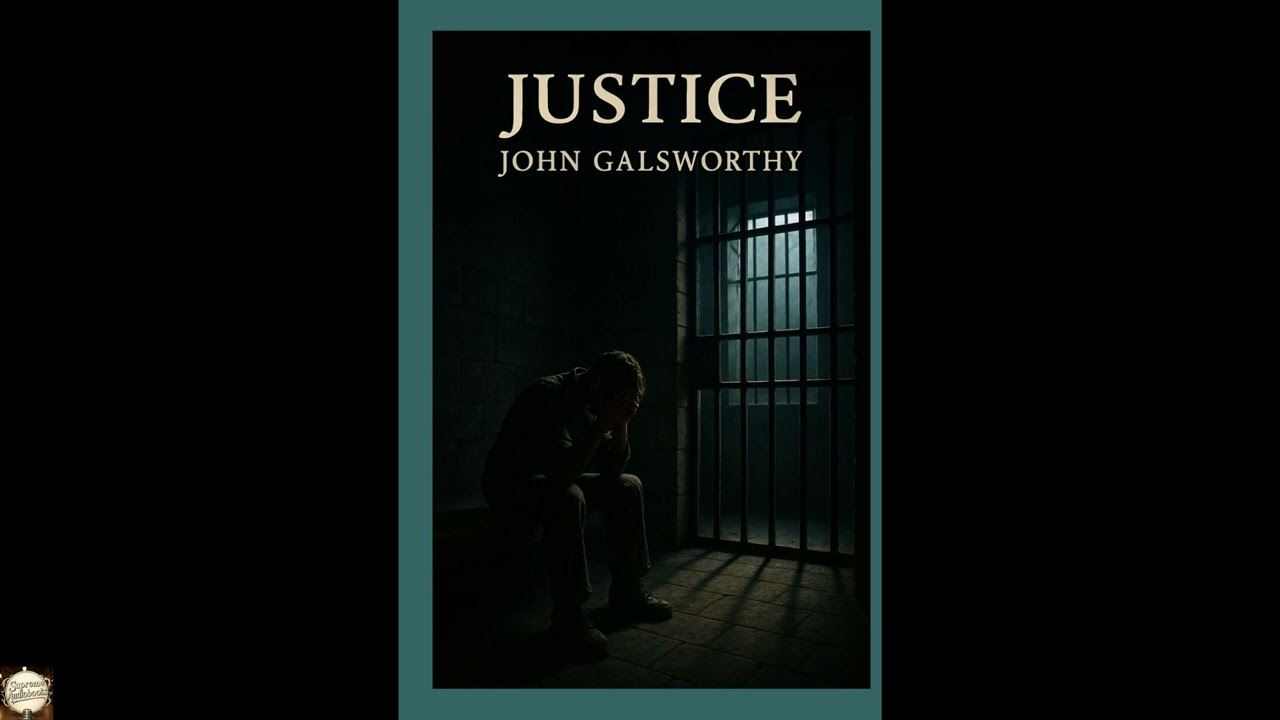
The 4K cinematic visuals accompanying this audiobook are generated by an AI image model from prompts derived from the source text. No copyrighted photos, paintings, or stock footage are used. AI generation is disclosed on every video on our YouTube channel as required by YouTube's altered/synthetic content policy.
English subtitles are transcribed from the LibriVox recording with OpenAI Whisper. Translations into the 11 other supported languages are produced by Meta's NLLB-200 neural translation model. No human translator's copyrighted translation is used.
Questions about sourcing or rights? See our DMCA & Sourcing policy or contact us.
Enjoyed this audiobook?
If you'd like to own a copy of JUSTICE or hear a professionally produced edition, the links below help support free audiobook production at no extra cost to you.
As an Amazon Associate we earn from qualifying purchases. Audible / print links are affiliate.