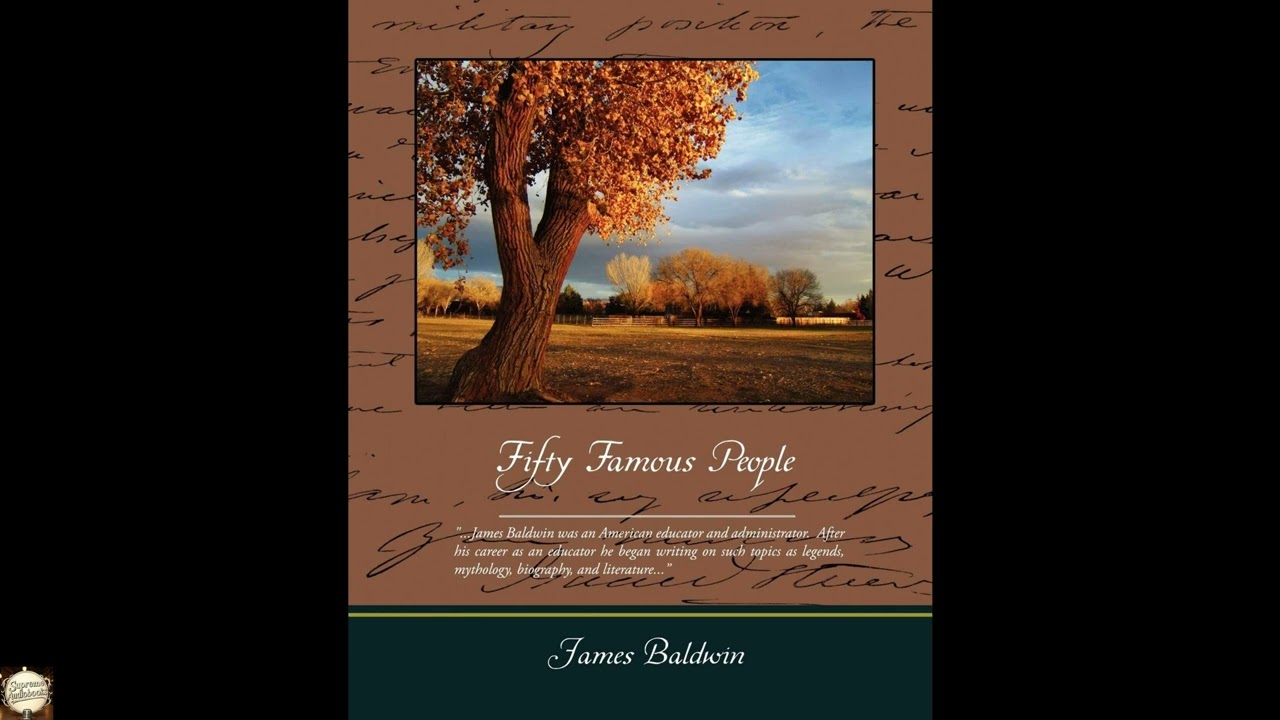
Fifty Famous People
Dive into a panorama of human achievement and struggle with Fifty Famous People, a foundational work by the esteemed American educator James Baldwin PhD. This book offers listeners a compelling collection of biographical sketches, each a window into the lives of individuals whose actions, ideas, and characters left indelible marks on history. More than just a recitation of facts, these narratives are designed to illuminate the qualities that define greatness, challenge the spirit, and inspire reflection on leadership, perseverance, and the enduring human quest for impact. In an age of fleeting information, Baldwin’s carefully crafted stories cut through the noise, offering concrete examples of courage, ingenuity, and moral strength that remain profoundly relevant today, shaping our understanding of both the past and our own potential. Fifty Famous People presents a fascinating mosaic of historical periods and diverse cultures, spanning from the heroes of antiquity to figures whose influence shaped more recent centuries, relative to Baldwin’s time. Each sketch introduces a distinct personality – kings and queens, artists and inventors, philosophers and generals – all bound by their extraordinary contributions and the challenges they faced. Listeners will encounter individuals like the legendary Roman Cincinnatus, called from his plow to save the republic; the visionary Queen Elizabeth I, navigating the treacherous waters of 16th-century politics; the scientific pioneer Galileo Galilei, whose observations transformed our understanding of the cosmos; and the indomitable Christopher Columbus, whose voyages redefined the known world. The central thread weaving through these disparate lives is the universal human struggle to overcome adversity, to innovate, and to leave a meaningful legacy. Each biography begins by setting the stage for the subject’s birth and upbringing, often highlighting the humble beginnings or significant early experiences that shaped their character, before charting their rise through defining moments, critical decisions, and ultimate achievements. The narrative arc for each of the fifty lives is a testament to the power of individual will and the often-unforeseen circumstances that pave the path to fame. Listeners witness the relentless dedication of figures like Johann Gutenberg, toiling in secret to perfect the printing press, or the strategic brilliance of Alexander the Great, forging an empire through unparalleled military prowess. While the book carefully details their public triumphs, it also subtly hints at the personal costs, the sacrifices, and the internal conflicts that often accompany such monumental endeavors. Baldwin presents these stories not as detached historical accounts, but as living examples, urging the listener to consider the choices made, the principles upheld, and the consequences faced by these eminent figures. The book invites reflection on what it truly means to be “famous” – often not merely through renown, but through the profound and lasting influence on human civilization itself, allowing the listener to draw their own conclusions about the impact of these incredible lives without revealing every final outcome or precise historical twist. The author, James Baldwin, born in rural Indiana in 1841, dedicated his life to education and the dissemination of knowledge. Though largely self-educated in his early years, his passion for learning propelled him into a career as a school teacher, eventually leading to his tenure as a superintendent of schools. His practical experience in the classroom profoundly influenced his approach to writing, instilling in him a keen understanding of how to engage and instruct young minds. Later in his career, he joined the American Book Company as a literary editor, a position that allowed him to shape educational materials on a national scale. He penned over 50 books during his prolific lifetime, making him one of the most significant figures in American educational publishing of his era. Baldwin’s other notable works include Baldwin's Readers, a widely used series of graded textbooks that taught generations of American children to read, as well as captivating retellings of classical mythology and legend such as Old Greek Stories, The Story of Roland, and The Story of Siegfried. His literary contributions were central to a movement focused on making history, literature, and ethical instruction accessible and appealing to a broad audience, particularly children and young adults. He was not associated with a specific literary school of fiction, but rather stood as a pillar of educational literature, bridging the gap between classical scholarship and popular understanding. His writings aimed to impart not just facts, but also moral character and a sense of shared cultural heritage, firmly establishing his place in the canon of American instructional literature. He passed away in 1925, leaving behind an educational legacy that continues to resonate. The central themes woven through Fifty Famous People are as relevant today as when the book was first conceived. One prominent theme is courage and perseverance, vividly illustrated by stories such as that of Horatius at the bridge, a Roman soldier who single-handedly defended a crossing against an entire Etruscan army, buying crucial time for his city. Similarly, the relentless determination of Christopher Columbus, facing mutiny and skepticism on his perilous transatlantic voyages, underscores the human spirit's ability to overcome immense odds. Another significant theme is leadership and civic duty, exemplified by figures like George Washington, who despite personal desire for a private life, answered the call to lead a fledgling nation through war and constitutional formation, demonstrating unwavering commitment to public service. His ability to unite disparate factions and establish precedents for American governance stands as a testament to responsible leadership. Beyond individual bravery and leadership, the book also champions innovation and discovery. The account of Johann Gutenberg's tireless efforts to perfect the printing press highlights the transformative power of technological advancement, a single invention that revolutionized the spread of knowledge. Galileo Galilei’s persistent observation of the heavens, even in the face of ecclesiastical resistance, showcases the vital role of scientific inquiry and the pursuit of truth, often against prevailing dogma. Furthermore, an overarching theme of moral character and virtue implicitly guides these narratives. Baldwin’s selection and presentation of these lives subtly teaches lessons about honesty, integrity, diligence, and humility, encouraging listeners to discern the ethical underpinnings of historical events and to consider the long-term impact of individual choices on character and reputation. Fifty Famous People emerged during a period of profound change in the United States, roughly spanning the late 19th and early 20th centuries. This era was characterized by rapid industrialization, significant waves of immigration, and a burgeoning public education system that sought to assimilate diverse populations into a shared national identity. There was a pressing need for common cultural touchstones and moral instruction that could unify a diverse populace and instill a sense of civic responsibility. Educational leaders and authors like Baldwin recognized the power of narrative to convey these values. The "Great Man" theory of history—which posits that history can be largely explained by the impact of highly influential individuals—was a prevalent intellectual framework, making biographical accounts a natural fit for this educational mission. Baldwin's work fit squarely into a broader educational reform movement that aimed to make learning more engaging and accessible, moving beyond rote memorization to foster critical thinking and moral reasoning. By presenting history through the inspiring lives of famous figures, he provided an accessible and compelling means for both students and the general public to connect with historical events and appreciate the virtues deemed essential for a functioning society. The book served as a vital tool in shaping the values and historical understanding of generations of American schoolchildren, offering them a pantheon of heroes to admire and emulate, thereby reinforcing societal norms and aspirations. Listening to Fifty Famous People as an audiobook offers a unique and engaging way to absorb these vital historical narratives. A skilled narrator brings each of the fifty distinct lives into sharp focus with a single, authoritative voice, imbuing the historical accounts with immediacy and presence. With a run length of "several hours," this collection is perfectly suited for commutes, for accompaniment during household tasks, or for sustained listening over a series of evenings, allowing ample time to reflect on each biographical sketch before moving to the next. The pacing is thoughtful and measured, providing space for contemplation rather than rushing through facts. A good narrator will employ a clear, articulate, and perhaps subtly warm voice, evoking the original intent of the text as both instructive and inspiring. While not a novel, these accounts feature attributed quotes and direct speeches from the famous figures, which a nuanced narration can deliver with compelling gravitas. The overall atmosphere generated by the audiobook is one of quiet intellectual engagement and historical appreciation, making the distant past feel intimately relevant to contemporary life.
Enjoyed Fifty Famous People? A few ways to support us
Audible & Amazon links are affiliate; we may earn a small commission at no extra cost.
About this production
Human narration by a volunteer reader from LibriVox.org, the public-domain audiobook project. LibriVox volunteers record literary works whose copyright has expired in the United States, releasing the resulting recordings into the public domain.
Fifty Famous People by James Baldwin PhD. The underlying text is in the U.S. public domain. We do not republish any modern copyrighted edition, translation, or commentary.
The 4K cinematic visuals accompanying this audiobook are generated by an AI image model from prompts derived from the source text. No copyrighted photos, paintings, or stock footage are used. AI generation is disclosed on every video on our YouTube channel as required by YouTube's altered/synthetic content policy.
English subtitles are transcribed from the LibriVox recording with OpenAI Whisper. Translations into the 11 other supported languages are produced by Meta's NLLB-200 neural translation model. No human translator's copyrighted translation is used.
Questions about sourcing or rights? See our DMCA & Sourcing policy or contact us.
View 10 famous quotes from this book →
Enjoyed this audiobook?
If you'd like to own a copy of Fifty Famous People or hear a professionally produced edition, the links below help support free audiobook production at no extra cost to you.
As an Amazon Associate we earn from qualifying purchases. Audible / print links are affiliate.