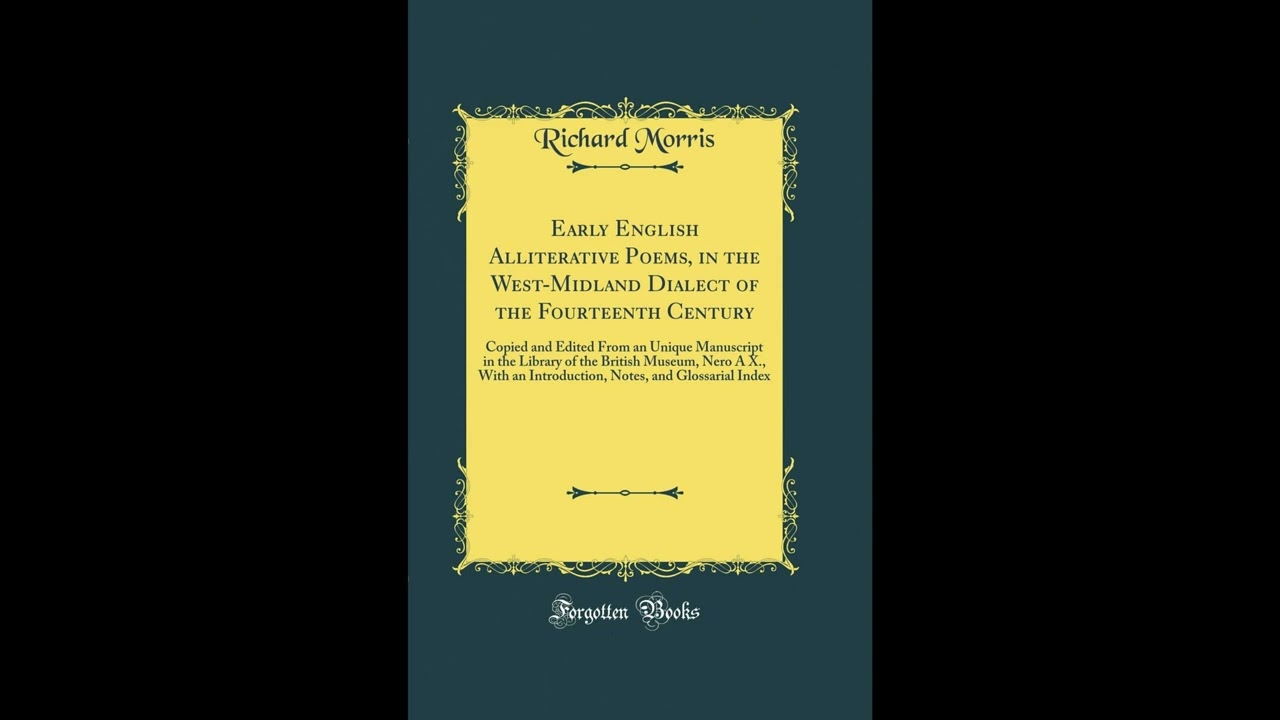
Early English Alliterative Poems, in the West-Midland Dialect of the Fourteenth Cen
Step into a world where language itself hums with the echoes of medieval England, a time when heroic deeds, profound spiritual quests, and the very fabric of human virtue were woven into powerful verse. Early English Alliterative Poems, in the West-Midland Dialect of the Fourteenth Century is not merely an academic artifact; it is a direct portal to the creative heart of a distant past. This collection of anonymous brilliance represents a pinnacle of Middle English poetic achievement, offering a unique opportunity to connect with the origins of our literary heritage. It’s a chance to hear the English language not as we speak it today, but in a form bursting with rhythmic force and narrative clarity, presenting universal themes of faith, honor, and resilience that resonate with listeners across the centuries. This monumental collection typically gathers some of the most remarkable narrative and allegorical poems from the period, including the revered Pearl, the moralizing Cleanness and Patience, and the unparalleled chivalric romance, Sir Gawain and the Green Knight. While each stands alone as a complete work, together they paint a vivid picture of the ethical and spiritual concerns of late medieval England. Pearl, for instance, begins with a father’s profound grief over the loss of his young daughter. He falls asleep in a garden and experiences a dream vision, finding himself in a landscape of shimmering beauty where he encounters his daughter, now a radiant maiden, across a stream. Their dialogue forms the central part of the poem, as she explains divine truths and the nature of salvation, guiding him through his sorrow toward a deeper understanding of God’s grace and the celestial realm. Similarly, Patience recounts the Old Testament story of the prophet Jonah, focusing on his reluctant obedience to God’s command to preach to the people of Nineveh. Listeners follow Jonah as he attempts to flee his divine calling, endures the terrifying ordeal within the great fish, and grapples with his own petulance when God shows mercy to the Ninevites. The poem is a compelling examination of human stubbornness versus divine will, teaching a profound lesson in endurance and submission. Cleanness, also known as Purity, further illustrates these moral principles through a series of vivid biblical narratives, including the story of Noah and the Flood, the destruction of Sodom, and Belshazzar's Feast. Each episode serves to highlight the severe consequences of spiritual impurity and God's righteous judgment, while celebrating the beauty and necessity of a pure heart and spirit. The poems within this collection do not lead to a singular concluding twist, but rather bring their individual characters to a moment of significant internal understanding or moral reckoning, leaving the audience with powerful ethical insights. The author of these remarkable poems remains unknown to history, a figure often referred to as the "Gawain Poet" or "Pearl Poet" due to the traditional grouping of these works. Active in the latter half of the fourteenth century, this anonymous writer likely lived and worked in the West Midlands region of England, a relatively remote area that fostered a distinct literary tradition. Unlike the courtly poetry of Geoffrey Chaucer, which often employed French-influenced rhyming schemes, the Gawain Poet masterfully employed the older, native English tradition of alliterative verse, a style characterized by a strong rhythmic beat and the repetition of initial consonant sounds. This choice of form speaks to a sophisticated and learned individual, one deeply familiar with both classical and vernacular literature, as well as theological doctrine. The poems stand as a testament to the thriving cultural life and linguistic diversity outside London during this crucial period for the English language, solidifying their place as some of the most beautiful and intellectually substantial works of the Middle Ages. One of the central themes running through these poems is the profound nature of divine providence and human patience. In Patience, the story of Jonah serves as a vivid illustration, showing how even against the prophet’s own recalcitrance and suffering, God's will ultimately prevails, shaping events towards a greater, merciful end. Jonah's trials in the belly of the whale and his subsequent anger at God's mercy reveal the continuous need for human beings to align their will with the divine, enduring hardship with steadfastness. Another key theme is spiritual purity and moral consequences. Cleanness, through its series of stark biblical exempla, explicitly demonstrates the devastating outcomes of impurity—both physical and spiritual—and the absolute necessity of maintaining a blameless heart and conscience before God. The poem's graphic descriptions of divine wrath serve as powerful warnings, emphasizing the sanctity of spiritual truth. Furthermore, the collection profoundly examines chivalric virtue and temptation, nowhere more brilliantly than in Sir Gawain and the Green Knight. Here, the paragon of Arthurian chivalry, Sir Gawain, faces not just a supernatural challenge to his courage, but also a subtle and persistent test of his honesty, courtesy, and fidelity within the seemingly welcoming halls of Hautdesert. His struggle to maintain his knightly vows in the face of clever seduction and the threat of death lays bare the complex demands of virtue. Finally, grief, consolation, and salvation form the heart of Pearl. The father's intense personal sorrow is gradually transformed through a theological dialogue with his blessed daughter, who guides him toward a transcendent understanding of eternal life and the New Jerusalem, offering a path from earthly lament to heavenly hope. These themes are not merely stated but are enacted through compelling narratives and vividly drawn characters, demonstrating the enduring power of these works. These poems emerged during a tumultuous yet creatively fertile period in English history—the latter half of the fourteenth century. England was still reeling from the devastating impact of the Black Death, which had radically reshaped its social and economic landscape, leading to significant shifts in labor and class structures, culminating in events like the Peasants' Revolt of 1381. Politically, the Hundred Years' War against France was ongoing, fostering a growing sense of English national identity and a gradual decline in the prestige of French as the language of the elite. Culturally, this was an era of intense religious devotion and fervent theological debate, with figures like John Wycliffe challenging established church doctrines. It was also a pivotal moment for English literature, seeing the rise of vernacular writers like Geoffrey Chaucer, John Gower, and William Langland, all contributing to the blossoming of English as a sophisticated literary language. The alliterative revival, represented by these poems from the West Midlands, thus signifies a conscious return to an older, more Germanic poetic tradition, providing a powerful, uniquely English voice that stood alongside and perhaps in subtle contrast to the more French-influenced rhyming verse gaining popularity elsewhere. To experience these Early English Alliterative Poems as an audiobook is to gain a deeper appreciation for their inherent musicality and the skillful craftsmanship of their anonymous author. A gifted narrator breathes life into the Middle English dialect, making the intricacies of the language accessible and allowing the listener to fully grasp the nuances of rhythm, alliteration, and imagery. The several hours of listening time provide ample space to immerse oneself in these expansive narratives and allegories, whether consumed in concentrated sittings or broken into smaller, contemplative segments. Listening carefully to the pacing, the distinct voices given to different characters—from the grieving father to the celestial maiden, or the boisterous Green Knight to the steadfast Gawain—enhances the dramatic impact of the stories. The spoken word reveals the powerful atmospheric quality of the verse, allowing the listener to truly hear the soundscape of medieval spiritual contemplation and chivalric adventure, connecting directly to the oral traditions that first brought these profound works to audiences centuries ago.
Enjoyed Early English Alliterative Poems, in the West-Midland Dialect of the Fourteenth Cen? A few ways to support us
Audible & Amazon links are affiliate; we may earn a small commission at no extra cost.
About this production
Human narration by a volunteer reader from LibriVox.org, the public-domain audiobook project. LibriVox volunteers record literary works whose copyright has expired in the United States, releasing the resulting recordings into the public domain.
Early English Alliterative Poems, in the West-Midland Dialect of the Fourteenth Cen by Anonymous. The underlying text is in the U.S. public domain. We do not republish any modern copyrighted edition, translation, or commentary.
The 4K cinematic visuals accompanying this audiobook are generated by an AI image model from prompts derived from the source text. No copyrighted photos, paintings, or stock footage are used. AI generation is disclosed on every video on our YouTube channel as required by YouTube's altered/synthetic content policy.
English subtitles are transcribed from the LibriVox recording with OpenAI Whisper. Translations into the 11 other supported languages are produced by Meta's NLLB-200 neural translation model. No human translator's copyrighted translation is used.
Questions about sourcing or rights? See our DMCA & Sourcing policy or contact us.
Enjoyed this audiobook?
If you'd like to own a copy of Early English Alliterative Poems, in the West-Midland Dialect of the Fourteenth Cen or hear a professionally produced edition, the links below help support free audiobook production at no extra cost to you.
As an Amazon Associate we earn from qualifying purchases. Audible / print links are affiliate.