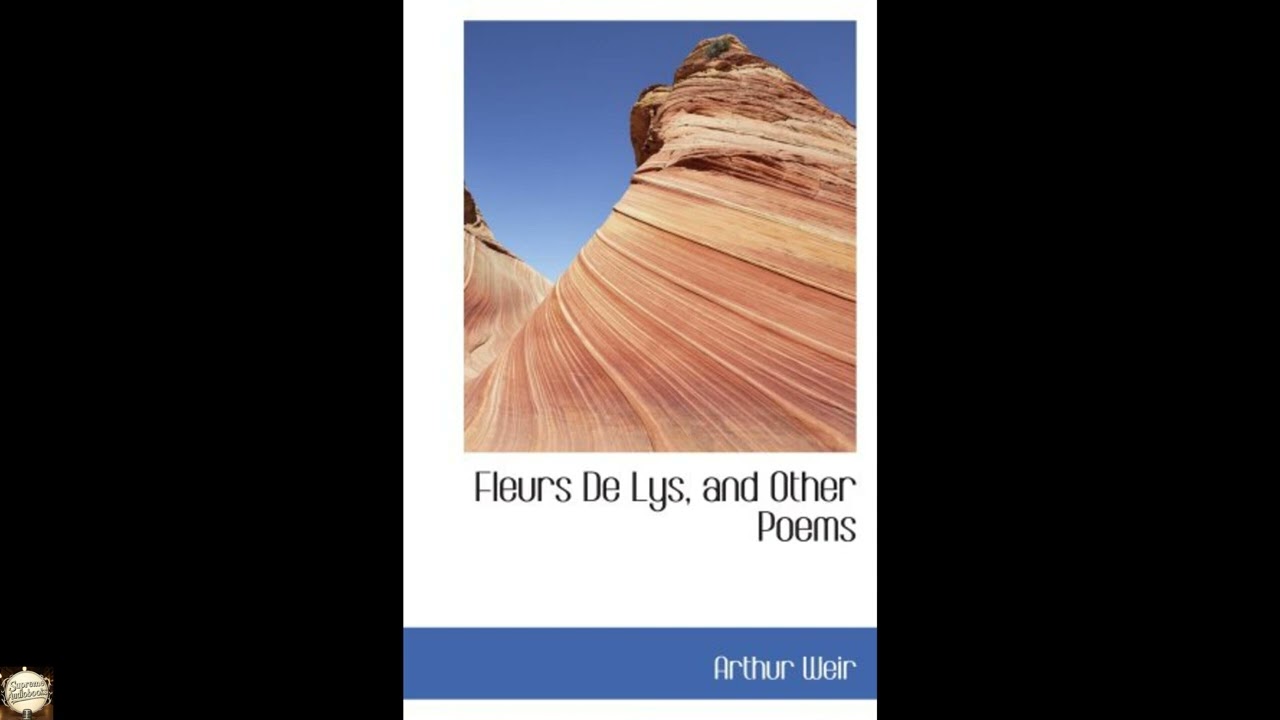
Fleurs De Lys, and Other Poems
Step into a world where language itself becomes a delicate instrument, poised to capture the fleeting beauty of existence and the persistent echoes of history. Arthur Weir's Fleurs De Lys, and Other Poems offers far more than a simple collection of verses; it is an invitation to experience thought and emotion rendered with a precision and grace rarely found in contemporary prose. Through these pages, or rather, these spoken words, listeners are transported to a sensibility that values contemplation, observes the natural world with keen insight, and grapples with the grand questions of humanity's place amidst the passage of time. This collection speaks to the enduring human need for beauty, for understanding the past, and for finding expression for the inexpressible—concerns as relevant today as when these poems first came into being. The centerpiece of this collection, the titular "Fleurs De Lys," sets a tone that oscillates between reverence for historical grandeur and a quiet melancholy concerning its inevitable decline. Throughout the varied poems, the listener encounters a panorama of observations: from the hushed solemnity of an ancient ruin bathed in moonlight to the sudden, joyful burst of spring blossoms in an urban park. Weir's lines frequently pause to contemplate the interplay between the external world and the inner landscape of feeling, presenting scenes not merely as descriptions but as catalysts for deeper reflection. We meet figures drawn from myth and history, their stories reinterpreted through the lens of a poet keenly aware of human fallibility and aspiration. The collection then branches out, revealing an array of poetic forms and subjects. Listeners will find odes to forgotten heroes, elegies for lost loves, and thoughtful meditations on the changing seasons. One moment, the verse might evoke the precise scent of a garden at dusk, the next it might launch into a philosophical rumination on the nature of memory. There is no single narrative arc in the traditional sense, but rather a progression of moods, insights, and images that coalesce into a coherent artistic statement. Each poem acts as a distinct window, yet together they form a comprehensive view of the poet's world, challenging the listener to observe closely, to feel deeply, and to consider the delicate balance between permanence and impermanence that defines human experience. Arthur Weir, a voice largely associated with the late nineteenth and early twentieth centuries, inhabited a period of profound transition, a factor often reflected in his nuanced verse. Though details of his private life remain somewhat shaded by the passage of time, it is known that he moved among literary circles that prized both classical erudition and a burgeoning appreciation for modern psychological insight. His early publications appeared in esteemed literary magazines, earning him a reputation as a stylist whose command of traditional forms was matched by an emerging sensitivity to the complexities of individual consciousness. Weir was not one for bombast or radical experimentation; instead, his strength lay in his meticulous craftsmanship and his ability to infuse familiar subjects with fresh emotional resonance. Unlike some of his more overtly experimental contemporaries, Weir largely adhered to established poetic structures, allowing his profound emotional and intellectual content to surface through carefully chosen diction and measured rhythm. While he may not always be listed among the towering figures of his era, his place in the broader literary firmament is secured by the quiet integrity and profound humanity of his poetic output. His work stands as a testament to an era when the beauty of language itself was held in high regard, a period where poets wrestled with the implications of an increasingly industrialized world while still drawing inspiration from nature, history, and the profound depths of the human heart. Among the central concerns that resonate throughout Fleurs De Lys, and Other Poems is the inherent beauty and inevitable transience of life itself. The recurring motif of the flower—the titular lily, a rose fading in a vase, a wild blossom fighting the elements—serves as a constant reminder of both exquisite loveliness and the relentless march of decay. Weir might present a vivid image of a dew-kissed petal at dawn, only to follow it with lines that hint at its delicate fragility, showing how even the most perfect moment is destined to pass. Another prominent theme is the burden and blessing of history and memory. Many poems turn to the past, reflecting on forgotten legends, the weight of ancestral voices, or the poignant remnants of ancient civilizations, suggesting that while the present rushes forward, the past continues to shape our understanding of who we are. Furthermore, Weir frequently turns his gaze to the natural world, not merely as a backdrop, but as a source of profound spiritual and emotional insight. He depicts landscapes that mirror internal states, where a stormy sea can represent inner turmoil, or a serene sunset can evoke a moment of peace. His poetry often examines the tension between humanity's ambition and the humbling power of the natural order. Finally, the collection often touches upon the universal experiences of love and loss, friendship and solitude. Whether it is a bittersweet recollection of a cherished relationship or a quiet contemplation of human isolation, Weir approaches these deeply personal emotions with both sensitivity and a detached philosophical perspective, giving them a universal resonance. The period during which Arthur Weir wrote was marked by a fascinating confluence of social, scientific, and artistic shifts. The tail end of the Victorian era gave way to the early stirrings of the twentieth century, bringing with it a sense of both anxious anticipation and a lingering reverence for established traditions. Politically, empires were consolidating or beginning to show cracks, leading to widespread discussion of national identity and global relations. Culturally, scientific advancements like Darwin's theories had irrevocably altered humanity's perception of its place in the universe, prompting artists and thinkers to re-examine fundamental beliefs. In the literary world, the grand sweep of Romanticism was giving way to more nuanced forms of expression, including Symbolism and Aestheticism, which prized sensory detail, suggestion, and the pursuit of beauty for its own sake. Weir's delicate balance of classical form and sensitive introspection places him squarely in this era of transition, where poets were seeking new ways to articulate the human condition without abandoning the formal elegance of earlier traditions. His work emerged from a desire to reconcile the enduring human spirit with a rapidly changing world. Listening to Fleurs De Lys, and Other Poems as an audiobook transforms the experience of poetry, returning it to its ancient roots as a spoken art form. The "several hours" run length allows for a gradual immersion, encouraging a reflective pace that printed text sometimes cannot enforce. A skilled narrator brings out the subtle cadences and musicality of Weir's lines, illuminating the poet's choices in rhythm and meter that might otherwise be overlooked. Listen for the narrator's interpretation of emotion in each stanza, the way a voice can convey the weight of history in one poem, or the fleeting joy of a natural observation in another. The spoken word amplifies the atmospheric quality of Weir's verse, allowing the listener to truly inhabit the soundscape and emotional landscape that the poet so carefully constructed, making the philosophical and personal resonations of the collection all the more potent and immediate.
Enjoyed Fleurs De Lys, and Other Poems? A few ways to support us
Audible & Amazon links are affiliate; we may earn a small commission at no extra cost.
About this production
Human narration by a volunteer reader from LibriVox.org, the public-domain audiobook project. LibriVox volunteers record literary works whose copyright has expired in the United States, releasing the resulting recordings into the public domain.
Fleurs De Lys, and Other Poems by Arthur Weir. The underlying text is in the U.S. public domain. We do not republish any modern copyrighted edition, translation, or commentary.
The 4K cinematic visuals accompanying this audiobook are generated by an AI image model from prompts derived from the source text. No copyrighted photos, paintings, or stock footage are used. AI generation is disclosed on every video on our YouTube channel as required by YouTube's altered/synthetic content policy.
English subtitles are transcribed from the LibriVox recording with OpenAI Whisper. Translations into the 11 other supported languages are produced by Meta's NLLB-200 neural translation model. No human translator's copyrighted translation is used.
Questions about sourcing or rights? See our DMCA & Sourcing policy or contact us.
Enjoyed this audiobook?
If you'd like to own a copy of Fleurs De Lys, and Other Poems or hear a professionally produced edition, the links below help support free audiobook production at no extra cost to you.
As an Amazon Associate we earn from qualifying purchases. Audible / print links are affiliate.