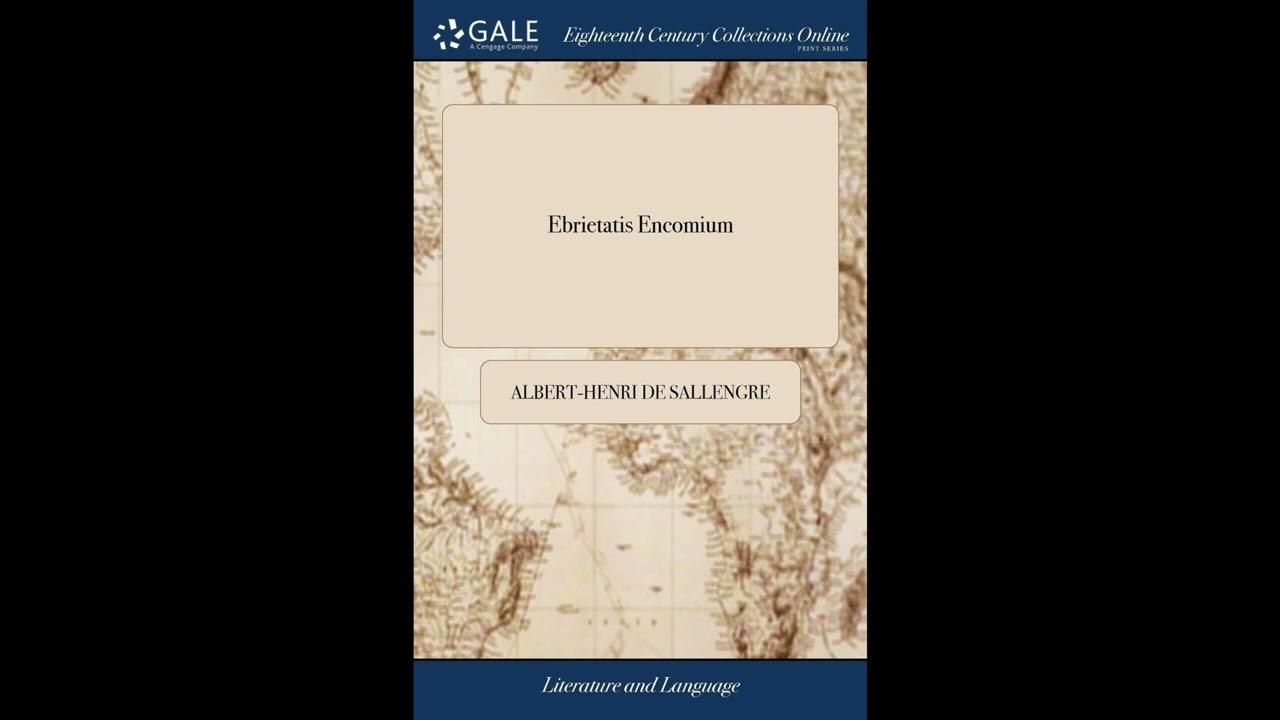
Ebrietatis Encomium: Or, the Praise of Drunkenness. Wherein is Authentically, and M
Few works challenge conventional morality with such playful erudition as Ebrietatis Encomium: Or, the Praise of Drunkenness. This isn't merely a historical curiosity; it is a spirited, witty, and surprisingly convincing defense of inebriation that forces listeners to reconsider their assumptions about vice, virtue, and the very nature of human pleasure. In an age often obsessed with self-improvement and rigorous sobriety, this classical text offers a refreshing, counter-intuitive perspective, inviting us to examine not just the arguments for indulgence, but the often-unquestioned basis of our condemnations. It speaks to the eternal human tension between Apollonian restraint and Dionysian abandon, making its ancient voice resonate with surprising modernity. The book unfurls its argument not as a story with characters in a setting, but as a meticulously constructed rhetorical exercise, akin to a sophisticated philosophical debate staged within the pages of a book. The "protagonist" is the persuasive voice of the anonymous author, who acts as a skilled orator, guiding the listener through a labyrinth of classical references, historical anecdotes, and logical inversions. The "setting" is the intellectual salon of the mind, where established ideas are held up to scrutiny and playfully dismantled. The central "conflict" pits the prevailing societal disapproval of drunkenness against the author's relentless, ingenious justification of its benefits. The "arc" of this work begins by establishing a historical and mythological precedent for the veneration of drink, drawing upon figures from Greek and Roman antiquity who celebrated Bacchus and his gifts. From there, the author systematically presents a series of purported advantages that arise from a state of inebriation. These range from the purely social—wine loosening tongues and fostering camaraderie—to the surprisingly profound, suggesting that alcohol can inspire creativity, unlock deeper truths, or even offer a temporary respite from the burdens of existence. The argument proceeds with clever reversals, anticipating and refuting potential criticisms with an almost legalistic precision, painting a picture not of destructive excess, but of a liberating, even enlightening, state. The text builds to a celebratory crescendo, aiming to leave the listener not necessarily converted to a life of perpetual tipsiness, but certainly more open to the complex, often contradictory, nature of human experience and the surprising ways we seek escape or transcendence. The author of Ebrietatis Encomium remains unknown, a delightful mystery that only enhances the text's aura of playful subversion. Yet, the work itself sits firmly within a long and distinguished tradition of paradoxical encomia, a genre popular since antiquity, where an orator or writer would offer a serious, or seemingly serious, praise of an ignoble, trivial, or even harmful subject. Think of Erasmus's In Praise of Folly, which similarly uses humor and irony to critique societal norms and human shortcomings. Such works allowed authors to engage in social commentary and philosophical debate under the guise of intellectual jest, often revealing more about human nature through their inversions than through direct critique. The first English translation, which is the basis for this presentation, appeared in 1723. While the original Latin source is likely older, perhaps from the Renaissance or even earlier, the anonymous English translator clearly embraced the spirit of the original, bringing its wit and erudition to a new audience. The work demands a mind well-versed in classical literature, mythology, and philosophy, as its arguments are frequently bolstered by references to figures like Plato, Seneca, and myriad historical emperors and poets. The author, whoever they were, demonstrates a profound knowledge of the classical world, employing it not just for ornament, but as the very foundation of their audacious defense. This anonymity, rather than detracting from the work, allows the ideas themselves to take center stage, becoming a voice that transcends time and person. Several significant themes animate Ebrietatis Encomium. Foremost among them is paradox and satire. The entire premise — the earnest praise of drunkenness — is a grand exercise in paradox. For instance, the text might argue that wine, by dulling the senses, actually sharpens perception in other ways, allowing for insights that sobriety obscures. Another key theme is human nature and pleasure. The work interrogates what truly constitutes human happiness and whether strict adherence to societal norms truly leads to it. It proposes that certain "vices" might, in specific contexts, unlock aspects of the human spirit — creativity, courage, uninhibited social interaction — that a purely sober existence might suppress. The author might cite historical figures who composed their greatest works or uttered their most profound statements under the influence, using these anecdotes to challenge the simple equation of sobriety with virtue. The work also engages with social critique, subtly questioning the arbitrary lines society draws between acceptable and unacceptable behavior. By elevating drunkenness, the author shines a light on the often hypocritical standards of "polite society." A clever example might involve contrasting the lavish, wine-fueled feasts of ancient heroes, celebrated in legend, with the quiet disapproval reserved for modern indulgence. Finally, the extensive use of classical scholarship is a theme in itself. The author's arguments are not merely personal opinions but are meticulously buttressed by references to ancient texts, philosophers, and historical events, transforming what might otherwise be a simple polemic into a learned and persuasive discourse. This reliance on authority provides a sophisticated intellectual scaffolding for what is, at its heart, a highly unconventional argument. The 1720s, when the English edition of Ebrietatis Encomium first saw print, marked a vibrant period in European intellectual and literary history. It was an age of Enlightenment, characterized by a burgeoning public sphere where ideas were debated in coffee houses, salons, and through the increasingly accessible medium of printed books. Satire flourished, with writers like Jonathan Swift and Alexander Pope holding society's foibles up to sharp, witty scrutiny. The growing urban centers were melting pots of ideas, commerce, and diverse social strata. In this environment, a work that playfully upended moral conventions, dressed its arguments in classical erudition, and appealed to a sophisticated sense of humor would have found a ready and appreciative audience among the literate classes. It emerged from a cultural landscape that valued wit, argumentation, and a certain degree of intellectual daring, making it a perfect fit for the philosophical and satirical tastes of the Georgian era. Listening to Ebrietatis Encomium as an audiobook offers a unique gateway into its rhetorical brilliance. The very nature of the text, an extended encomium, is designed for oral delivery, reminiscent of an ancient philosophical lecture or a public debate. A skilled narrator breathes life into the anonymous author's voice, allowing the listener to truly appreciate the subtle shifts in tone, the carefully placed ironies, and the building momentum of the argument. Over several hours, you can immerse yourself in the elegant prose and the delightful intellectual gymnastics, allowing the historical anecdotes and classical allusions to unfold at a comfortable pace. Listen for the narrator's interpretation of the author's wit—the playful sarcasm, the mock-serious conviction, and the overall atmosphere of urbane intellectual amusement. It's an experience that transforms a centuries-old text into a surprisingly intimate and engaging performance.
Enjoyed Ebrietatis Encomium: Or, the Praise of Drunkenness. Wherein is Authentically, and M? A few ways to support us
Audible & Amazon links are affiliate; we may earn a small commission at no extra cost.
About this production
Human narration by a volunteer reader from LibriVox.org, the public-domain audiobook project. LibriVox volunteers record literary works whose copyright has expired in the United States, releasing the resulting recordings into the public domain.
Ebrietatis Encomium: Or, the Praise of Drunkenness. Wherein is Authentically, and M. The underlying text is in the U.S. public domain. We do not republish any modern copyrighted edition, translation, or commentary.
The 4K cinematic visuals accompanying this audiobook are generated by an AI image model from prompts derived from the source text. No copyrighted photos, paintings, or stock footage are used. AI generation is disclosed on every video on our YouTube channel as required by YouTube's altered/synthetic content policy.
English subtitles are transcribed from the LibriVox recording with OpenAI Whisper. Translations into the 11 other supported languages are produced by Meta's NLLB-200 neural translation model. No human translator's copyrighted translation is used.
Questions about sourcing or rights? See our DMCA & Sourcing policy or contact us.
Enjoyed this audiobook?
If you'd like to own a copy of Ebrietatis Encomium: Or, the Praise of Drunkenness. Wherein is Authentically, and M or hear a professionally produced edition, the links below help support free audiobook production at no extra cost to you.
As an Amazon Associate we earn from qualifying purchases. Audible / print links are affiliate.
More by Unknown

Children's Internet Protection Act (CIPA) Ruling- Full Audiobook
Notes and Queries, Index of Volume 2, May-December, 1850 (Classic Books)
Seven wives and seven prisons: or Experiences in the life of a matrimonial monomani