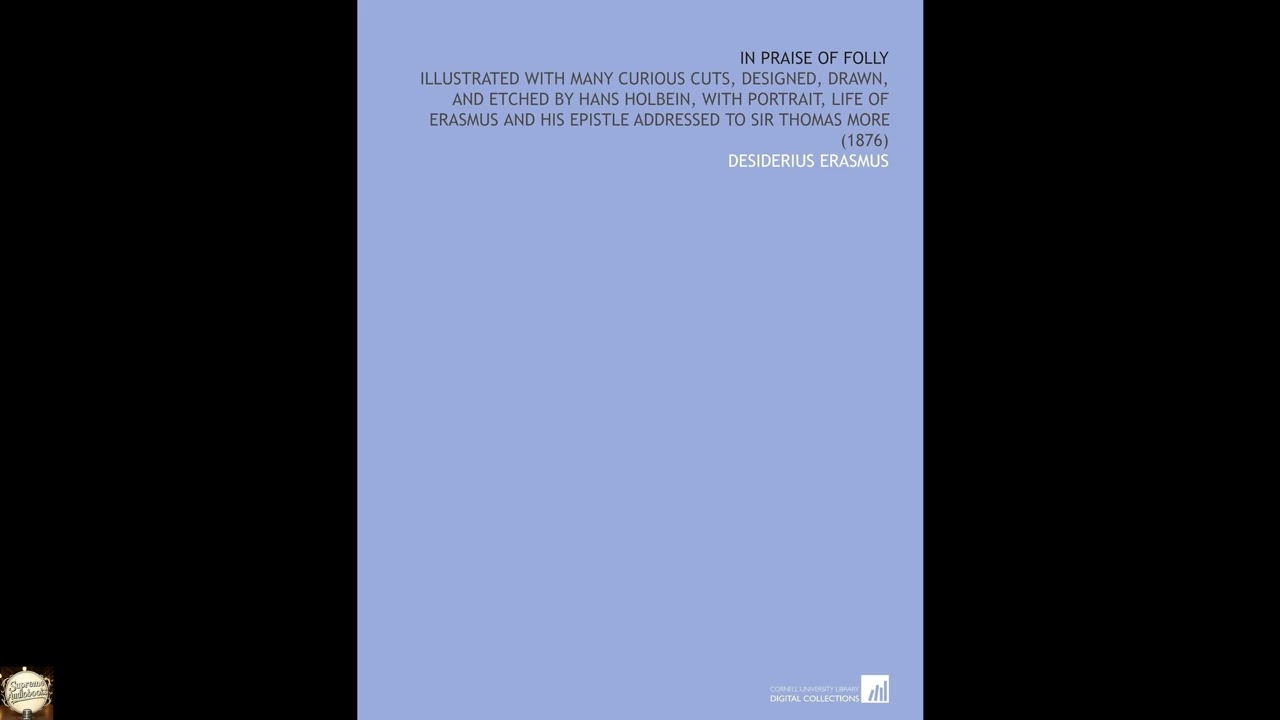
In Praise of Folly: Illustrated With Many Curious Cuts, Designed, Drawn, and Etched
"In Praise of Folly: Illustrated With Many Curious Cuts, Designed, Drawn, and Etched" invites listeners into a witty, profound, and utterly delightful discourse that peels back the layers of human pretense and self-deception. This is not merely a book; it is a grand, spirited address delivered by Folly herself, a character who, despite her name, proves to be the most insightful and charming observer of human nature imaginable. Why should anyone care about a discourse on folly today? Because the human condition, with its endearing absurdities, its desperate quests for happiness, and its often-unseen reliance on illusion, remains as true now as it ever was. This work offers a mirror, held up with a knowing smile, reflecting our collective quirks and comforts, asking us to recognize the necessary follies that make life not just bearable, but truly joyful. The work unfolds as a lengthy, persuasive oration by Folly, who has taken it upon herself to celebrate her own pervasive influence throughout human existence. She begins by proudly proclaiming her lineage and asserting her indispensable role in the lives of all mortals, from birth to old age. With a mischievous glint, she sets out to prove that nearly every aspect of human happiness, every pleasure, every ambition, and even every social structure, owes its vitality and endurance to her gentle touch. Folly does not argue with a heavy hand; instead, she draws upon a seemingly endless supply of examples from everyday life and from the grand stages of power, demonstrating her presence in the most unexpected places. Her observations span the entire social spectrum. She points out how lovers thrive on mutual illusions, how children find joy in harmless games, and how old age itself is rendered tolerable by a convenient forgetfulness of past hardships. She takes aim at various professions and societal roles, playfully suggesting that the grave judge, the pompous scholar, the pious cleric, and the ambitious ruler are often more effective and indeed happier when they embrace their own particular brand of folly. Each of these claims is buttressed by the titular "curious cuts"—imagined visual representations that underscore the humor and truth of her arguments, offering a rich, complementary layer to her verbal wit. The unfolding arc of this unusual narrative is not one of a traditional plot, but rather a systematic, delightful dismantling of conventional wisdom, leaving the listener to ponder whether life without a touch of Folly would truly be worth living. The exact origins of "In Praise of Folly: Illustrated With Many Curious Cuts, Designed, Drawn, and Etched" remain shrouded in the mists of antiquity or perhaps a deliberate anonymity, with its author listed as unknown and its creation year as '0'. This unique classification suggests a work that has either transcended specific historical markers, possibly passed down through generations in various forms, or one whose true provenance has been lost to time. What this mystery highlights, however, is not a deficit, but a testament to the universal and enduring nature of the observations contained within. It positions the work not as the product of a single, identifiable genius from a particular era, but rather as a voice that speaks from a deeper, collective human understanding, resonating across cultures and centuries. Instead of a biographical sketch, then, we find ourselves contemplating the tradition from which such a voice might emerge. This is the tradition of the keen observer, the insightful satirist, the anonymous philosopher who prefers to let the message speak for itself rather than drawing attention to the messenger. It places the work firmly within a lineage of allegorical and satirical writing that stretches back to ancient Greece and Rome, where abstract concepts were often personified to offer critique or wisdom. Such works frequently flourished in periods where direct social commentary might have been risky, or where the author simply wished the focus to remain on the universal truths being presented. The "curious cuts" further connect this work to a long history of illustrated texts, where image and word combined to amplify meaning, humor, and didactic purpose, suggesting a collaborative or accumulative artistry rather than a singular authorial hand. One of the central themes Folly champions is the essential utility of self-delusion. She contends that without a certain measure of blindness to our own imperfections and to the harsh realities of life, genuine happiness would be impossible. For instance, she illustrates how lovers, if they were truly to see each other's flaws with unvarnished clarity, would quickly grow disillusioned, yet it is their shared, mutual glorification of one another that sustains their bond and brings joy. Another powerful theme woven throughout the text is the critique of pretension and false wisdom. Folly delights in pointing out how often those who claim the greatest sagacity – the philosophers, the theologians, the rulers – are themselves steeped in their own forms of vanity and irrationality, sometimes even more so than the common person. She might present the example of a stern academic, puffed up with arcane knowledge, who, despite his intellectual prowess, clings to the most superstitious beliefs, demonstrating that even the loftiest minds are not immune to her influence. A third significant theme is the inversion of conventional values. Folly repeatedly suggests that what society often esteems as "wisdom" or "virtue" can lead to misery, isolation, or arrogance, while a good-natured embrace of one's own folly can foster connection, joy, and humility. This leads to a reconsideration of what constitutes true happiness – is it the pursuit of unadulterated truth, or the comfort found in agreeable illusions? Historically, the emergence of such a work, even if its specific date is unknown, speaks to a perennial human need for social critique and self-reflection presented through humor. Throughout history, societies have produced satirical works to question authority, expose hypocrisy, and grapple with the paradoxes of human existence. From the jesters of medieval courts to the biting satirists of Enlightenment salons, there has always been a role for the "wise fool" who, under the guise of foolishness, delivers uncomfortable truths. This work, with its emphasis on illustrated commentary, aligns with a long tradition of visual and textual storytelling designed to engage, provoke, and entertain audiences across varying levels of literacy and societal standing. It could have emerged from any era where observation of human nature was acute, and where the human impulse for laughter and introspection converged. Listening to "In Praise of Folly" as an audiobook offers a particularly rewarding experience. The very nature of the work – a sustained oratorical address – lends itself perfectly to the spoken word. The listener gains direct access to Folly's charming, persuasive, and occasionally mischievous voice, allowing the nuances of her wit and the rhythm of her arguments to sink in effortlessly. The "several hours" run length makes it substantial enough for deep engagement, yet accessible for listeners seeking intellectual stimulation without an epic commitment. The pacing of the narration is often conversational, allowing time for the listener to ponder Folly's ingenious observations and the delightful ironies she presents. One can truly hear the satirical bite in Folly's descriptions, the twinkle in her eye as she exposes human foibles, and the subtle shifts in her tone as she moves from lighthearted jest to more profound philosophical musings. While the physical "curious cuts" are not visible, the skilled narrator's voice paints vivid pictures, allowing the listener to imagine the expressive illustrations that originally accompanied Folly's compelling discourse. This audiobook format transforms a written philosophical satire into an intimate, engaging performance, making the wisdom of Folly an immediate, personal encounter.
Enjoyed In Praise of Folly: Illustrated With Many Curious Cuts, Designed, Drawn, and Etched? A few ways to support us
Audible & Amazon links are affiliate; we may earn a small commission at no extra cost.
About this production
Human narration by a volunteer reader from LibriVox.org, the public-domain audiobook project. LibriVox volunteers record literary works whose copyright has expired in the United States, releasing the resulting recordings into the public domain.
In Praise of Folly: Illustrated With Many Curious Cuts, Designed, Drawn, and Etched by Desiderius Erasmus. The underlying text is in the U.S. public domain. We do not republish any modern copyrighted edition, translation, or commentary.
The 4K cinematic visuals accompanying this audiobook are generated by an AI image model from prompts derived from the source text. No copyrighted photos, paintings, or stock footage are used. AI generation is disclosed on every video on our YouTube channel as required by YouTube's altered/synthetic content policy.
English subtitles are transcribed from the LibriVox recording with OpenAI Whisper. Translations into the 11 other supported languages are produced by Meta's NLLB-200 neural translation model. No human translator's copyrighted translation is used.
Questions about sourcing or rights? See our DMCA & Sourcing policy or contact us.
Enjoyed this audiobook?
If you'd like to own a copy of In Praise of Folly: Illustrated With Many Curious Cuts, Designed, Drawn, and Etched or hear a professionally produced edition, the links below help support free audiobook production at no extra cost to you.
As an Amazon Associate we earn from qualifying purchases. Audible / print links are affiliate.