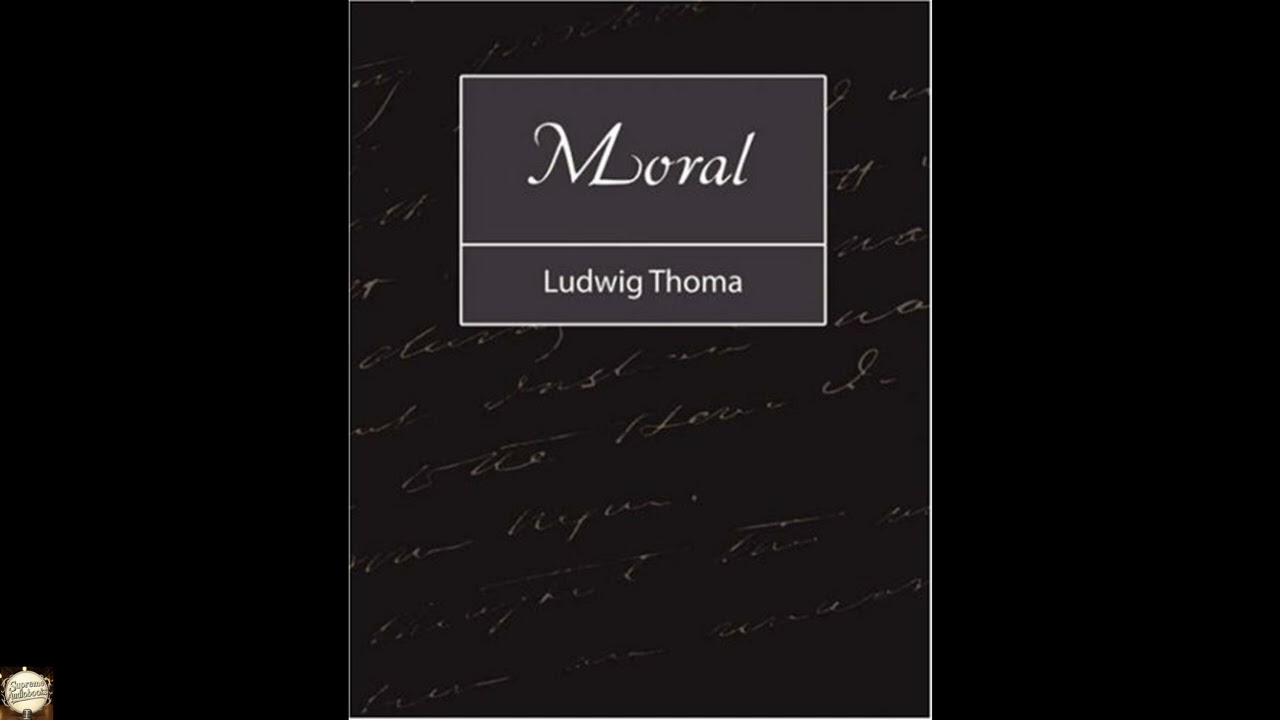
Moral
Ludwig Thoma's "Moral" presents a piercing, yet often hilarious, dissection of societal hypocrisy that remains startlingly relevant in our own era of carefully curated public images and rapid-fire scandal. Published in the early years of the 20th century, this sharp comedic play unearths the delicate balance between outward respectability and private indulgence, demonstrating how quickly the pillars of a community can crumble under the weight of an inconvenient truth. It invites us to consider what happens when the very individuals who champion virtue are revealed to be its most flagrant violators, and why the appearance of rectitude often matters far more than its genuine practice. For anyone interested in the enduring comedy of human failing and the timeless absurdity of social performance, Thoma offers a mirror held up to every age. The story unfolds in a provincial German town, a seemingly idyllic picture of order and uprightness, overseen by a self-appointed "League for the Preservation of Public Morality." At the head of this formidable institution stands Frau Direktor von Schmettau, a woman of unyielding principles and a fierce guardian of the town's good name. Her world, and the carefully constructed facade of the community, is thrown into disarray when Gustl, her young maid, is discovered to be pregnant and unwilling to name the father. This revelation, especially coming from a member of the League's own household, threatens to ignite a scandal that could expose the private lives of several prominent, "honorable" gentlemen who regularly attend the League's meetings. The ensuing scramble to manage the crisis forms the backbone of the play's action, revealing the intricate web of personal interests and social anxieties that dictate public behavior. As the story progresses, what begins as a simple moral outrage quickly transforms into a desperate comedy of errors. Frau von Schmettau, initially driven by righteous indignation, finds herself navigating a labyrinth of half-truths, thinly veiled threats, and desperate attempts at damage control. The mayor, the school principal, and other respected figures suddenly become deeply invested in suppressing the truth, not out of concern for Gustl, but to protect their own reputations and positions. The audience watches, both amused and disturbed, as the very foundation of the League's mission – to uphold morality – becomes a tool for concealing its opposite. The core conflict crystallizes around the question of whether truth can survive when powerful individuals have every incentive to bury it. Ludwig Thoma, the brilliant satirist behind "Moral," was born in Oberammergau, Bavaria, in 1867, and passed away in 1921. Initially trained as a lawyer, Thoma found his true calling in literature and journalism, becoming a celebrated voice in German letters. He was a key figure in the Munich artistic and literary scene at the turn of the century, most notably as co-editor of Simplicissimus, a highly influential satirical weekly magazine known for its sharp wit and often biting social critique. His experiences as a lawyer in small Bavarian towns provided him with ample material for observing human nature and societal peccadillos, which he masterfully translated into his stories and plays. Thoma's output was diverse, including prose, poetry, and plays, often infused with Bavarian dialect and a keen sense of local color. His early successes, such as the Lausbubengeschichten (Stories of a Rascal), chronicled the antics of a mischievous boy, while his Filserbriefe (Filser Letters) offered humorous correspondence from a fictional Bavarian politician. "Moral" stands as a prime example of his theatrical prowess, cementing his reputation as a master of social satire. Thoma’s position in the German literary canon rests firmly on his ability to blend regional charm with universal observations about human nature, a knack for exposing pretense, and a facility for creating vivid, memorable characters who embody the contradictions of their age. "Moral" brilliantly enacts several profound themes that resonate far beyond its specific time and place. Central among these is the theme of hypocrisy, a force that drives much of the play's comedic and dramatic tension. We see it plainly in Frau von Schmettau’s unwavering public commitment to purity, even as she inadvertently becomes complicit in shielding the very men who violate those standards. The play pointedly satirizes the chasm between professed virtues and actual behavior, especially among the "pillars of society." Another key theme is the precarious nature of reputation and the lengths to which individuals will go to protect it. The frantic efforts of the mayor and school principal to silence Gustl are not born of concern for her well-being, but from a desperate fear that their own carefully constructed images of respectability might shatter. Furthermore, Thoma dissects the mechanics of public versus private morality. He shows how society, particularly in a small, gossipy community, places immense value on outward appearances and decorum, often turning a blind eye to hidden transgressions as long as they remain out of the public sphere. The play suggests that the sin is not in the act itself, but in its revelation. Finally, Thoma’s work is a powerful testament to the genre of social satire, using laughter to expose deep-seated societal flaws. He doesn't just mock individuals; he critiques the entire system of bourgeois values that prioritizes decorum over genuine ethics, making us laugh at characters we might otherwise condemn. "Moral" emerged from the specific cultural and political landscape of Wilhelmine Germany in the years leading up to the First World War. This period, roughly from 1890 to 1918, was characterized by rapid industrialization, burgeoning nationalism, and a strong emphasis on tradition, order, and respectability. German society, particularly among the rising middle classes, adhered to a rigid code of conduct that valued outward conformity and moral rectitude. Beneath this veneer, however, significant social changes and anxieties simmered. Thoma, as a journalist for Simplicissimus, was at the forefront of a movement that used satire and caricature to critique the perceived stuffiness, militarism, and often hypocritical moral standards of the Wilhelmine era. His play was a direct commentary on the prevalent double standards, the pervasive influence of public opinion, and the often-absurd lengths to which people would go to maintain their social standing in such a buttoned-up society. Listening to "Moral" as an audiobook offers a unique gateway into Thoma's world of sharp wit and societal observation. A skilled narrator can perfectly capture the distinctive voices of the provincial characters, from Frau von Schmettau’s self-righteous pronouncements to the mayor's blustering attempts at damage control, and the maid Gustl's surprisingly astute observations. The medium allows the satirical timing to truly shine, highlighting the ironic turns of phrase and the comedic pauses that are so crucial to the play's humor. Listeners can fully appreciate the quick-fire dialogue and the building tension as the town’s secrets threaten to unravel, all while sensing the underlying atmosphere of stifling respectability and impending chaos. The run length makes it an ideal choice for focused listening, perhaps during a commute or over a few evenings, allowing the intricate social critique to settle and spark reflection.
Enjoyed Moral? A few ways to support us
Audible & Amazon links are affiliate; we may earn a small commission at no extra cost.
About this production
Human narration by a volunteer reader from LibriVox.org, the public-domain audiobook project. LibriVox volunteers record literary works whose copyright has expired in the United States, releasing the resulting recordings into the public domain.
Moral by Ludwig Thoma. The underlying text is in the U.S. public domain. We do not republish any modern copyrighted edition, translation, or commentary.
The 4K cinematic visuals accompanying this audiobook are generated by an AI image model from prompts derived from the source text. No copyrighted photos, paintings, or stock footage are used. AI generation is disclosed on every video on our YouTube channel as required by YouTube's altered/synthetic content policy.
English subtitles are transcribed from the LibriVox recording with OpenAI Whisper. Translations into the 11 other supported languages are produced by Meta's NLLB-200 neural translation model. No human translator's copyrighted translation is used.
Questions about sourcing or rights? See our DMCA & Sourcing policy or contact us.
Enjoyed this audiobook?
If you'd like to own a copy of Moral or hear a professionally produced edition, the links below help support free audiobook production at no extra cost to you.
As an Amazon Associate we earn from qualifying purchases. Audible / print links are affiliate.