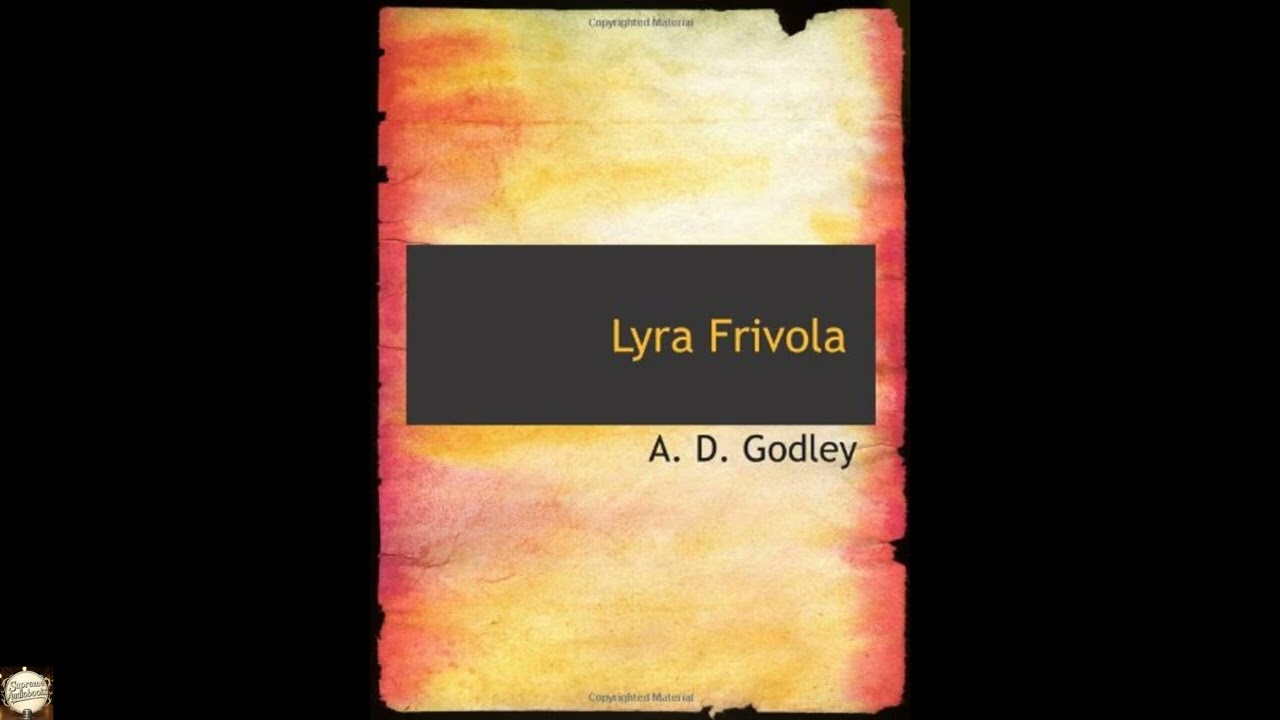
Lyra Frivola
Step into a world where the hallowed halls of academia meet the gently mocking muse, where classical erudition dances with a distinctly modern, often self-deprecating wit. A. D. Godley’s Lyra Frivola is not merely a collection of verse; it is a delightful conversation across centuries, a testament to the enduring power of laughter and the subtle art of parody. This charming and surprisingly resonant work offers listeners a refreshing perspective on the intellectual life of a bygone era, illuminating the quirks of human nature and scholarship that remain relevant even today. It reminds us that seriousness can coexist with levity, and that even the most profound subjects can benefit from a touch of ingenious playfulness. From the quiet cloisters of Oxford to the bustling streets of late Victorian and Edwardian England, Godley’s collection ushers the listener into a speaker’s world characterized by a keen observational eye and a ready turn of phrase. The "main character," if one can call it that, is the poet himself—a genial, learned, yet always slightly detached commentator on the absurdities of life, letters, and the occasional inconvenience. We encounter a series of vignettes and observations, each a miniature world populated by well-meaning dons, eager students, political figures, and the ever-present ghosts of Homer and Virgil. The central conflict isn’t a grand narrative struggle, but rather the ongoing, good-natured clash between the weight of classical tradition and the lighter, often silly demands of contemporary existence. The arc of Lyra Frivola isn't a linear progression of events, but a thematic and emotional journey through the poet’s mind. Each piece, whether a playful ode, a biting epigram, or a clever translation, contributes to a broader understanding of his perspective. The collection often begins with a seemingly serious premise, only to undercut it with an unexpected pun, a sudden shift in register, or a droll observation, revealing the speaker's knack for seeing the humorous side of even the most august subjects. Listeners will find themselves immersed in a series of engaging encounters with a mind that values both learning and laughter, finding the ridiculous in the sublime and the sublime in the seemingly ridiculous, always with an understated charm that never descends into cynicism. A. D. Godley, born Alfred Denis Godley in 1856, was a quintessential Oxford figure of his time. Educated at Marlborough College and Balliol College, Oxford, he spent much of his distinguished career as a classical scholar and tutor at Magdalen College, eventually becoming Public Orator of the University in 1910, a position he held until his death in 1925. Godley was more than just an academic; he was a prolific and highly regarded writer of light verse, renowned for his command of classical languages and his unique ability to wield them with wit and humor. His contributions frequently graced the pages of The Oxford Magazine, The Spectator, and Punch, establishing him as a master of sophisticated literary parody and gentle satire. Godley’s literary standing is rooted in his precision, his classical sensibility, and his unerring ear for rhythm and rhyme, often demonstrated through his skilled translations and imitations of ancient Greek and Latin poets. He wrote not only Lyra Frivola, but also collections like Second Strings and his posthumously published Reliquiae, which gathered much of his best work. His influence lay in demonstrating that classical scholarship did not have to be a dry, dusty pursuit, but could be a wellspring of intelligent amusement. He belonged to a tradition of learned humorists who found joy in the interplay between ancient forms and modern sensibilities, forging a unique place in English literature as a poet of exceptional wit and erudition. One of the prominent themes running through Godley’s work is the juxtaposition of classical ideals with modern trivialities. He often begins a poem in the grand style of a Homeric epic or a Horatian ode, only to apply that lofty language to a mundane subject like a railway journey or a university committee meeting. For instance, he might craft a meticulous Greek couplet to lament the declining quality of college butter, highlighting the absurdity of applying ancient grandeur to contemporary banalities, while simultaneously celebrating the beauty of the classical form itself. This playful tension between the venerable past and the prosaic present is a constant source of quiet humor and intellectual delight. Another significant theme is satire of academic life and pedantry. While Godley was deeply embedded in the Oxford system, he was not blind to its foibles. His verse frequently pokes gentle fun at the obsessive precision of scholars, the often circuitous logic of university politics, and the sometimes-inflated self-importance of the common room. He might describe a university examination as a heroic struggle, using the language of ancient battles to depict students grappling with Latin irregular verbs, thereby softening the critique with affectionate humor. He observes, critiques, and ultimately embraces the eccentricities of scholarly existence with a knowing smile. Godley wrote during a fascinating period in British history, primarily in the late nineteenth and early twentieth centuries. This was an era marked by the fading grandeur of the Victorian age and the dawn of the Edwardian era, a time of immense social and scientific change. Despite the industrial revolution and emerging global conflicts, classical education remained the bedrock of intellectual life among the British elite, particularly in universities like Oxford and Cambridge. Godley’s work arose directly from this environment, where a shared understanding of Latin and Greek was not just common but expected among educated readers. His humor often relied on this collective classical literacy, allowing him to play with allusions and forms that his audience would immediately recognize and appreciate. His brand of wit provided a delightful counterpoint to the more serious philosophical and social debates of the time. While literary modernism was beginning to take shape, Godley's verse maintained a connection to older forms and values, offering a sophisticated form of escapism and intellectual diversion. He emerged at a moment when traditional institutions were being re-evaluated, and his playful subversion of classical seriousness served as both a comfort and a gentle challenge to the prevailing intellectual climate, showcasing that intelligence could also be light-hearted and self-aware. Listening to Lyra Frivola as an audiobook offers a singular opportunity to fully appreciate the musicality and precise rhythms of Godley’s verse. A skilled narrator brings Godley’s classical cadences and comedic timing to life, allowing the listener to catch every nuanced pun, every subtle irony, and the delicate balance between high erudition and low humor. The several hours of listening provide ample time to settle into the poet’s unique voice, allowing the delightful shifts in tone and clever wordplay to truly sink in. The spoken word emphasizes the performance aspect inherent in Godley’s often conversational style, making the experience feel like sharing a witty exchange with a learned friend, where the emphasis on pacing and vocal characterization truly elevates the material.
Enjoyed Lyra Frivola? A few ways to support us
Audible & Amazon links are affiliate; we may earn a small commission at no extra cost.
About this production
Human narration by a volunteer reader from LibriVox.org, the public-domain audiobook project. LibriVox volunteers record literary works whose copyright has expired in the United States, releasing the resulting recordings into the public domain.
Lyra Frivola by A. D. Godley. The underlying text is in the U.S. public domain. We do not republish any modern copyrighted edition, translation, or commentary.
The 4K cinematic visuals accompanying this audiobook are generated by an AI image model from prompts derived from the source text. No copyrighted photos, paintings, or stock footage are used. AI generation is disclosed on every video on our YouTube channel as required by YouTube's altered/synthetic content policy.
English subtitles are transcribed from the LibriVox recording with OpenAI Whisper. Translations into the 11 other supported languages are produced by Meta's NLLB-200 neural translation model. No human translator's copyrighted translation is used.
Questions about sourcing or rights? See our DMCA & Sourcing policy or contact us.
Enjoyed this audiobook?
If you'd like to own a copy of Lyra Frivola or hear a professionally produced edition, the links below help support free audiobook production at no extra cost to you.
As an Amazon Associate we earn from qualifying purchases. Audible / print links are affiliate.