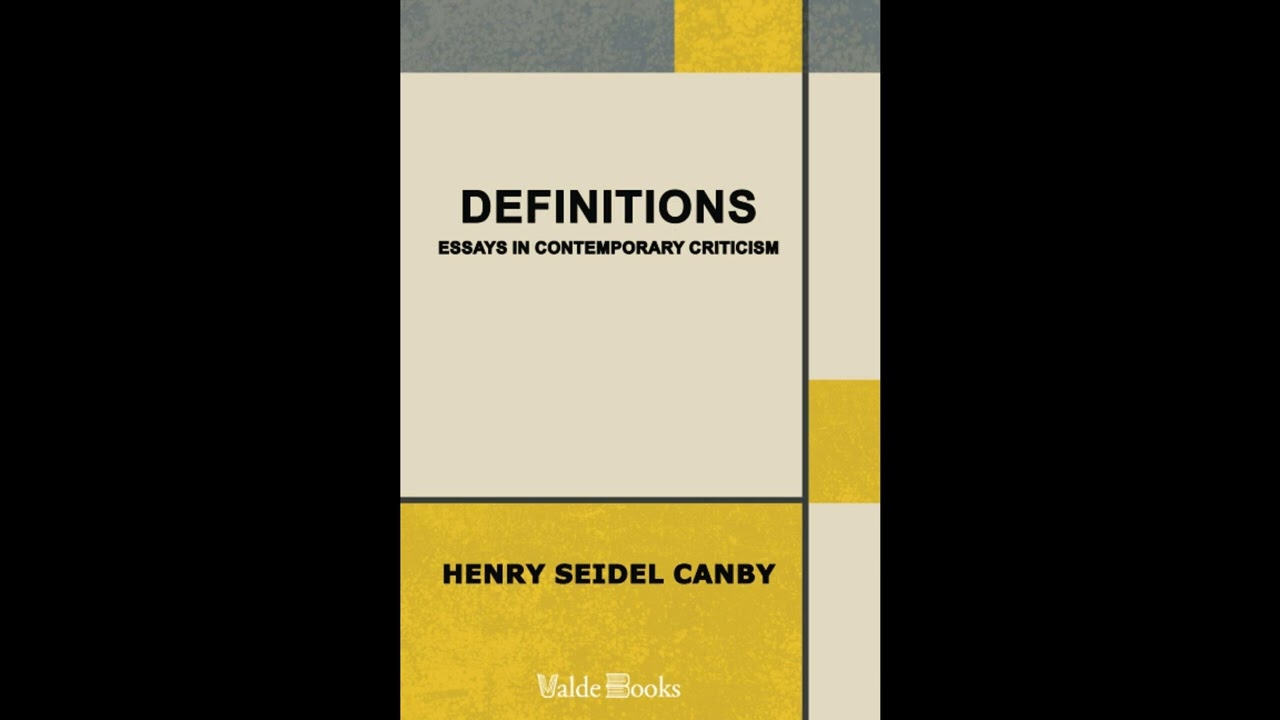
Definitions: Essays in Contemporary Criticism
In the dynamic world of literary discourse, some voices stand out as foundational, not merely for their opinions but for their ability to articulate the very framework of critical thought. Henry Seidel Canby's Definitions: Essays in Contemporary Criticism offers precisely such a voice, providing a rare opportunity to witness the birth pangs of modern American literary analysis. Published in 1922, this collection of essays is more than a historical artifact; it is a vital lens through which we can understand how literature shapes, and is shaped by, its era. Canby grapples with questions of artistic purpose, societal impact, and the evolving nature of storytelling that remain acutely relevant today, inviting listeners to engage with the intellectual debates that continue to inform our understanding of books and culture. This collection doesn't present a traditional narrative with characters and a central conflict, but rather an intellectual expedition across the literary landscape of the early twentieth century. Canby acts as a perceptive guide, leading the reader through a series of thoughtful examinations of contemporary authors, literary forms, and the broader role of the critic. He sets the stage by addressing the burgeoning confusion and excitement surrounding new artistic movements, questioning what "modern" truly signifies in literature. Each essay then tackles a specific facet of this literary moment, whether dissecting the craft of a popular novelist, analyzing the societal implications of a new poetic style, or pondering the future trajectory of American letters. The collection’s intellectual arc mirrors Canby's own pursuit of clarity amidst change. He systematically works to define the boundaries and possibilities of various literary genres, articulating the criteria by which new works should be judged and understood. The "story" here is one of intellectual wrestling—Canby’s engagement with prevailing literary theories, his advocacy for an authentic American voice, and his efforts to provide a coherent framework for understanding a rapidly diversifying field. He challenges readers to move beyond superficial appreciation, encouraging a deeper, more analytical connection with the printed word, always aiming to crystallize the essence of what makes a piece of literature resonate with its audience. Henry Seidel Canby (1878–1961) was a pivotal figure in American literary criticism and education during the first half of the twentieth century. Born in Wilmington, Delaware, Canby pursued his education at Yale University, where he later returned to teach English for many years. His career was characterized by a deep commitment to fostering an informed and engaged readership, particularly for American literature. He rose to prominence not only as an academic but also as a public intellectual who believed in the accessibility and social significance of literary criticism. Canby’s most enduring legacy lies in his work as an editor. He served as the first editor of The Literary Review of the New York Evening Post, which he transformed into a respected platform for serious literary discussion. Following this, he became the founding editor of The Saturday Review of Literature in 1924, a publication that would become one of the most influential literary periodicals in the United States. Under his guidance, The Saturday Review championed American authors and helped to shape public taste and critical opinion, providing a forum for thoughtful engagement with both new and established works. Beyond his editorial roles, Canby was a prolific author of his own, penning biographies such as Thoreau and cultural histories like The Age of Confidence, which further solidified his place as a leading commentator on American life and letters. One of the central themes that runs through Definitions is the role and responsibility of the literary critic. Canby positions the critic not as a gatekeeper or a mere arbiter of taste, but as an essential bridge between the artist and the public. He argues that criticism should illuminate, interpret, and provide context, helping readers to understand complex works and appreciate their nuances. For instance, in an essay where he discusses the burgeoning popularity of realistic novels, Canby doesn't simply praise or condemn; instead, he carefully unpacks the author's method, showing how specific choices in character development or setting contribute to the overall effect, thereby demonstrating how a critic can enhance the reading experience rather than dictate it. Another prominent theme is the search for a distinct American literary identity. At a time when American literature was still often seen through the lens of European traditions, Canby passionately advocated for the unique voices and experiences emerging from the United States. He examines how American writers were grappling with their own history, landscape, and social dynamics, striving to forge a style and subject matter that was authentically their own. He might point to a contemporary novel that captures the rhythms of a particular American region or a poet who finds inspiration in everyday American life, illustrating how these works contribute to a growing national literary canon, separate from European influences. When Canby penned Definitions in 1922, the world was still reeling from the aftermath of World War I. This period, often called the Roaring Twenties, was marked by rapid social, cultural, and technological change. In America, industrialization was transforming cities, women had recently gained the right to vote, and new forms of entertainment like jazz music and cinema were reshaping public life. Intellectually, traditional certainties were being challenged by Freudian psychology, Einsteinian physics, and a growing skepticism toward established institutions. In the literary world, this meant a dramatic break from Victorian conventions. Modernism was in full swing, with writers like T.S. Eliot, Ezra Pound, and Virginia Woolf experimenting with form, language, and narrative structure. American literature, in particular, was experiencing an explosion of talent and a newfound confidence, as figures like F. Scott Fitzgerald, Ernest Hemingway, and William Faulkner began to publish their groundbreaking works. Canby’s book emerged from this ferment—a critical attempt to make sense of the new literary order, to clarify its aims, and to provide guidance for readers navigating a landscape that often felt bewilderingly new. He offered a much-needed steady hand, helping to define the intellectual boundaries of a new era for American letters. Listening to Definitions: Essays in Contemporary Criticism as an audiobook offers a unique way to engage with Canby’s insightful prose. A skilled narrator can bring the academic rigor and thoughtful argumentation of these essays to life, transforming what might otherwise be dense critical analysis into an engaging intellectual discussion. The measured pacing of the narration allows listeners to absorb complex ideas without feeling rushed, encouraging reflection on each argument as it unfolds. The clear, articulate voice of the narrator emphasizes Canby’s precision and lucidity, making his definitions of literary concepts and his assessments of authors feel both authoritative and accessible. This format is ideal for sustained listening, whether during a commute, while walking, or during dedicated study time, allowing the listener to truly settle into the intellectual atmosphere of early 20th-century critical thought.
Enjoyed Definitions: Essays in Contemporary Criticism? A few ways to support us
Audible & Amazon links are affiliate; we may earn a small commission at no extra cost.
About this production
Human narration by a volunteer reader from LibriVox.org, the public-domain audiobook project. LibriVox volunteers record literary works whose copyright has expired in the United States, releasing the resulting recordings into the public domain.
Definitions: Essays in Contemporary Criticism by Henry Seidel Canby. The underlying text is in the U.S. public domain. We do not republish any modern copyrighted edition, translation, or commentary.
The 4K cinematic visuals accompanying this audiobook are generated by an AI image model from prompts derived from the source text. No copyrighted photos, paintings, or stock footage are used. AI generation is disclosed on every video on our YouTube channel as required by YouTube's altered/synthetic content policy.
English subtitles are transcribed from the LibriVox recording with OpenAI Whisper. Translations into the 11 other supported languages are produced by Meta's NLLB-200 neural translation model. No human translator's copyrighted translation is used.
Questions about sourcing or rights? See our DMCA & Sourcing policy or contact us.
Enjoyed this audiobook?
If you'd like to own a copy of Definitions: Essays in Contemporary Criticism or hear a professionally produced edition, the links below help support free audiobook production at no extra cost to you.
As an Amazon Associate we earn from qualifying purchases. Audible / print links are affiliate.