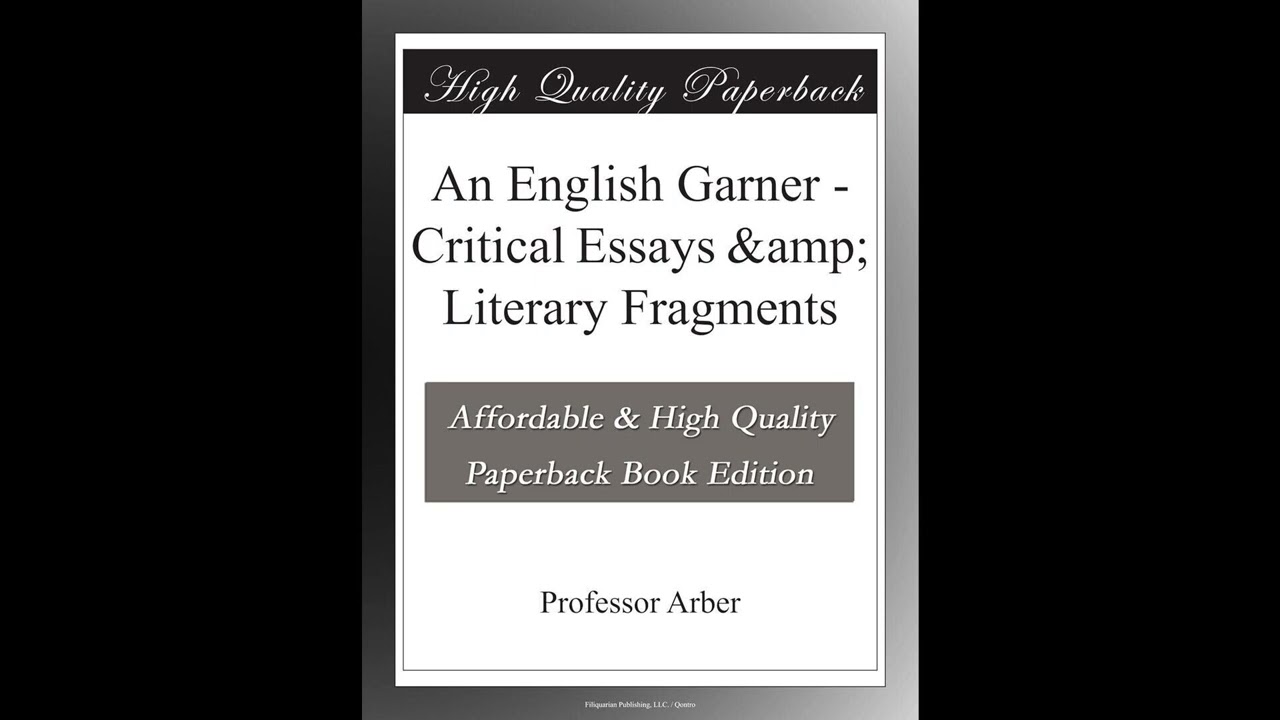
An English Garner - Critical Essays & Literary Fragments
"An English Garner - Critical Essays & Literary Fragments" invites you to a unique literary experience, a carefully curated collection offering direct access to the thoughts and creative expressions that shaped English letters over centuries. This is not a single story with a singular author, but rather a grand assembly, a symposium of voices brought together by the meticulous scholarship of Professor Arber. Within these gathered pieces lies the very bedrock of our literary understanding – the forgotten poems, the astute critical observations, the historical anecdotes, and the philosophical musings that, taken together, form an indispensable window into the intellectual and artistic currents of the past. It offers both a broad sweep of historical periods and a close-up on specific moments of brilliance, reminding us that the foundations of modern literature are built upon an enduring tradition of thought and creation. It is an opportunity to directly encounter the raw material that scholars and writers have referenced for generations, presented with the clarity and dedication of its esteemed editor. The "story" of An English Garner unfolds not as a linear narrative but as a meticulously arranged gallery, where each piece—whether a fragment of verse, a biographical sketch, a historical report, or a critical assessment—contributes to a larger portrait of English intellectual history. The setting spans the breadth of centuries, from the foundational years of English prose and poetry up through periods closer to Professor Arber's own time. The "main characters" are the authors of these diverse fragments: anonymous scribes, celebrated poets, keen-eyed observers, and pioneering critics whose individual voices echo across the ages. The central "conflict," if one can call it that, resides in the act of selection itself: Professor Arber’s challenge to discern the most illuminating, representative, and often overlooked pieces from the vast ocean of English literature, presenting them in a way that reveals their individual merit and their collective significance. Listeners will find themselves moving through distinct phases within this collection. One moment, they might be immersed in a passionate plea from a forgotten pamphleteer, arguing a point of social justice from centuries past. The next, they could be contemplating the lyrical beauty of an early ballad, its rhythms and language a direct link to the emotional lives of a distant era. Further on, a sharp-witted critical essay might illuminate the literary tastes and aesthetic debates of a particular generation, offering insights into why certain works were championed and others dismissed. The arc of this "story" is the listener's own developing understanding, a gradual accretion of knowledge and appreciation for the evolving forms, concerns, and linguistic textures of English letters, all without revealing any grand, overarching narrative conclusion beyond the sheer wealth of discovery. Each "chapter" or fragment stands on its own, yet contributes to a cumulative sense of the vastness and dynamism of literary tradition. The discerning mind behind this expansive collection was Edward Arber (1836–1912), a figure of monumental importance in the preservation and popularization of early English literature. Born in London, Arber dedicated his life to scholarship and the making of historical texts accessible to a wider readership. He began his career in the British civil service, but his true passion lay in the meticulous editing and reprinting of works from bygone eras. His most significant academic appointment came as Professor of English Language and Literature at University College London, and later at King's College London, positions that allowed him to institutionalize his groundbreaking work in literary pedagogy and historical bibliography. Arber’s prodigious output included not only An English Garner series, but also his renowned English Reprints, a monumental project that saw him personally edit and publish faithful reproductions of nearly all the significant early English texts then available. These reprints, often distributed at affordable prices, revolutionized the study of English literature by making primary sources readily available to students and scholars for the first time. His dedication was not merely academic; it was a profound belief in the intrinsic value of literary heritage and the necessity of direct engagement with original works. Arber’s place in the literary canon is that of a foundational scholar, a meticulous textual editor, and an invaluable archivist who single-handedly brought countless forgotten works back into the light, shaping the very curriculum of English studies in his era and influencing generations of literary historians who followed. He was less an interpreter and more a facilitator, a conduit through which the past could speak directly to the present. An English Garner foregrounds several profound themes, chief among them being the preservation of literary heritage. Through Arber’s careful selection, works that might otherwise have been lost to obscurity are given new life. Listeners might encounter a seventeenth-century broadside ballad, its language and concerns reflecting the daily lives and anxieties of a time far removed from our own, yet presented with such clarity that its historical voice remains potent. This act of preservation is not just about saving old texts; it is about keeping alive the continuum of human thought and expression, demonstrating how ideas and artistic forms evolve and echo across centuries. Another central theme is the evolution of critical thought and literary taste. By juxtaposing critical essays from different periods, the collection illustrates how standards of literary evaluation shift over time. One fragment might offer an analysis of a classical author, reflecting a rigid neoclassical aesthetic, while another might champion a more romantic approach to authorship. These contrasting perspectives demonstrate that literary judgment is not static but a dynamic process, shaped by cultural shifts and intellectual paradigms. Furthermore, the very act of compiling such a diverse collection speaks to the theme of the interconnectedness of literary forms, revealing literature not as isolated creations, but as an ongoing conversation across genres and eras. Professor Arber’s monumental work of compilation and reprinting emerged during a pivotal period in English intellectual history, broadly encompassing the late Victorian and early Edwardian eras. This was a time of burgeoning national consciousness and a widespread movement to codify and celebrate Britain’s cultural heritage. The rise of academic institutions saw the establishment of English Literature as a distinct and rigorous field of study, moving beyond gentlemanly appreciation towards scholarly analysis. There was a pressing need for accessible, reliable editions of primary texts, as many foundational works were either out of print or prohibitively expensive. Arber’s efforts were perfectly aligned with these forces, providing the essential building blocks for this new academic discipline and for a public increasingly interested in their shared cultural legacy. His Garner was a direct response to this intellectual hunger, democratizing the study of English letters. Listening to An English Garner as an audiobook transforms the solitary act of reading into an intimate encounter with history. The narration becomes the thread that weaves together these disparate fragments, offering a consistent and guiding voice through the myriad styles, historical periods, and critical perspectives. Imagine the narrator shifting seamlessly from the formal prose of an Elizabethan essayist to the rhythmic cadence of a Restoration-era poem, each delivered with an authentic respect for its original intent and texture. The several hours of run time make it ideal for sustained listening, or for dipping into specific sections as curiosity dictates. Pay attention to the subtle shifts in tone, the careful pacing that allows the listener to digest complex ideas, and the way the narrator's voice conjures the distinct atmosphere of each piece. This format brings a fresh vitality to these foundational texts, making the past speak directly to you.
Enjoyed An English Garner - Critical Essays & Literary Fragments? A few ways to support us
Audible & Amazon links are affiliate; we may earn a small commission at no extra cost.
About this production
Human narration by a volunteer reader from LibriVox.org, the public-domain audiobook project. LibriVox volunteers record literary works whose copyright has expired in the United States, releasing the resulting recordings into the public domain.
An English Garner - Critical Essays & Literary Fragments by Professor Arber. The underlying text is in the U.S. public domain. We do not republish any modern copyrighted edition, translation, or commentary.
The 4K cinematic visuals accompanying this audiobook are generated by an AI image model from prompts derived from the source text. No copyrighted photos, paintings, or stock footage are used. AI generation is disclosed on every video on our YouTube channel as required by YouTube's altered/synthetic content policy.
English subtitles are transcribed from the LibriVox recording with OpenAI Whisper. Translations into the 11 other supported languages are produced by Meta's NLLB-200 neural translation model. No human translator's copyrighted translation is used.
Questions about sourcing or rights? See our DMCA & Sourcing policy or contact us.
Enjoyed this audiobook?
If you'd like to own a copy of An English Garner - Critical Essays & Literary Fragments or hear a professionally produced edition, the links below help support free audiobook production at no extra cost to you.
As an Amazon Associate we earn from qualifying purchases. Audible / print links are affiliate.