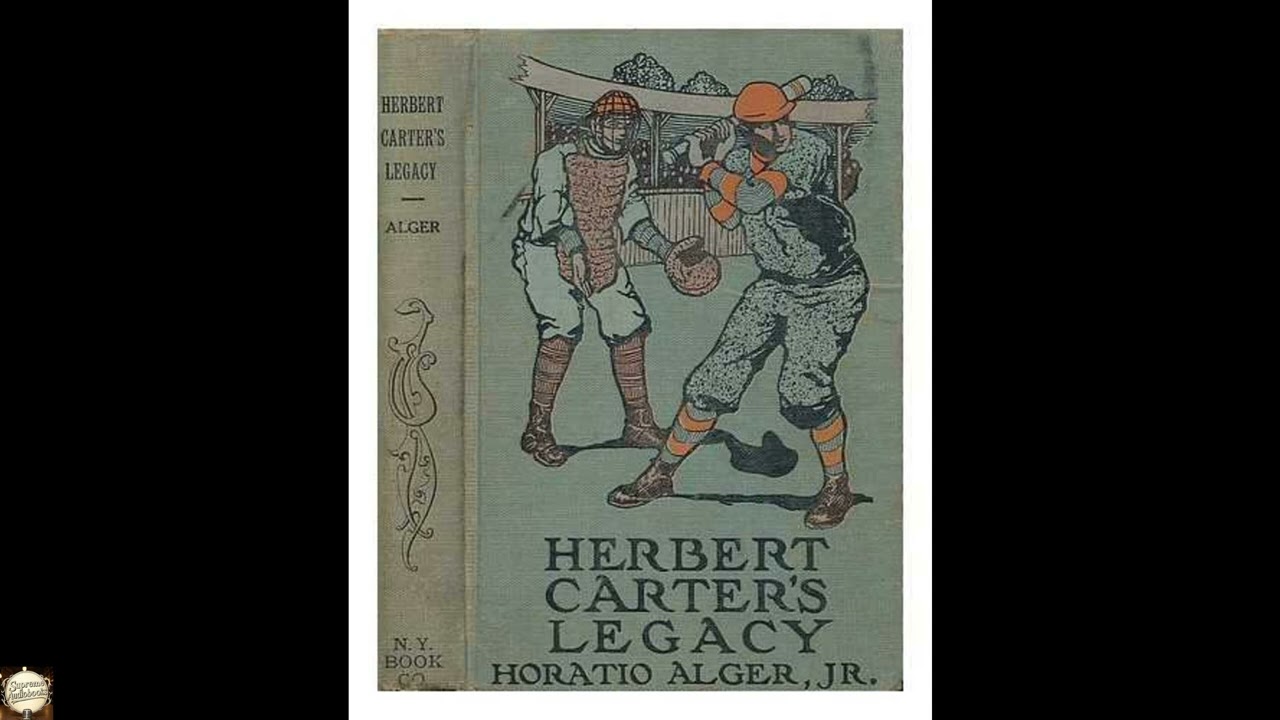
Herbert Carter's Legacy, Or, the Inventor's Son
In an era frequently defined by rapid change and complex narratives, the enduring appeal of a straightforward tale about industry, integrity, and the ultimate triumph of virtue remains compelling. Horatio Alger, Jr.'s Herbert Carter's Legacy, Or, the Inventor's Son offers precisely such a story – a clear window into a bygone America where moral uprightness and diligent effort were seen as the indispensable keys to overcoming adversity, and a young man's good character stood as his most valuable inheritance. This particular volume, part of Alger's vast output, distills the quintessential "rags-to-riches" formula into an accessible and reassuring experience, reminding listeners that even in the face of profound challenge, honesty and hard work can pave the path to a brighter future. It’s a narrative that, despite its late nineteenth-century origins, continues to resonate with anyone who believes in the power of individual agency and the possibility of rising above one's initial circumstances. Our story introduces young Herbert Carter, a promising and industrious boy who finds himself thrust into the harsh realities of the world after the sudden death of his beloved father. Mr. Carter, an ingenious but financially struggling inventor, leaves behind not wealth, but a potential legacy – a revolutionary invention that promises to change lives and, hopefully, secure his son's future. However, Herbert's circumstances are immediately complicated by the presence of a conniving and unscrupulous relative, Mr. Simon Carter, who quickly seizes control of the inventor's papers and machinery, intending to appropriate the patent and its future profits for himself. Left with little more than the clothes on his back and a deep sense of injustice, Herbert is cast out to make his own way in the bustling, indifferent metropolis. The central conflict of the narrative thus becomes Herbert's struggle to survive and, eventually, to reclaim what is rightfully his. He takes on various humble jobs – selling newspapers, running errands, working as an office boy – all while maintaining an unwavering commitment to honesty and hard work. Along his arduous path, he encounters a diverse cast of characters: some benevolent individuals who recognize his innate goodness and offer a helping hand, others who are suspicious or even openly hostile. Herbert faces numerous setbacks, close calls, and temptations, yet he consistently chooses the path of rectitude, holding fast to the memory of his father's integrity and his own burgeoning sense of self-reliance. The unfolding narrative details his gradual rise through sheer perseverance, demonstrating how small acts of kindness and honest labor incrementally build towards a greater purpose, even as the shadow of his uncle's deception looms large. Horatio Alger, Jr., the author of this emblematic tale, was born in Chelsea, Massachusetts, in 1832. After graduating from Harvard College and then Harvard Divinity School, he initially pursued a career as a Unitarian minister. However, a significant scandal in 1866 led to his resignation from the ministry, prompting a profound shift in his life and career trajectory. Alger subsequently relocated to New York City, where he dedicated himself to writing for young people, focusing particularly on the plight of street urchins and newsboys. This period marked the beginning of his prolific output, which would eventually comprise over 100 novels and countless short stories. Alger quickly became a publishing phenomenon, his name synonymous with the "rags-to-riches" narrative that captivated a generation of American youth. His formulaic yet immensely popular stories, including titles like Ragged Dick, Tattered Tom, and Luck and Pluck, consistently featured an impoverished but virtuous boy who, through hard work, honesty, and a stroke of good fortune (often involving the timely intervention of a wealthy benefactor), rises from destitution to a respectable middle-class life. Though criticized by later literary scholars for their simplistic plots and didacticism, Alger's books were foundational in shaping the American mythos of self-made success and exerted an enormous influence on the moral education and aspirations of young readers in the late 19th century, cementing his unique, if sometimes controversial, place in the literary canon. At its core, Herbert Carter's Legacy beautifully enacts several foundational themes. Foremost among these is the celebration of self-reliance and hard work. Herbert does not wait for a miraculous inheritance or a handout; he immediately seeks employment, demonstrating initiative and a willingness to perform any honest labor. For instance, early in the story, despite his inexperience, he secures a position as a delivery boy, showing up reliably and diligently completing his tasks, which slowly earns him the trust and respect of his employer. This unwavering commitment to earning his own way, even in the most modest circumstances, underscores the Algerian ideal that personal effort is the bedrock of success. Another powerful theme is unwavering integrity and the ultimate reward of virtue. Even when faced with destitution, Herbert steadfastly refuses to compromise his moral principles. He is tempted by dishonest schemes and encounters individuals who would encourage him to cut corners or engage in deceit, yet he consistently adheres to a strict code of ethics. A crucial scene might involve Herbert finding a lost wallet and, despite his own dire need, returning it to its rightful owner without hesitation. This act, seemingly small, often leads to recognition and assistance from influential figures, illustrating the belief that good character eventually attracts positive outcomes, distinguishing him starkly from his conniving uncle. The period in which Horatio Alger, Jr. wrote Herbert Carter's Legacy and his other popular works—the decades following the American Civil War, often referred to as the Gilded Age—was a time of immense social and economic transformation in the United States. Rapid industrialization, the growth of large cities, and an influx of immigrants created both unprecedented opportunities and significant social inequalities. There was a prevailing cultural belief, deeply ingrained in the American psyche, in the ideal of upward mobility – the "American Dream" – where any individual, regardless of their origins, could achieve success through sheer effort and moral fortitude. Alger's novels emerged as direct reflections and reinforcers of this ideal. These stories served a dual purpose: they offered moral instruction to impressionable youth, promoting virtues like thrift, sobriety, and perseverance, while also providing reassuring narratives of hope and possibility in a rapidly changing and sometimes bewildering world. For many young readers, often themselves from humble backgrounds, Alger's protagonists like Herbert Carter offered relatable role models and a comforting blueprint for navigating the complexities of modern life, suggesting that individual virtue held the key to unlocking the promised land of middle-class respectability and financial security. Listening to Herbert Carter's Legacy, Or, the Inventor's Son as an audiobook offers a distinctive way to connect with this classic of American juvenile literature. The narration experience breathes new life into Alger's earnest prose, allowing the listener to fully immerse themselves in Herbert's struggles and triumphs without the visual distractions of print. A skilled narrator can deftly differentiate between Herbert's youthful optimism, the gruff but kind tones of his benefactors, and the insidious whispers of his adversaries, creating a vibrant soundscape that transports the audience directly into the heart of late nineteenth-century urban life. With its run length of several hours, this production is an ideal companion for commutes, daily chores, or quiet evenings, inviting listeners to appreciate the pacing of a classic narrative and the straightforward, didactic dialogue that defined a generation of popular fiction. It provides a chance to hear the very rhythms and cadences that once shaped the moral imagination of countless young Americans.
Enjoyed Herbert Carter's Legacy, Or, the Inventor's Son? A few ways to support us
Audible & Amazon links are affiliate; we may earn a small commission at no extra cost.
About this production
Human narration by a volunteer reader from LibriVox.org, the public-domain audiobook project. LibriVox volunteers record literary works whose copyright has expired in the United States, releasing the resulting recordings into the public domain.
Herbert Carter's Legacy, Or, the Inventor's Son by Horatio Alger, Jr. The underlying text is in the U.S. public domain. We do not republish any modern copyrighted edition, translation, or commentary.
The 4K cinematic visuals accompanying this audiobook are generated by an AI image model from prompts derived from the source text. No copyrighted photos, paintings, or stock footage are used. AI generation is disclosed on every video on our YouTube channel as required by YouTube's altered/synthetic content policy.
English subtitles are transcribed from the LibriVox recording with OpenAI Whisper. Translations into the 11 other supported languages are produced by Meta's NLLB-200 neural translation model. No human translator's copyrighted translation is used.
Questions about sourcing or rights? See our DMCA & Sourcing policy or contact us.
Enjoyed this audiobook?
If you'd like to own a copy of Herbert Carter's Legacy, Or, the Inventor's Son or hear a professionally produced edition, the links below help support free audiobook production at no extra cost to you.
As an Amazon Associate we earn from qualifying purchases. Audible / print links are affiliate.