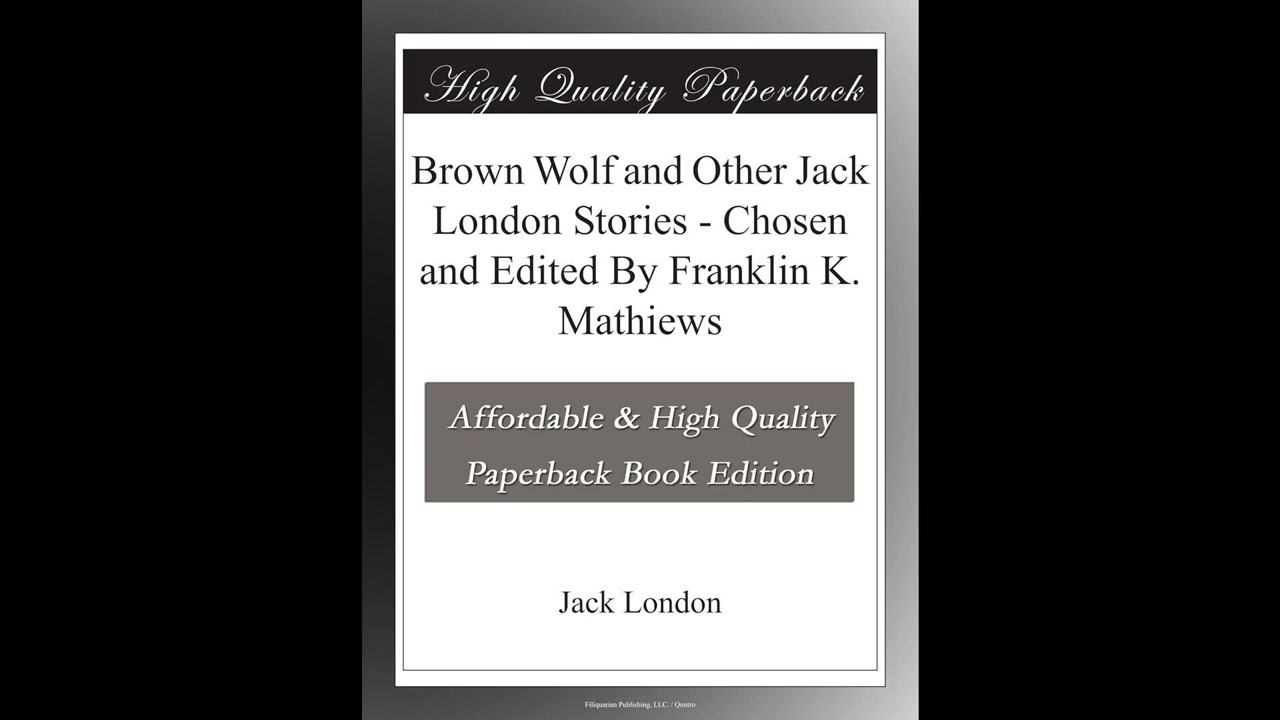
Brown Wolf and Other Jack London Stories - Chosen and Edited By Franklin K. Mathiews- Full Audiobook
Jack London’s powerful narratives plunge readers into worlds where primal instincts clash with human ambition, where the wild dictates the terms of survival, and where the line between civilization and savagery blurs. This collection, "Brown Wolf and Other Jack London Stories," gathered and edited by Franklin K. Mathiews, offers a quintessential taste of London’s genius, presenting tales that resonate with enduring questions about identity, belonging, and the persistent struggle against the elements. London's stories are not mere adventures; they are profound investigations into the raw heart of existence, asking what truly defines us when stripped of comfort and convention. They force us to confront the animal within, the call of the untamed, and the tenacity of the human and animal spirit in the face of overwhelming odds. To listen to these stories today is to connect with a literary force whose insights into nature and humanity remain as sharp and relevant as they were over a century ago. The titular story, "Brown Wolf," serves as a poignant gateway into London's thematic landscape, focusing on a magnificent wolf-dog that finds itself caught between two worlds. Initially living a domesticated life in a cozy cabin with a writer and his wife, Walt and Madge, in the serene California landscape, the animal seems to have shed its wild past. It’s a loyal companion, an integral part of their quiet domesticity. Yet, an undercurrent of its former life—its past as a sled dog and a free creature of the North—continues to stir within it. The animal’s true identity becomes a point of contention and mystery when a weathered trapper from the Yukon arrives, claiming the dog as his own, identifying it as "Skiff." This sets up a profound conflict, not just between the humans vying for ownership, but within the wolf-dog itself. The story carefully observes the creature's reactions, its subtle shifts between its learned domesticity and the deep-seated instincts of its ancestral wilderness. The trapper, Matt, understands the dog's heritage in a way the gentle Walt and Madge cannot, appealing to its primitive memories with smells and sounds from its past life in the frozen North. The narrative follows the slow, internal reckoning of the animal, as it grapples with where its true loyalty lies – with the comforts and affections of its present life or with the harsh, but familiar, freedom of its past. This central struggle—the pull of the wild versus the security of civilization—is a recurring motif throughout London’s work, and in "Brown Wolf," it is distilled into a deeply moving and psychologically keen portrayal of an animal's quest for identity and belonging. The collection then expands upon these themes, featuring other narratives that transport the listener to the brutal beauty of the Klondike gold rush, the perilous lives of sailors on the high seas, and the unforgiving frontier where men and beasts alike fight for every breath. Each story, in its own way, examines moments of ultimate choice and the inherent strength required to endure. Jack London, born John Griffith Chaney in San Francisco, California, in 1876, lived a life as vivid and adventurous as any of his fictional characters. His early years were marked by poverty and constant struggle, which profoundly shaped his worldview and fueled his prolific writing career. He left school at a young age to support his family, taking on a remarkable array of jobs that exposed him to the harshest realities of American society. He worked as an oyster pirate on San Francisco Bay, a seal hunter, a longshoreman, and a hobo traveling the United States and Canada by rail, experiencing firsthand the lives of the working class and the marginalized. These experiences instilled in him a deep sense of social justice and a fascination with human endurance. The pivotal turning point in London's life and literary trajectory came with the Klondike Gold Rush in 1897. Though he did not strike it rich in gold, the eighteen months he spent in the Yukon Territory, enduring the brutal cold and unforgiving wilderness, provided him with an inexhaustible wellspring of material. It was here, amidst the stark beauty and immense hardship, that he gathered the raw inspiration for many of his most celebrated stories, including "Brown Wolf," and later, his iconic novels like The Call of the Wild and White Fang. Upon his return, he dedicated himself to writing, quickly rising to become one of the most famous and highest-paid authors of his time. London was a central figure in American naturalism and realism, literary movements that sought to depict life as it truly was, often highlighting the influence of environment, heredity, and social conditions on human fate. His works frequently explored themes of survival, social Darwinism, and class struggle, reflecting his own socialist convictions and his belief in the power of the individual spirit against overwhelming odds. Beyond his Alaskan tales, he penned other acclaimed novels such as The Sea-Wolf, a brutal psychological drama set on a sealing schooner, and Martin Eden, a semi-autobiographical novel about a working-class sailor who strives to become a writer. London's unique blend of visceral adventure and profound philosophical inquiry secured his place as a foundational voice in American literature before his untimely death in 1916 at the age of forty. One of the most enduring themes found throughout London's work, and certainly evident in "Brown Wolf," is the stark confrontation between civilization and wilderness. London masterfully portrays the delicate balance and often violent tension between the ordered world of human society and the untamed, primal forces of nature. In "Brown Wolf," this theme is embodied in the very essence of the titular character, a creature whose lineage traces back to the wild but who has adapted to the comforts of a human home. The arrival of the trapper, with his rougher ways and his intimate knowledge of the wild, acts as a catalyst, pulling the dog's latent instincts to the surface and forcing a choice between the two compelling but utterly distinct ways of life. The story illustrates how the wilderness, even when seemingly subdued, retains an undeniable hold on those who have experienced its raw freedom. Closely linked to this is the theme of survival and the "law of the wild." London’s narratives often strip away the veneers of polite society to reveal the fundamental struggle for existence that underlies all life. His characters, whether human or animal, are frequently tested against the elements, against other creatures, and often against their own physical and mental limitations. The scenes in "Brown Wolf," where the dog's past life is recalled through its reactions to familiar scents and commands, vividly demonstrate how deep-seated instinct can override learned behavior, echoing the brutal efficiency of natural selection. Furthermore, London often depicts social Darwinism, not necessarily endorsing it, but showing its harsh realities: the strong endure, the weak perish, and compassion is a luxury rarely afforded. His stories also celebrate the indomitable human spirit and the sheer tenacity required to face such overwhelming forces, finding courage and resilience even in the most desperate circumstances. Jack London's stories emerged during a period of immense change and cultural introspection in America, roughly from the late nineteenth century into the early twentieth. The closing of the American frontier was a significant backdrop, with the myth of the wild west giving way to industrialization and rapid urbanization. London's Klondike tales, written shortly after the actual Gold Rush of 1897-1899, tapped into a national fascination with the last remaining untamed territories and the romantic ideal of striking it rich through sheer grit and daring. This era also saw a growing interest in scientific theories, particularly Darwin's theories of evolution and survival of the fittest, which profoundly influenced London's naturalistic approach to storytelling. Furthermore, the period was marked by significant social and economic upheaval. The rise of large industrial corporations, stark class divisions, and labor movements were pressing issues, and London, a self-proclaimed socialist, often wove critiques of capitalism and class inequality into his narratives. His work provided a stark contrast to the genteel literature that often dominated the publishing world, instead offering raw, unflinching portrayals of life's struggles. His powerful narratives of individuals battling unforgiving environments, whether the frozen North or the brutal confines of a ship, resonated with an audience grappling with their own sense of place in a rapidly modernizing and often challenging world, making his stories not just thrilling adventures but also profound social commentaries. Listening to "Brown Wolf and Other Jack London Stories" as a full audiobook offers a uniquely immersive and powerful experience. The extended run length, encompassing several hours of rich storytelling, allows the listener to fully sink into the distinctive worlds London so vividly creates. A skilled narrator breathes life into the rugged landscapes, the compelling characters, and the fierce emotions that define these tales. Imagine the subtle shifts in voice that differentiate the gentle musings of a California writer from the gruff pronouncements of a seasoned Yukon trapper, or the evocative pacing that builds suspense as a creature makes a momentous decision. The spoken word amplifies the raw atmosphere London crafts, from the biting cold of the Alaskan wilderness to the quiet domesticity of a cabin hearth, allowing the nuanced dialogue and compelling narrative voice to unfold directly into the imagination. This format captures the visceral quality of London's prose, making the instincts, the struggles, and the profound choices within these stories feel immediate and deeply personal.
Enjoyed Brown Wolf and Other Jack London Stories - Chosen and Edited By Franklin K. Mathiews- Full Audiobook? A few ways to support us
Audible & Amazon links are affiliate; we may earn a small commission at no extra cost.
About this production
Human narration by a volunteer reader from LibriVox.org, the public-domain audiobook project. LibriVox volunteers record literary works whose copyright has expired in the United States, releasing the resulting recordings into the public domain.
Brown Wolf and Other Jack London Stories - Chosen and Edited By Franklin K. Mathiews- Full Audiobook. The underlying text is in the U.S. public domain. We do not republish any modern copyrighted edition, translation, or commentary.
The 4K cinematic visuals accompanying this audiobook are generated by an AI image model from prompts derived from the source text. No copyrighted photos, paintings, or stock footage are used. AI generation is disclosed on every video on our YouTube channel as required by YouTube's altered/synthetic content policy.
English subtitles are transcribed from the LibriVox recording with OpenAI Whisper. Translations into the 11 other supported languages are produced by Meta's NLLB-200 neural translation model. No human translator's copyrighted translation is used.
Questions about sourcing or rights? See our DMCA & Sourcing policy or contact us.
Enjoyed this audiobook?
If you'd like to own a copy of Brown Wolf and Other Jack London Stories - Chosen and Edited By Franklin K. Mathiews- Full Audiobook or hear a professionally produced edition, the links below help support free audiobook production at no extra cost to you.
As an Amazon Associate we earn from qualifying purchases. Audible / print links are affiliate.
More by Unknown

For Every Music Lover: A Series Of Practical Essays On Music

Report of the Committee of Inquiry into the Various Aspects of the Problem of Abort
Letters on the Nicobar Islands, Their Natural Productions and the Manners, Customs