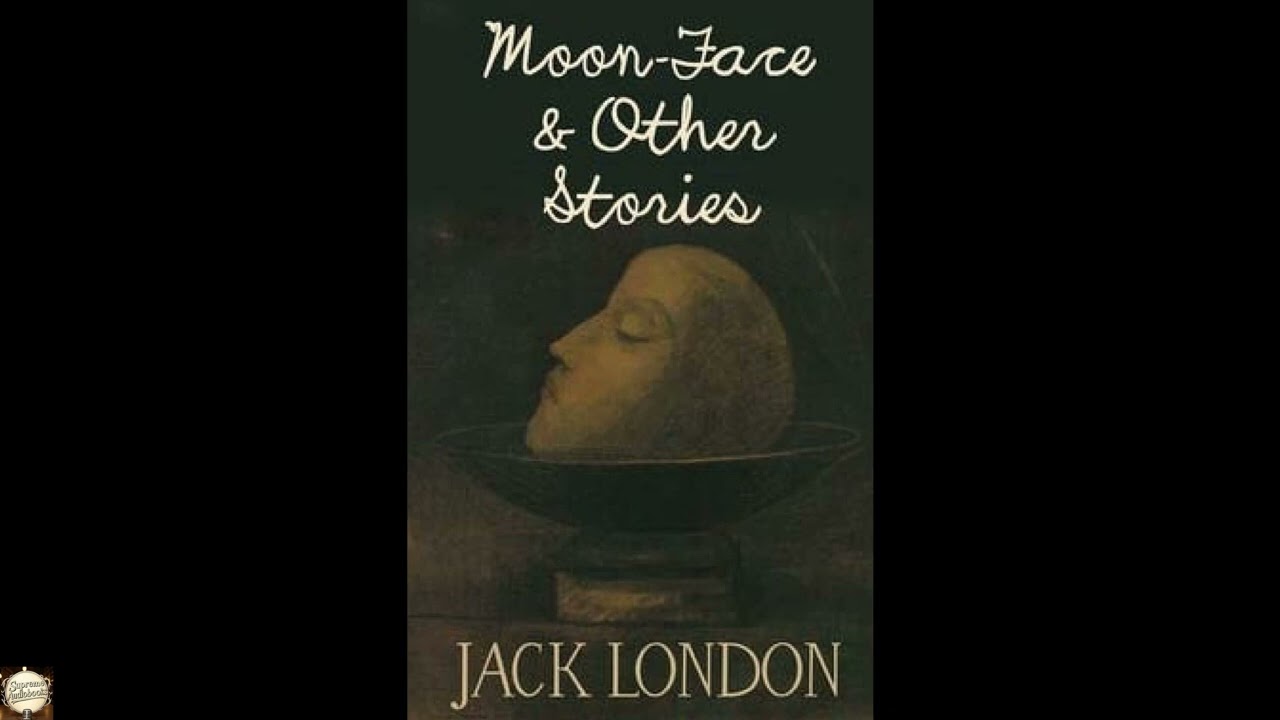
Moon-Face & Other Stories
Jack London’s Moon-Face & Other Stories invites listeners into a less familiar, yet equally potent, corner of an author renowned for grand adventure. Far from the heroic dogs of the Klondike or the stoic sailors battling the Pacific, this collection peels back the veneer of civilization to reveal the savage instincts, psychological dramas, and moral ambiguities that define humanity. Why listen today? Because London’s stark examinations of obsession, prejudice, and the raw struggle for existence remain disturbingly relevant, echoing in our own anxieties about society’s pressures and the dark corners of the individual psyche. This is not merely a historical artifact; it is a raw, unflinching mirror held up to the complexities of human nature, challenging us to confront the uncomfortable truths lurking beneath the surface. The collection, published in 1906, introduces a diverse array of characters grappling with harsh realities, though none perhaps as unsettling as the narrator of the titular story, “Moon-Face.” Set in a seemingly tranquil rural California, the tale unfolds through the meticulous, unsettling account of John Claverhouse. His life, by all outward appearances serene and comfortable, is poisoned by an inexplicable, consuming hatred for his neighbor, a man he derisively nicknames "Moon-Face." This unassuming figure, whose chief offenses seem to be a gratingly cheerful demeanor and a penchant for small, irritating habits, becomes the singular focus of Claverhouse’s escalating fury. The story’s central conflict is not external, but an internal one: the narrator’s descent into an almost primal loathing, meticulously cataloging every slight, every perceived indignity, until his thoughts turn towards unspeakable acts. The arc of "Moon-Face" charts this chilling progression from mere annoyance to an all-encompassing, homicidal obsession, a psychological spiral that exposes the thin line between civility and savagery. Beyond the unsettling rural claustrophobia of its opening story, this collection presents other vignettes that underscore London's unflinching gaze at human and animal behavior under duress. Listeners will find themselves transported from the cold, indifferent landscapes where men battle the elements and each other for survival, to the confines of society where social stratification and the pursuit of wealth can be equally brutal. While settings shift from the rugged wilderness to the urban jungle, a consistent thread runs through these narratives: the relentless pressure of circumstances and the often-brutal choices individuals make when pushed to their limits. London’s characters are frequently pitted against overwhelming forces, be they the crushing indifference of nature or the equally unforgiving strictures of human society. Jack London, born John Griffith Chaney in San Francisco in 1876, lived a life as dramatic and adventurous as any of his fictional creations. Raised in poverty, he left school early to become an oyster pirate, a sailor, a hobo riding the rails across America, and a gold prospector in the treacherous Klondike Gold Rush. These formative experiences—struggling against the elements, witnessing social injustice firsthand, and living on the fringes of society—infused his writing with an authenticity and raw power that few authors could match. Largely self-educated, London voraciously read in public libraries, particularly Darwin, Marx, and Nietzsche, whose ideas profoundly influenced his worldview. London’s literary career truly took off in the early 1900s, making him one of the first authors to achieve significant wealth and fame through his writing. He became an international sensation with works like The Call of the Wild (1903) and The Sea-Wolf (1904), followed by White Fang (1906) and the semi-autobiographical Martin Eden (1909). A staunch socialist, London used his platform to advocate for labor rights and social reform. He passed away prematurely in 1916 at the age of 40, leaving behind a prodigious body of work that solidified his place as a pioneering voice in American literature, a key figure in the Naturalist movement who brought an unparalleled vigor and directness to his tales of struggle and survival. Moon-Face & Other Stories strongly enacts several themes central to London’s broader body of work. One prominent theme is primitivism and the beast within, illustrated with chilling clarity in "Moon-Face." Claverhouse’s sophisticated exterior peels away to reveal a man driven by irrational hatred, regressing to a state where primal urges eclipse reason and civility. His elaborate schemes and justifications serve only to highlight the underlying, animalistic impulse to eliminate an irritant, a dark reflection of the survival instincts London often celebrated in the wilderness. Another recurring theme is the relentless pressure of environment and heredity in shaping human destiny, a hallmark of literary Naturalism. Whether it is the economic desperation driving characters to extremes in urban settings or the cold indifference of nature forcing brutal choices in remote landscapes, London consistently shows how external forces can dictate internal states and actions, often reducing individuals to their most basic, survivalist selves. A third theme apparent throughout the collection is the corrupting nature of obsession and prejudice. "Moon-Face" offers a stark portrayal of how a seemingly minor annoyance can metastasize into a consuming, destructive fixation. Claverhouse’s prejudice against his neighbor is baseless, yet it governs his entire existence, demonstrating how unchecked negative emotions can distort perception and drive individuals towards catastrophic ends. Furthermore, London often subtly critiques the illusions and hypocrisies of civilization. While his more famous works often contrast the wild with the tame, here he sometimes suggests that civilization itself can breed its own unique forms of cruelty and psychological dysfunction, revealing that the "savage" is not just found in the jungle, but also within the meticulously ordered lives of seemingly respectable citizens. This collection emerged during a fascinating period in American history: the late nineteenth and early twentieth centuries. This era, often called the Progressive Era, was marked by rapid industrialization, increasing urbanization, stark social inequalities, and significant intellectual shifts. Charles Darwin’s theory of evolution and Herbert Spencer’s Social Darwinism—ideas about the “survival of the fittest” applied to human society—were widely discussed and debated, profoundly influencing London’s deterministic worldview. Culturally, there was a growing fascination with psychology and the darker aspects of human nature, a reaction against the more idealized portrayals of Romanticism. Literarily, this was the ascendancy of Naturalism, a movement that sought to depict life with scientific objectivity, focusing on how heredity, environment, and chance shape human fate, often with pessimistic outcomes. London, with his experiential knowledge of hardship and his intellectual engagement with these ideas, became a leading voice of this movement. His stories, including those in Moon-Face & Other Stories, gave raw, uncompromising expression to the struggles of individuals caught in forces beyond their control, mirroring the broader societal anxieties about class conflict, economic shifts, and the perceived decline of traditional values in a rapidly modernizing world. Listening to Moon-Face & Other Stories as an audiobook offers a unique opportunity to immerse oneself in London’s direct and often unsettling prose. The narrator’s voice becomes the conduit for London’s muscular storytelling, bringing out the psychological tension in "Moon-Face" and the stark atmospheric descriptions in other narratives. The several hours’ run length allows for absorption of each distinct story, whether during a commute, an evening stroll, or a focused listening session. A skilled vocal performance accentuates the nuanced dialogue, the grim irony that often underpins London's observations, and the raw emotion of characters confronting their fates. The spoken word can particularly heighten the unsettling atmosphere, allowing the listener to fully absorb the weight of the moral dilemmas and the often-harsh realities London so unflinchingly presented, making the experience immediate and impactful.
Enjoyed Moon-Face & Other Stories? A few ways to support us
Audible & Amazon links are affiliate; we may earn a small commission at no extra cost.
About this production
Human narration by a volunteer reader from LibriVox.org, the public-domain audiobook project. LibriVox volunteers record literary works whose copyright has expired in the United States, releasing the resulting recordings into the public domain.
Moon-Face & Other Stories by Jack London. The underlying text is in the U.S. public domain. We do not republish any modern copyrighted edition, translation, or commentary.
The 4K cinematic visuals accompanying this audiobook are generated by an AI image model from prompts derived from the source text. No copyrighted photos, paintings, or stock footage are used. AI generation is disclosed on every video on our YouTube channel as required by YouTube's altered/synthetic content policy.
English subtitles are transcribed from the LibriVox recording with OpenAI Whisper. Translations into the 11 other supported languages are produced by Meta's NLLB-200 neural translation model. No human translator's copyrighted translation is used.
Questions about sourcing or rights? See our DMCA & Sourcing policy or contact us.
Enjoyed this audiobook?
If you'd like to own a copy of Moon-Face & Other Stories or hear a professionally produced edition, the links below help support free audiobook production at no extra cost to you.
As an Amazon Associate we earn from qualifying purchases. Audible / print links are affiliate.