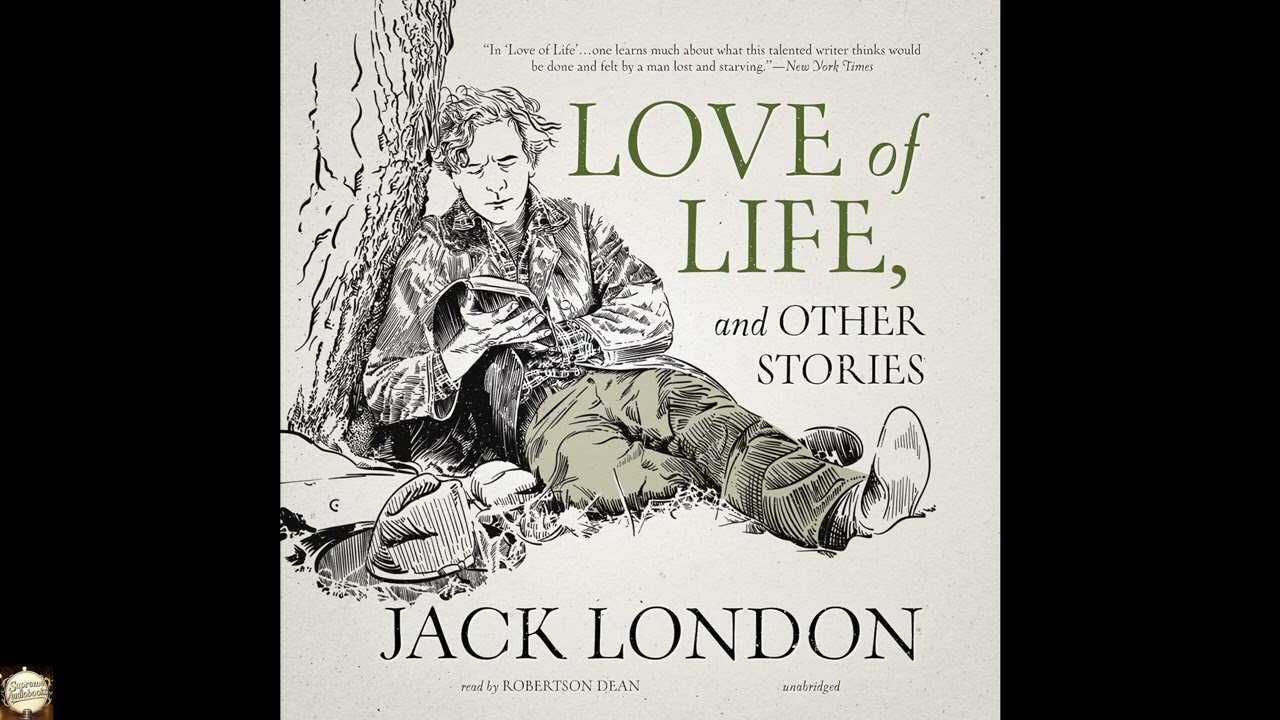
Love of Life and Other Stories
Jack London’s Love of Life and Other Stories plunges listeners directly into the raw, uncompromising heart of human endurance. This collection isn’t merely a set of adventure tales; it is a series of stark examinations of what happens when human beings are stripped bare of civilization’s comforts and conveniences, forced to confront the indifferent might of nature and the deepest recesses of their own will to survive. More than a century after London first penned these narratives, the questions they pose about resilience, courage, and the fundamental instinct to cling to existence remain profoundly resonant. In an age of comfort and digital connection, these stories serve as a potent reminder of the primal forces that shaped us and the extraordinary grit that lies dormant within the human spirit, waiting to be called upon. The collection’s titular story, “Love of Life,” exemplifies the kind of harrowing ordeal London excelled at depicting. Set against the vast, frozen desolation of the Canadian Klondike, it introduces an unnamed prospector, weakened by hunger and fatigue, abandoned by his partner, Bill, after injuring his ankle. His struggle for survival begins at that moment of betrayal. Alone in a landscape of endless snow and ice, with no food and a compass rendered useless by his delirium, he begins a relentless, agonizing crawl towards a vague hope of rescue. He faces starvation, the gnawing pain of his injury, the threat of wild animals, and the slow erosion of his sanity. The narrative follows his grim determination as he pushes beyond what seems humanly possible, sustained by an almost irrational instinct to live, consuming whatever sustenance he can find, and even battling a persistent, sickly wolf that mirrors his own desperate condition. Each step, each agonizing breath, is a testament to the raw, visceral desire for life, pushing the boundaries of physical and mental fortitude to their absolute limit. Other stories in the collection often present similar themes, taking readers from the icy north to the stormy South Seas, from the brutal boxing ring to the harsh realities of class struggle, always with London’s characteristic unflinching gaze at humanity’s darker impulses and its occasional flashes of heroic resolve. Born John Griffith Chaney in San Francisco in 1876, Jack London’s own life was a whirlwind of experiences that profoundly shaped his writing. He grew up in poverty in Oakland, California, experiencing child labor, working in canneries and jute mills, and later finding work as an oyster pirate, a sailor, and a hobo traveling across America. These early years forged his strong socialist convictions and his deep understanding of societal inequities. At age 20, he participated in the Klondike Gold Rush, an experience that, though financially unrewarding, provided him with invaluable material for some of his most enduring tales of the frozen North. Though largely self-educated, he became one of the highest-paid and most prolific writers of his era, producing more than 50 books, hundreds of short stories, and countless articles before his untimely death in 1916. Among his most famous works are The Call of the Wild, which told the story of a domesticated dog reverting to a primal state, and White Fang, a companion piece portraying a wild wolf-dog’s domestication. The Sea-Wolf offered a brutal study of a tyrannical ship captain, and Martin Eden served as a semi-autobiographical novel about a working-class man’s struggle for literary success. London is a key figure in American Naturalism, a literary movement that sought to depict life objectively, often portraying characters as victims of forces beyond their control. London’s writings, and especially the stories in this collection, are potent enactments of several powerful themes. Foremost among these is the sheer, unadulterated will to live. The unnamed prospector, with his broken body and dwindling strength, demonstrates this by continuing to move, to crawl, even to chew on the bones of his dead wolf antagonist, all driven by an instinct that transcends reason. This primal drive is not about heroism in a conventional sense, but about the stubborn, biological imperative to survive. Another pervasive theme is the unforgiving power of nature. London’s Arctic landscape is not merely a backdrop; it is an active antagonist, a vast, indifferent force that tests human limits without pity or malice. The cold, the hunger, the immense solitude—these elements conspire to break the human spirit, highlighting how fragile human life is against the backdrop of the natural world. Related to this is the theme of human morality under duress. The betrayal by the prospector's partner, Bill, raises questions about the breaking point of human loyalty and compassion when survival is on the line. London often places his characters in situations where the veneer of civilization is stripped away, revealing either the basest instincts of self-preservation or, occasionally, a flicker of profound self-sacrifice. Furthermore, these stories are prime examples of literary Naturalism. London often depicted humans as biological beings, subject to heredity, environment, and instinct. Characters are frequently depicted as struggling against forces—social, economic, or natural—that determine their fate, often with a stark, unsentimental realism that defined the movement. This collection emerged during a period of immense change in America, spanning the late 19th and early 20th centuries. The country was rapidly industrializing, and urbanization was shifting populations from rural areas to burgeoning cities. These societal transformations brought about new anxieties concerning class, labor, and the individual's place in a complex, often brutal, modern world. Culturally, there was a widespread fascination with the remaining untamed frontiers, particularly after events like the Klondike Gold Rush, which captured the public imagination with its tales of hardship and the promise of quick fortune. London, having personally experienced the Klondike, tapped directly into this cultural fascination. Literarily, Naturalism was gaining prominence as a reaction against the Romantic ideals of earlier eras. Writers like Émile Zola, Stephen Crane, and Frank Norris sought to portray life as it truly was, often influenced by scientific theories such as Darwinism and Spencer's social Darwinism. London’s work fit perfectly into this landscape, offering a raw, unflinching look at human struggle, often suggesting that environmental and biological forces played a dominant role in shaping human destiny. His stories provided a compelling narrative voice for a society grappling with profound questions about progress, survival, and the nature of humanity itself. Listening to Love of Life and Other Stories as an audiobook offers a particularly immersive and powerful experience. The several hours of runtime allow for deep immersion into London's world, whether during a long drive, a workout, or quiet contemplation. A skilled narrator can bring London’s lean, direct prose to life, giving voice to the protagonist’s grunts of exertion, his whispered delirium, and the stark internal monologues that accompany his physical suffering. The pacing of London’s writing—often slow and deliberate in its depiction of endurance, punctuated by sudden, violent struggles—translates exceptionally well to the auditory medium, allowing the listener to truly feel the passage of time and the weight of each moment. The atmosphere of brutal cold, vast emptiness, and gnawing hunger can be conveyed with chilling immediacy through vocal tone and subtle dramatic interpretation, transforming the stark written word into a visceral encounter with the limits of human will. The isolation and the desperate, animalistic struggle become almost tangible, creating an unforgettable sonic landscape that lingers long after the final word.
Enjoyed Love of Life and Other Stories? A few ways to support us
Audible & Amazon links are affiliate; we may earn a small commission at no extra cost.
About this production
Human narration by a volunteer reader from LibriVox.org, the public-domain audiobook project. LibriVox volunteers record literary works whose copyright has expired in the United States, releasing the resulting recordings into the public domain.
Love of Life and Other Stories by Jack London. The underlying text is in the U.S. public domain. We do not republish any modern copyrighted edition, translation, or commentary.
The 4K cinematic visuals accompanying this audiobook are generated by an AI image model from prompts derived from the source text. No copyrighted photos, paintings, or stock footage are used. AI generation is disclosed on every video on our YouTube channel as required by YouTube's altered/synthetic content policy.
English subtitles are transcribed from the LibriVox recording with OpenAI Whisper. Translations into the 11 other supported languages are produced by Meta's NLLB-200 neural translation model. No human translator's copyrighted translation is used.
Questions about sourcing or rights? See our DMCA & Sourcing policy or contact us.
Enjoyed this audiobook?
If you'd like to own a copy of Love of Life and Other Stories or hear a professionally produced edition, the links below help support free audiobook production at no extra cost to you.
As an Amazon Associate we earn from qualifying purchases. Audible / print links are affiliate.