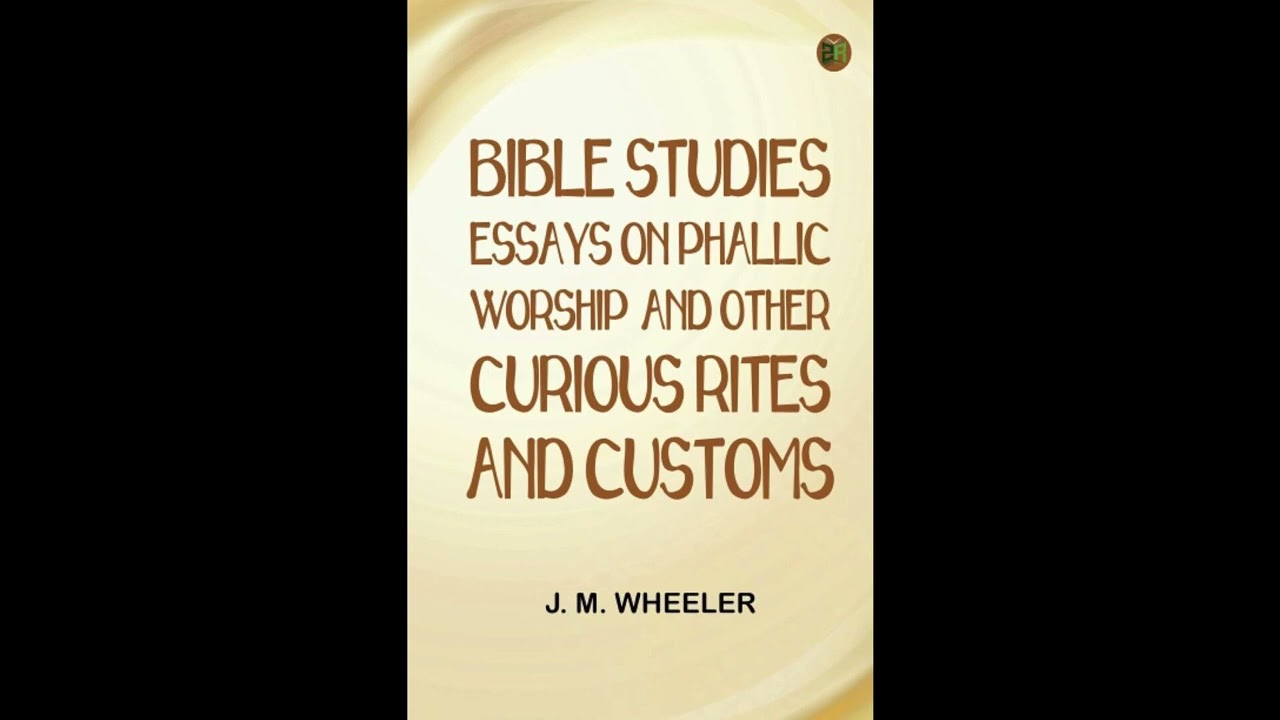
Bible Studies: Essays on Phallic Worship and Other Curious Rites and Customs
Step into a hidden corner of human history, where the sacred and the primal intertwine, and conventional understandings of faith are challenged by a startling array of practices. Bible Studies: Essays on Phallic Worship and Other Curious Rites and Customs is not a theological treatise in the traditional sense, but rather a profoundly insightful collection of essays that meticulously documents the less-examined aspects of human spirituality and cultural expression. This remarkable compilation offers a window into the origins of symbolism, the universality of certain ritualistic acts, and the persistent human drive to connect with the divine through myriad, often astonishing, forms. For today’s listener, this collection serves as a powerful reminder of the diversity of human belief, the fluid nature of taboo, and the enduring quest for meaning that transcends time and geography. It asks us to look beyond the surface of established religions and consider the foundational elements of worship that have shaped civilizations from their earliest dawns. The essays collected here do not unfold a linear narrative with protagonists and antagonists in the conventional literary sense. Instead, the "story" is an intellectual expedition across the breadth of human civilization, from the fertile crescent to ancient European cults, from the misty origins of folk belief to the codified practices of forgotten empires. The central focus is the compelling argument for the pervasive presence of phallic reverence and related fertility rites across cultures, suggesting a fundamental human impulse to worship life-giving forces. The "characters" are the countless anonymous individuals, societies, and priests whose customs are painstakingly reconstructed and analyzed, often from fragmentary evidence – inscriptions, archaeological finds, and the veiled allusions within classical texts. The setting shifts ceaselessly, transporting the listener from the sun-baked plains where ancient gods of fecundity were honored, to the secret groves where esoteric rituals were performed, to the domestic altars of forgotten peoples. The "conflict" within this intellectual framework is the tension between what later societies deemed proper worship and the often-misunderstood, or deliberately suppressed, practices that preceded or ran parallel to them. It is a confrontation between the exoteric and the esoteric, between the publicly acknowledged and the privately revered. The arc of this "story" is not one of dramatic resolution but of gradual revelation: as each essay introduces a new practice, a new cultural context, or a new interpretation of symbolism, a broader picture emerges. The collection builds its case with methodical scholarship, demonstrating how seemingly disparate customs from different continents share underlying principles, often centered around themes of creation, regeneration, and the vital forces of nature. The author guides the listener through this complex intellectual terrain, inviting a reconsideration of what constitutes "sacred" and how profoundly these "curious rites" have shaped the collective consciousness of humanity. The author of this monumental work remains unknown, a silent scholar whose name has been lost to the annals of history, adding an intriguing layer of mystery to the text itself. This anonymity, however, does not diminish the profound scholarship and intellectual rigor that permeates every page. Instead, it places Bible Studies firmly within a venerable tradition of antiquarian research and comparative studies that flourished particularly during the late nineteenth and early twentieth centuries. During this period, scholars increasingly turned their attention to the origins of religion, myth, and folklore, often challenging prevailing orthodoxies with audacious theories drawn from archaeology, anthropology, and philology. Works of this nature were frequently published without an individual author’s name, sometimes due to the controversial nature of their content, sometimes because they represented a collective effort of scholarship, or simply because the original compilers’ identities faded over time. This particular collection stands as a testament to that era’s relentless pursuit of knowledge, a time when intellects grappled with the implications of evolutionary theory, the burgeoning science of anthropology, and new archaeological discoveries. The work is not simply an assemblage of facts, but a deeply considered meditation on humanity’s spiritual legacy, contributing to the foundational ideas that would later be expanded upon by figures like James Frazer in The Golden Bough and other pioneering scholars of comparative religion. Its place in the canon is not necessarily as a definitive academic treatise — as understandings of history and anthropology have naturally evolved — but as an essential historical document that captures a significant moment in intellectual history, a brave and often provocative attempt to synthesize a vast array of human practices into a coherent, if challenging, framework. It represents a spirit of inquiry that dared to look at the most intimate and often unspoken aspects of human culture. Among the central themes resonating throughout Bible Studies is the concept of the universality of symbolic expression. The essays demonstrate how disparate cultures, separated by vast distances and millennia, independently developed remarkably similar symbols and rites related to fertility, life, and death. For instance, the recurring motif of sacred pillars or stones, often carved or venerated in particular forms, is shown to appear in ancient Near Eastern religions, classical European cults, and even some indigenous traditions. This recurrence is not presented as mere coincidence but as evidence of a deep-seated human psychology that sought to personify and worship the generative forces observed in nature, using direct, often anatomical, representations. The text makes a compelling argument that these symbols were not merely crude expressions but sophisticated attempts to encapsulate profound mysteries of existence. Another significant theme is the interconnection between the sacred and the secular in early societies. The collection meticulously argues that what modern societies might compartmentalize as "religion," "sexuality," and "agriculture" were, for many ancient peoples, indivisible aspects of a single, holistic worldview. The "curious rites" described are often presented not as isolated acts of worship, but as integral components of daily life, agricultural cycles, and communal well-being. Consider the examples often cited of harvest festivals or spring rituals where specific objects or gestures, which might appear profane to an outside observer, were in fact crucial for ensuring bountiful crops, successful procreation, and the overall prosperity of the community. The author illustrates how these practices were deeply embedded in the social fabric, reflecting a profound understanding that human existence was inextricably linked to the rhythms and powers of the natural world. The historical backdrop for the emergence of such a work is crucial to understanding its enduring impact. The late nineteenth and early twentieth centuries witnessed an intellectual revolution driven by Darwin’s theories of evolution, which spurred a similar inquiry into the "evolution" of human culture, institutions, and religion. Scholars began to apply scientific methodologies to areas previously dominated by theological explanation. There was a widespread fascination with "primitive" societies and ancient civilizations, fueled by colonial expansion and burgeoning archaeological discoveries in Egypt, Mesopotamia, and the classical world. Books like Bible Studies emerged from this milieu, seeking to draw connections between disparate cultures and shed light on the common origins of human spiritual endeavor, often in ways that challenged established religious dogma and Victorian sensibilities. It was a period of intense curiosity about what lay beneath the surface of modern civilization, a time when the boundaries of acceptable academic inquiry were rapidly expanding. Listening to Bible Studies: Essays on Phallic Worship and Other Curious Rites and Customs as an audiobook offers a singular experience of immersion in historical scholarship. With several hours of content, it provides ample opportunity to truly absorb the detailed arguments and comparative analyses presented. The narrator's steady, clear voice becomes an essential guide through the complex academic terrain, ensuring that the sometimes challenging subject matter is articulated with precision and accessibility. The pacing allows for thoughtful consideration of each essay's implications, inviting listeners to ponder the revelations about human culture and belief at their own pace. Without the visual distractions of text, the listener can focus entirely on the conceptual connections being drawn, appreciating the author's meticulous research and the breadth of their cultural knowledge, allowing the often-startling insights to truly resonate. This format transforms what could be a dry academic exercise into an engaging intellectual discourse, perfect for quiet contemplation or enriching an otherwise mundane commute.
Enjoyed Bible Studies: Essays on Phallic Worship and Other Curious Rites and Customs? A few ways to support us
Audible & Amazon links are affiliate; we may earn a small commission at no extra cost.
About this production
Human narration by a volunteer reader from LibriVox.org, the public-domain audiobook project. LibriVox volunteers record literary works whose copyright has expired in the United States, releasing the resulting recordings into the public domain.
Bible Studies: Essays on Phallic Worship and Other Curious Rites and Customs. The underlying text is in the U.S. public domain. We do not republish any modern copyrighted edition, translation, or commentary.
The 4K cinematic visuals accompanying this audiobook are generated by an AI image model from prompts derived from the source text. No copyrighted photos, paintings, or stock footage are used. AI generation is disclosed on every video on our YouTube channel as required by YouTube's altered/synthetic content policy.
English subtitles are transcribed from the LibriVox recording with OpenAI Whisper. Translations into the 11 other supported languages are produced by Meta's NLLB-200 neural translation model. No human translator's copyrighted translation is used.
Questions about sourcing or rights? See our DMCA & Sourcing policy or contact us.
Enjoyed this audiobook?
If you'd like to own a copy of Bible Studies: Essays on Phallic Worship and Other Curious Rites and Customs or hear a professionally produced edition, the links below help support free audiobook production at no extra cost to you.
As an Amazon Associate we earn from qualifying purchases. Audible / print links are affiliate.